Travel with Osher!
Spring/Summer 2026
The Journal | Volume 36, No. 1
Contents
The Damned Engineers
By Jeanne Marie Randall Wills
War and mirth have an interesting connection in the human psyche. The first war stories to emerge from my father were stories about things that made him laugh. First the humor, then only at the end of his life was he able to talk about the trauma. A favorite story among engineers that my father enjoyed retelling to his children was of the “German Lt. Col. Peiper and his elite Waffen SS armor.” The German tanks needed to cross a bridge in Belgium to attack the allied forces. Peiper was thwarted by “engineers (who) had wired the bridge with more than 2,000 pounds of TNT…
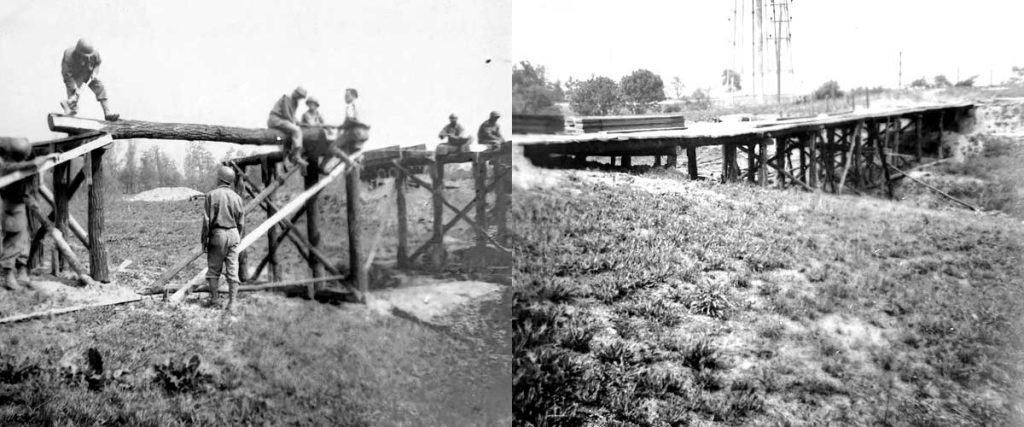
Just as Peiper’s tanks rolled up” the bridge exploded and Peiper could only “pound his knee and swear, ‘The damned engineers! The damned engineers!’”(*Essayons, p.182) Retelling this story made my father laugh.
A humorous experience when the US soldiers were holed up in a German village made my father smile almost wistfully when he told us about it. The men were cramped together in dark, dank dirt cellars because the German army was shelling them intermittently. My father and a few of his friends refused to stay in the insufferable conditions underground. Soldiers sometimes went house to house looking for pistols and arms to add to their inferior US weapons. Engineers also looked for things they could fix or alter to augment their scarce supplies. One house they entered brought delight. Upstairs they found beautiful bedrooms enticingly turned out. For a few days they were able to wash themselves, stay reasonably clean and sleep on soft, warm feather beds with clean sheets. During one dark night, an engineer arose and went into the dark forest alone. When they realized he was gone, they looked outside the window. In the dim light of the waning night sky, they could just make out the shadow of their friend carrying an axe and dragging something out of the forest. As he crossed the open space coming toward the house, they realized it was a felled pine tree. He was determined to have a tree for Christmas! As they gathered around to admonish the foolhardy behavior and hear the story, the engineer boasted, “I was never in any real danger because I chopped so fast the Germans couldn’t see me for the cloud of chips I sent flying.” And then my father would laugh and tell us how they had rigged electricity and made things in the house come alive. “One of the engineers took an engine apart and made a generator, so for a very brief time we even made a few lights come on.”
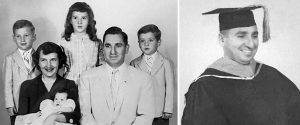
Growing up in my parents’ house I remember that everything worked, nothing stayed broken, and everything was in perfect order. Both my father and my mother were meticulous and well turned out. This was due in large part to my mother, who hung out Robert’s carefully starched and ironed clothes which she selected each morning so they would be color-coordinated throughout the day as a couple. My children loved this about their grandparents who matched and whom they found adorable. As a child, I knew my father as an aeronautical engineer who designed shapes to be secured in wind tunnels where engineers could create wind speeds well above hurricane force and watch what happened to different shapes under different wind speed conditions.
When my father reentered college on the GI Bill after the war, one of his aeronautical engineering professors came from the generation before wind tunnels, the generation who took their experiments into the sky, “storming” the plane out of the barn and hopefully aloft, usually with little to no safety gear. He called this professor an old “barn-stormer” and said his nose had been broken several times, along with broken arms and legs, and concussions, leaving a somewhat addled brain and humorous behavior. The barnstormer professor would stop in the middle of his lecture, open the window in freezing weather, and throw chalk down from the second floor at someone walking below. The barnstormer watched where the chalk fell, then he resumed his lecture, but sometimes, he would forget to close the window. As the room chilled, he would stop lecturing, go stand in front of the thermostat and complain, “I hope when you become engineers you can design a thermostat that will keep a room at a constant temperature!”
My father was also fond of telling the story of how he outwitted the drill sergeant daily. The officers training program and engineering education he was enrolled in at the University of Pennsylvania was to be discontinued six weeks before they completed their first year of college. The engineers were being sent to war ahead of schedule as Private First Class (PFC) soldiers due to devastating war casualties among the combat engineers. Each morning the freshmen engineers lined up in front of their dormitory and were marched around until they eventually stopped and entered the dining hall for breakfast. Finding the food objectionable, my father fell back until he was near the end of the unit; each day Robert made an abrupt turn out of formation when they passed a narrow walkway between buildings which led to an entrance to a hallway which he knew would lead him back to his dorm. He would prepare hot cocoa in his dorm room, eat a donut, and work on his designs and models he laid out on his desk. This part of the story always called up images for me from the stories he had told us of building model airplanes as a boy. “He almost caught me once,” my father loved to build suspense in his tale as he revealed that the Sergeant had grown suspicious. “I could hear him coming down the hall searching room by room, looking for me. I hid and remained perfectly still, without a stir of breath, when he entered my room.” The Sergeant stood in Robert’s dorm room. My father could hear him breathing. After a while the sergeant left and continued down the hall opening each door, entering each room, closing the door, and continuing down the hall searching.
It is not hard for me to imagine that college freshmen and engineers might sometimes balk at something that did not make sense to them, that they could see problems with and for which they had a much better solution developed in their head and were eager to collaborate with their friends and put into action if you would only let them try. The staff writers for the US Army Engineer School used the French word, Essayons which means “Let us try.” My father’s stories give me pause to wonder if the phrase, “The damned engineers,” was not also uttered by members of the allied forces with college freshmen combat engineers under their military command.
Bibliography
Randall, Robert E., Conversations with my father, 1975–2011,
Tampa, FL
* Essayons: The Origin and History of the US Army Engineer School, 30 July 2024
Back to the Table of Contents
Reflections on a Flawed Relationship with Nature
By Samuel Dowding
As I reflect on memories of my childhood in rural colonial Guyana, I now discern a then-prevalent attitude that nature was to be tamed, bent to serve us, molded to our use, or in the case of the green grass of home, disposed of. Indeed, we had many types of grass—and all green. There were those deep-rooted types that grew close to the ground in tight clumps, and the others that grew knee- and even waist-high. Then there were those unique types of wild grasses that stuck to your socks and trouser legs—“watchman” in local parlance—or that particular one often mistaken for lemon grass, which cut our bare legs with their sharp leaf blades, thus appropriately nicknamed “razor grass”! Woe betides the innocent who mistook razor grass for lemon grass! Then there were those grasses that grew in water, rooted many inches below the surface of our drains and trenches. The frogs and crapaud spawned their tadpoles in those drains among these grasses. We threw fist-sized stones at the frogs whenever we saw them and removed masses of their black tadpoles from the water, leaving them to dry and die in the sun. This was the genesis of the local proverb “what is fun fuh lil boy is dead fuh crapaud.”
Our attitude was that all nature was ours to tame—it was our divine right. Mind you, our childhood “taming” was almost always mindless, cruel, ignorant, and uncaring of the potential beneficial uses of nature. We chopped and slashed the bushes, grasses, and wild greenery by hand with our cutlasses, machetes, scythes, sickles, and hoes.
Because ½-inch-long black biting ants inhabited the hollow core of the mature trees, I grew to relish chopping down the young “Congo pump” trees. I was at that time ignorant and uncaring of the medicinal benefits inherent in its dry leaves. That changed later, when neighbors occasionally dropped by to inquire of my mother, amateur herbalist that she was, whether she knew or had any ”bush” to address one or another ailment, and I was told “boy, guh pick some dry Congo pump leaf fuh dis lady!” Congo pump, lime, and avocado leaves, among several others that grew in our yard, seemed to have medicinal properties, discovered by my ancestors and passed down to my mother.
Several types of lizards (mostly green but a few sandy brown) and the yellow- and black-flecked “salempenters” roamed our yard freely as if they owned it. Upon spotting any one or more of them, we would chase them by pelting them with whatever stone came to hand. Often, as was our wont as little boys, those reptiles offered target practice using our crudely fashioned but effective (when accurate) homemade slingshots. Even our slingshots were made from tamed nature: rubber tire strips, leather shoe tongues and Y-shaped “forks” from guava trees—the hardiest! Then there was the rare opossum, colloquially the yawarri, that we pursued even into its lair high up in the hearts of coconut trees.
Some denizens we found easiest to eliminate conscience-free. Because they posed danger to our wooden houses and our comfortable habitation in the yards where we lived, we had no hesitation in eliminating the local termite ants, as well as the vicious red and black biting ants, the marabunta wasps, and Africanized bees. Burning their nests was the usual way of eradicating these pests.
When it came to certain animals of the non-farmed variety, we respected Biblical diktat to “kill and eat.” For meat-eaters, the green iguanas made for great curries, as did the tapir, sloth, and savannah deer. The meat of two rainforest rodents, the accouri (agouti) and labba (paca) we savored even if only boiled in a salt and pepper broth. Best of all, a wild hog (peccary) pepperpot was superlative, without peer.
In the goldfields, we seemed not to care that overuse of mercury to extract the gold from the soil, as well as wanton disposal of petroleum products, were killing the very rivers upon which communities depended. I vividly remember the first time I laid eyes on the BG Consolidated Goldfields’ dredge, abandoned, I understand, after only a year of operation in the late fifties. In the middle of the Konawaruk rainforest, there it stood, a huge hulk of rusting iron, its two-inch-thick cast iron buckets the outstanding feature. The dredge sat in its self-created lake, which after decades had taken on a green iridescent hue, accented by a muddy brown fungus-like growth, evidently the only living thing that survived in that clearly unnatural environment.
Our dogs and cats were not pets. Cats were for catching or deterring rats and mice. Dogs were for protection of our property, to alert us when strangers including any with ill intentions, might enter our yard. Both were called by pursing the lips and exhaling sounds like “seeBBBBbee” for the cats or inhaling “pttpttPtptputput” for the dogs. Generally mongrel, our dogs had names like Rover, Pepsi, and Brownie. One was even called “Puppy” even into old age!
I recall an occasion when one of our dogs alerted us to the incursion by an alligator, actually a black caiman, in our yard. Perhaps attracted by the sounds and smells of young chickens, the reptile had stealthily emerged from the duckweed-covered pond that adjoined our backyards. Alerted by the dog’s barking, my uncle Lionel shouted urgently to his son “Clifton! Run go call Mr. Das! Tell him bring he gun fuh shoot dis alligitta!”
Uncle Lionel grabbed a loudly squawking chicken from the fowl pen, tied its feet, and attaching it to a long rope, tossed it about ten yards into the pond. As he slowly pulled it back in, we peered through the rays of our torchlights to see if the lure was working. It was—the caiman, only about six feet long, swiftly swam towards the chicken as it was reeled in. As he crawled onto land within a few feet of my uncle, his jaws wide open, Mr. Das fired his shotgun directly into its open maw, the shot grazing the trunk of the nearby banana tree. With an immediate about-turn the dark denizen dove under the thick duckweed-covered surface of the pond. Several days later, the distinctly odoriferous stench of death alerted us to the stiff carcass floating in the drainage trench.

We were the children of our history, culture, resources, and societal status. Poor descendants of peoples subjected to slavery and indentureship, we grew up on a still colonial and segregated rural sugar plantation. Only by leaving behind that environment and culture in later years are we able to incrementally disavow our needlessly cruel childhood behaviors towards nature and creation.

Back to the Table of Contents
Hiking The Himalayas
By Jim Herrell
An August Body of Scholars

Our original trekking party was an educated quintet, collectively possessing five BAs, six MAs, and two PhDs. One could reasonably expect scintillating discourse within this august body of scholars, even after four diplomas flew away in the helicopter with Bonnie, whose health issues on day one of the hike necessitated air-lifting her back to Kathmandu. (1)
The remaining four of us shared interests in classical music, polar exploration, and 20th-century art, architecture, and literature, among other subjects. I’d brought from my bookshelves four slim paperbacks for the group to read and discuss: The Heart of Darkness, The Red Pony, The Picture of Dorian Gray, and The Plague. We anticipated evenings around the campfire filled with weighty deliberations, but our discussions quickly devolved into more urgent issues.
Campfire Topics
Day 1: Alas, poor Bonnie. Our personal anxieties about what lay ahead.
Days 2–3: William Faulkner. Joseph Conrad. Marcel Duchamp. Gustav Mahler. Gaudi’s La Sagrada Familia. Disastrous Antarctic expeditions.
Days 4–22: Flatulence. Diarrhea. Constipation.
Partly because of the quantity of food our crew prepared each night, partly because dal bhat (2) was our daily staple, our digestive systems rebelled. For a couple of weeks, we guys were clogged, while Julie endured the opposite (and a bad cold). We obsessed about how long it had been since the last event, measured in days by the men and minutes by Julie. All of us flatulated, especially Louie, for whom we composed a couplet: “There goes Louie over Thorung La Pass, jet propelled by dal bhat gas.(3)” Although these problems abated as we adjusted to the food over time, we each had each problem, persisting for days. It’s hard to overstate how these afflictions affected our energy, and enthusiasm.
But, per Joseph Conrad in The Heart of Darkness, “One can’t live with one’s finger everlastingly on one’s pulse,” so we coped, and kept moving forward.
The Job
We quickly settled into a routine. The crew served breakfast at 5:30 a.m. In many campsites, snow melt from the mountains flowed nonstop from pipes, and after the crew ran the water through a filtration bag, we filled our water bottles, adding iodine to kill any remaining germs and a pinch of Kool-Aid to kill the iodine taste. By 7:00 a.m. we were on the trail, stopping for lunch around 11:00 a.m., and usually reaching our next campsite by 4:00 p.m. If the sun was still out and we felt particularly grungy or particularly foolish, we might dare to bathe by standing under a water pipe. Dinner usually began around 5:00 p.m. Darkness came early, so with no light for reading, we crawled into our sleeping bags, and were usually asleep by 8:00 p.m.
A routine-oriented person, I took comfort in the steady rhythm of the trek. But not Louie, who made a bundle of money early and hadn’t needed to work in years. “Up at the same time every day, out on the trail at the same time every day, in our sleeping bags at the same time every night. It’s too much like a job,” he groused, eliciting exactly no sympathy from the 75 percent of us who had actual jobs.

Ole!
The trail, much of it carved from a mountainside and no more than 10 feet wide, also served as a trade route. Often, we encountered donkey or yak trains carrying rice, potatoes, etc. Donkey trains, while longer, were less a problem for us than the yaks. Yak trains rarely had more than three or four yaks and couldn’t accurately be described as “trains.” One yak would be up a hill, one resting in a glen, one drinking from a stream, with one frustrated yak driver running, yelling, hitting his charges with switches. Yaks were more fun to watch than donkeys but less fun to encounter. A donkey, facing a trekker on a narrow path, viewed the person as an obstacle, going out of its way to prevent contact. Yaks viewed trekkers as challenges, and would sometimes come right at us, so we occasionally found ourselves fending off approaching yaks with walking sticks, like novice matadors.
The Idiot
Our trek began at an altitude of about a half mile, with each day ending higher. For the first few days, I walked well ahead of Skip and Julie, almost keeping up with Louie, our fastest hiker. I grumbled that our lunch breaks were too long and we ended the day’s hike an hour too early. I wasn’t in a hurry, just excited. After a day’s hike ended, I took solitary walks to waterfalls, Buddhist shrines, better vistas. My companions, all veteran hikers, told me to save my energy, I’d need it later, but I, the hiking rookie, was energized and wanted to experience everything I could.
On day three, we reached a mile high, above which temperatures were often unpleasantly cold. My initial approach to cold weather was to tolerate the discomfort rather than add layers for warmth. I feared that if I bundled up at this altitude at this temperature, I’d wouldn’t be able to handle 10,000 feet higher with wind chills below zero. My companions added or removed layers as temperatures varied and told me I was an idiot for not doing so.
Indeed.
We finished day seven over two miles high, with frozen waterfalls and snow-covered mountains surrounding the trail and a demonic wind blowing in our faces. On the morning of day eight, urine froze upon hitting the ground. When our crew chief, Manju, showed us his thermometer, which registered below zero, we threatened to break the damn thing if he ever again showed it to us when the temperature was that low. Before heading out, I put on three layers of pants, four layers of shirts and jackets, a ski mask, and two layers of socks and gloves. I was warm enough except my fingers and toes were so numb I needed help lacing my boots.

The altitude gain that day was 1,300 feet, with me bringing up the rear for the first time. Even Julie, still afflicted with a bad cold and diarrhea, was ahead of me. Probably a consequence of my cold weather strategy and solitary walks, my legs seemed to be trying to secede from the rest of me. I had long discussions with them, emphasizing the importance of moving ahead. They didn’t care. “Take normal strides,” I’d insist, but they stumbled along, foot length by foot length. “Watch out for that rock!” [Ouch!] “Step over the yak dung!” [Aw, jeez.] I wobbled into camp nearly an hour after everyone else, collapsing in my tent, emerging only for dinner. For the first time, I took seriously the possibility that I wouldn’t make it over Thorung La, just three days hence.
(1) Bonnie’s story, titled “Hiking the Himalayas Part I,” appeared the fall 2025 issue of the Journal.
(2) Dal bhat, lentil soup in steamed rice, is Nepal’s unofficial national dish. We all loved it, except for its aftereffects.
(3) Thorung La Pass, 3.3 miles high, is the highest point and greatest challenge of our hike. We’d reach it on Day 11.
Back to the Table of Contents
Summer Of 1957
By Randy Barker
“Brothers and Others … all kinds of garden work. Can bring our own tools,” Those words, written on 3×5 cards, launched our summer of 1957 in Baltimore.
The brothers and others were me, my twin brother Billy, and our best friend Don Woodruff (“Woodro”). We were 17 and we needed to put together a plan. By summer’s end we had gotten work, made a pile of money, and taken a long road trip.

Work and Money
Mrs. Owens of West Lake Avenue phoned to say she needed a lot of help with her lawn and shrubs. Three or four weeks later we had worked all day every day for Mrs. Owens, Mrs. Affluent Owens. Her husband’s family made and sold Owens Yachts, top-of-the-line yachts with varnished woodwork. I think Mrs. Owens became the goose that laid the golden egg because she liked having three skinny, shirtless teenage boys around all day. I can hear her saying “Boys there are dandelions all over my lawn … please get every one of them.”
Meantime, Billy and I had become owners of our sister Betty’s two-door blue Ford Customline coupe. She had given it to us in March when she got married and moved to Manhattan. We washed and Simonized it every week and used it to get to Mrs. Owens’ place every day. Above all, we made plans for a road trip.
The Road Trip
We knew from the outset what our itinerary would be, based on people and places and several paper road maps. For the road trip, the third member of our trio was now Billy McQuilken (“Milkin”), a friend we had known at Hyde Bay Camp in the late 1940s and early 50s. He had flown to Baltimore to visit. Now we would drive north, with his home in Rochester, New York, on our itinerary.
Day one, with the radio playing, we drove to Wildwood, New Jersey. We listened to popular songs like “Ghost Riders in the Sky” sung by Vaughn Monroe and “How Much is That Doggie in the Window?” by Patti Page. In Wildwood, Joanie MacIntosh, a college friend of Betty’s, had invited us to spend a few days helping out at a camp for inner city kids. We played games on the beach, supervised fun in the water, helped grill hot dogs, and collected lots of conch shells. Then we set off to the north.
We drove a long day till we got to Rochester where his parents greeted us. We learned that his mother was a poet and saw printed books of her poetry lying around. She was very welcoming and made lots of grilled hamburgers for us, heaped with ketchup and relish. Little did my brother Billy know, but about 20 years later he was to make Rochester his lifelong home, where he was a member of the faculty at the University of Rochester School of Medicine.
Our destination after Rochester was Montreal where Mucky and Tanny MacLeod expected us. They were the younger siblings of our Uncle Colin. We had liked them when they visited the states. They were probably in their 20s. Their friendliness came with a likeable Canadian accent. For example, when they said, “We’ve been looking forward to having your visit” they pronounced been “bean.” What I remember best about Montreal was hills everywhere, I guess the reason for the “mont” in Montreal.
From Montreal, we headed southeast to Deer Isle, on the coast of Maine, where the family of our classmate Woody Woodward had built a large cabin out of unpainted pine. You could smell the scent of pine all through the cabin. During the days of our visit, we daily ran across the soggy flats that appeared at low tide, enjoyed multiple lobsters with melted butter, and hacked around with Woody’s friends Freddie and Johnny Hitz from Boston. Hacking around included motoring about a mile across Penobscot Bay to Isle au Haut in a small boat that was low to the water and seemed ready to take on water in the middle of the bay. The Hitz boys let us know “When you’re in Maine, you can’t leave till you’ve jumped into the ocean from rocks where the water is deep.” Sure enough we found a place like that, and eventually everyone got up the courage to leap bare ass into the frigid water and scramble back out, fast.
We got home for Labor Day weekend, after which we would start our senior year at school and then head off to independent lives as college freshmen. We had had a sample of that independence during those two weeks.

As I write this account in 2025, I realize that the idea of staying in touch with home then meant sending post cards and using the telephone, for free, in a way unknown to today’s 17-year-olds: The unaccepted collect call … Operator: “There is a call from Randy Barker from Montreal. Will you accept it?” Answer: “There is no one here who can accept the call.” By this device, in which we had persuaded our mother to collude, every few days we “texted” to home our whereabouts and our safety. Long distance phone calls were prohibitively expensive. In its way, our thousand-mile road trip as enterprising teenagers had matched the adventures that enterprising teenagers undertake these days, including the all-important promise to “keep in touch.”
Back to the Table of Contents
My Conrad Pillow Pile-Up
By Randy Barker
 Kurtz is dead.
Lord Jim is dead.
Nostromo is dead.
Improbably I am alive.
The pillows! The pillows!
That ingots as weighty as Heart of Darkness,
Lord Jim, Nostromo
Wore down my knees,
A virtual San Tomé of tomes,
Night after night
Explains my caramba!
When two nights from the
Garibaldini’s gun shot
My own cordillera settled and rose up on my lap
And the protecting it afforded
Brought me to the place any reader
of Conrad deserves:
An easiness for my hands, my arms, my shoulders, my spine
So just his looks at humanity could
weigh down my mind.
Awakened treasuring 3-pillow support
for my Conrad tome, discovered the last
week of the course 12/9/25.
Back to the Table of Contents
Remembering Auntie Bina
By Judith Phibbs
 Some memories can cut, like pieces of broken glass. My memories of my Auntie Bina’s final years have many glass shards, making me wince and try to change them, perhaps add a happier ending. I want to sweep up the shards, throw them away, but I feel the same pain each time I remember how she spent her final years. While she had formerly commanded my grandfather’s household for 40 years, she spent her last years in her bedroom, looking out the window. Sometimes, she would try to read from her bible, but she would give up after a few minutes, then finger her rosary only to drop it as she cried, covering her eyes with her hands. That was her life at the end, stuck in her bedroom of crucifixes, crocheted doilies, miniature painted scenes of Irish huts. I imagine that she was trying to find a biblical passage that would comfort her, say that her life had meaning, and take away her painful feelings of purposelessness. But I do not think that she could ever find a passage that spoke directly to her.
Her younger self was so quite different, at least that is what my father remembered. We all called her Auntie Bina, but her proper name was Sabina Louise Kelly, my great aunt from Loughrea, Ireland, who had given her last 40 years to care for other people’s children. Heeding my Irish grandparents’ plea for help to raise their children, she had also escaped another of Ireland’s “Time of the Troubles.” In 1919, Churchill had sent in the Black and Tans, ex-prisoners, to squelch the rebellious Irish. Since the Kelly home was a refuge for “the boys on the run,” and the Black and Tans had raided their home, Bina was in danger. My grandparents brought her to live with them in 1921.
After her arrival, Bina took over all household duties, letting my grandmother join my grandfather as he set up his medical advertising business. Bina brought her suitcase of passions for the Catholic church and an independent Ireland across the Atlantic and never changed into modern American customs. She poured her love for Ireland and the Catholic church into the same pot, mixing songs of Irish rebels with evening prayers.
In my father’s words, “Between my mother and my aunt, the voice of God was only heard through the Catholic church, and I was equipped with rosary beads as soon as I could read and mumble.” My father later added, “In my Aunt Bina’s world, any deviation from devout Catholicism was a ticket to hell.”
And devout Catholicism in the 1920s demanded not grumbling about the nuns’ beatings at parochial schools, never missing Mass on Sundays, and confessing your mortal sins of thinking bad thoughts of the cutest girl in your third-grade class in her underwear.
Auntie Bina would call on “Jesús, Mary, and Joseph,” or ask “May the saints to preserve us” whenever my father skipped his duties as an altar boy.
When my father whined about gagging down “a horrible slush called porridge” for breakfast, Auntie Bina would cut him short, saying:
“I am sorry for your troubles but not very. Now eat your porridge like a Christian. This is what Irish children eat.”
My father continued, “Her fairy tales spoke of leprechauns, magic fields, like the one you crossed and remained hungry for the rest of your life, and the Banshee, the spirit woman and guardian of your family whose wailing could be heard outside the window before someone in your family was about to die.”
Until her death, Auntie Bina kept the practices and customs of Irish people. Whenever anyone came to their home, she would ask them for a drink “to take the curse off the house.” If my grandfather drank too much, she would warn my father to “keep a close watch and a proper distance” from him. A month before Christmas, Auntie Bina would knock about the kitchen, mixing flour, sugar, raisins, dried cherries, and currants together, and then soak the batter in whiskey to make the Irish version of Barmbrack.
After my grandmother, Teresa Kelly Phibbs, died in 1926, Auntie Bina, in my father’s words, “was the glue that held the family together.” Putting aside her grief, she raised her three nephews and niece to be, in all ways, Irish and Catholic. Bina stayed when my grandfather’s second wife died in 1938. And Bina stayed when my grandfather married a third time in 1939, caring for his fourth child Donal when he appeared in 1940. Bina was there to help care for my older sister and brother in 1945 when my family lived with them during the post-war housing shortage, and Bina was there in 1951 to bring my brother scones and ginger ale before my family moved to Wyoming. But Auntie Bina was only human, flesh and blood, and she began to leave the stove on when she cooked her Christmas Barmbrack cakes or put the pans in the wrong place, and so my grandfather’s third wife politely confined Bina to her bedroom. And there she stayed until her death in 1961.
The last time that I saw her really stings. My family had driven east to Illinois from our home in Casper, Wyoming, to stay with my grandfather and his family of Irish immigrants in their three-story home in Winnetka, Illinois. The fruit of my grandfather’s prodigious efforts, his home at 627 Blackthorn Road, had enough bedrooms for all the families’ Irish relatives to sleep with rooms to spare. And Auntie Bina had her own bedroom.
“Why don’t you read to Auntie Bina? She is so lonely and would love some company,” my father asked on our second morning there.
With nothing else to do, I peeked around her bedroom door.
“Auntie Bina, would you like me to read to you?”
She was sitting in a puffy white chair next to a window, a bible in her lap. “Oh, good morning, Judy. How nice of you to offer. I was just reading this passage from the bible.” I took the open bible from her and tried to read, but I stumbled, sounding out about every third word.
Maybe it was Revelation 21 from the King James version—something like:
But the fearful and unbelieving, and the abominable, and murderers, and whoremongers, and sorcerers, and idolaters, and all liars, shall have their part in the lake which burneth with fire and brimstone: which is the second death.
I was 10 years old then, and I had never read the bible, at least not an adult version. I am guessing that I would have messed up on “burneth” and “idolaters” or maybe “whoremongers.”
“Thank you, Judy, but I am tired now, and I think that I should rest.”
I knew that I had messed up royally and remember mumbling something like “OK” as I handed her bible back to her and looked at her rose-colored carpet as I left her bedroom.
The next day, I overheard the housekeeper and the cook gossiping about Auntie Bina. “She is up in her bedroom crying again. I asked her if she wanted Judy to read her bible to her, but she said that Judy does not read very well, and she does not want to hurt her feelings.” Then I felt stung as they both laughed. I felt stripped, my stupidity exposed, and so I spent the rest of our vacation hiding in my grandfather’s basement watching old Westerns on a black and white television, far from Auntie Bina, the housekeeper, and the cook.
That was the last time that I saw my Auntie Bina. My family had been visiting over our Christmas vacation and drove back in our station wagon through the Iowa cornfields and the Nebraska sagebrush to our home in Casper, Wyoming. We left her world of crucifixes and rosaries to our home and life that had no backlit portraits of Jesus, and maybe one bible. While Auntie Bina attended mass every morning, read the bible at least three times a day and slept clutching her rosary, we listened to my father’s harangues against all organized religion at the dinner table and only attended Episcopalian services at Christmas and Easter.
Auntie Bina died two years later, gradually losing her hold on her rosary or her bible. In the end, she could not say prayers, but she could still cry and clutch her rosary, fading into a silent, white-haired ghost of her past self. No more cooking, no more cleaning, no more nudges to her niece and nephews to “act like a Christian,” just hours and hours alone in her bedroom. And now, only a few of our family who knew her are alive. As a grandmother, I can now fully understand her pain at the end of her life. Auntie Bina had found meaning and purpose as she cleaned and cooked, scolded, and warned. “What use am I to anyone now?” she might have thought. “Who will remember me?” she may have feared.
When I remember Auntie Bina’s final days of isolation, my mind now adds different, softer endings. I imagine that I return to her bedroom, apologize for my lousy reading skills but ask if I can write down some of her memories from her childhood. “What was it like to go to elementary school in Loughrea, Ireland in 1880? Was she scared when the Black and Tans raided her family home?”
In another scenario, I might ask, “Can I have your recipe for Irish Barmbrack bread?” Or, better yet, I ask, “Can you sit in the kitchen and guide me as I make the bread?”
All impossible now, but soothing, nevertheless. I search for any way to thank her for her years caring for my father, my aunt, and my uncles, rescuing her nieces and nephew from partial neglect and giving them a sense that they were loved and cared for. Always the aunt and never the mother, Auntie Bina still stepped in to make sure that her nieces and nephews had presents under the tree at Christmas and chocolate eggs at Easter. Auntie Bina made sure that they completed their homework, went to mass, and it was Auntie Bina who warned them to keep a distance when their father had too much to drink. My father only had mild complaints about his two stepmothers. In his words they never became the witches of Grimms Fairy Tales, but it was Auntie Bina who stepped in to be a second mother.

I cannot go back in time, but I can tell her story. I traveled to Loughrea, Ireland in September of 2024, wandering about its historic streets in my attempt to see her family home, to take pictures of her former school and her church. I would like to write of her life in Ireland, growing up in genteel poverty as one of 12 children in a society that treated the Irish as serfs. I marvel at her years of unceasing work and devotion and wonder about the source. Did her religion give her such a strong code of ethics? Strong enough to keep her going for 40 years? Her total life is a story worth telling, my way of finally thanking her.
Back to the Table of Contents
Memoir Writing as Detective Work
By Maurine Beasley
 When I sat down to write a memoir of my childhood, I realized that I really did not know my mother very well. I had vivid recollections of a nice-looking woman who loved me but had little interest in the perpetual cooking and cleaning that absorbed the lives of middle-class housewives like her in Sedalia, Missouri. I needed documentary evidence of what made her somewhat different from her peers. I did recall what made her laugh and smile—officiating in women’s clubs. She wanted to become the regent (president) of the local chapter of the Daughters of the American Revolution. She was crushed when she was not allowed to on grounds of “family background.” Her father’s father had kept a “blind pig,” a bootlegging operation at Longwood, a village 16 miles north of Sedalia.
My mother particularly loved meetings of the AAUW (American Association of University Women). She liked the company of other educated women; there were few women college graduates except for teachers in Sedalia. Her parents, who owned a farm near Longwood, had little formal education. Her father signed his name with an X; my mother, an only child, contended that was because he had poor vision, not because he was illiterate. To give my mother an education beyond a one-room schoolhouse, her parents had moved to Sedalia, bought an old house, and rented rooms to boarders.
My mother was very proud of having a college degree from the University of Missouri at Columbia, 60 miles away. Before she was married to my father, a local judge, in 1933, she had been a successful mathematics teacher at the Sedalia high school. I grew up listening to her repeat what the principal said when she announced her forthcoming marriage: “I might have known you would go. All I have left are wanted neither by man nor God.” His crass comment reflected the fact that the faculty consisted of “maiden ladies” (plus a few male coaches). Married women were not allowed to teach in many public schools in those days.
My mother never said much about her first two years of college at what we all called “Warrensburg,” a state college 30 miles away. When I set out to write a memoir, I started to look through a box of her things I had kept for years but never opened. The first item: a file of weekly college newspapers from my mother’s first semester at Warrensburg in the fall of 1917 when she was 17 years old. I was amazed that she had kept them—and, wonders of wonders, that she had underlined items of special interest. I had priceless, if scanty, evidence of who she had been as a young woman.
She did not mark news of things I would have thought important—World War I, public education, teaching jobs, the change in Warrensburg’s status itself, as it transited from being State Normal School No. 2 to Central Missouri State Teachers’ College. (Today it is the University of Central Missouri.) What she highlighted were college clubs, jokes, printed in a column titled “Salmagundi,” and mentions of a fellow student named Frank McDonald. Possibly he was a boyfriend—I will never know, but she underlined the rules for men students to call on women at their boarding houses (no dormitories in those days). Women were to ask landladies for use of a “reception room” and arrange for them to meet the male guests.
The jokes, appallingly juvenile, apparently used names of actual students and faculty members. An example: “Dorothy Thompson—‘Why that’s Archie Leach. Didn’t you see him play football yesterday?’ Bertha Dawson—‘Oh, yes, he’s the one that pitched, isn’t he?’” They showed my mother had a sense of fun, which she rarely demonstrated during my childhood. To me as detective, the references to college clubs provided useful evidence of who she was as a young person. They meant she was reaching out to make friends in her new environment, since she had never been away from home before. She was interested in the “Periclean,” described as the “girls” literary society, which sometimes met with the “boys” group, the “Athenian.”
What really struck me was her interest in the Science Club. She had carefully underlined every word of a headline: “Science Club Holds Its First Meeting” over a long article detailing a lecture on “The Insect Enemies of Corn.” Was she truly engaged by the subject of science or more intrigued by the club’s male membership? I found a Warrensburg annual for 1918 that pictured her as one of the very few women who belonged to the Science Club. Frank McDonald, I noticed, was not listed as a member. Remembering that she had capably managed her father’s farm as he aged, I decided that agricultural science itself had appealed to her. Her skill in math could very well have led her to scientific study if she had been born at a different time and place.
My detective work revealed that my mother had not recorded any interest in Warrensburg’s Home Economics Club or allied groups. It helped me understand why she once threw in my father’s face a basket of peaches that he bought for her to can. Her personal interests ranged far beyond the kitchen during a period when middle-class women were supposed to be there. I saw her in a totally different light as a woman whose life had been stifled by social and economic restrictions confronting women in the mid-20th century.
Back to the Table of Contents
Legacy In Stone Where Vanity Goes To Die
By Charles Fortin
The Mount Rushmore National Memorial is worth a visit. Before buying a postcard and a travel guide, many, hopefully most, could identify the figures of these past presidents. After perusing CliffsNotes, the more curious tourists could then boastfully declare to their travel companions that these famous men represent the nation’s foundation, expansion, development, and preservation. A gesture of minimal legacy-sharing.

Carved in granite, at one-inch erosion every 10,000 years, the shrine was sculptured to endure for centuries, even relative “perpetuity.” After all, developers envisioned the Black Hills site as a forever golden goose tourist attraction. Work began in 1927 and 14 years later the stream of visitors began their persistent flow, now totaling three million annually.
What had occurred previously, however, suggests that change is inevitable and can threaten the value attached to venerable treasures. In other words, ingenious endeavors and their physical representations can eventually be reduced to rubble. Or others can decide what to do with them if we are not around to advocate or protest. (Witness the statue take-down of former alleged Confederate war heroes.) Originally “Paha Sapa” (hills of black), the US Government promised this territory to the Sioux in perpetuity (until gold was discovered).
The Lakota had no say in renaming the mountain (“Rushmore Rock”) after a New York lawyer Charles E. Rushmore. It’s likely that few knew or cared if he was ever a competent attorney or performed pro bono work for some lasting common good. And of course, who could forget Gutzon Borglum? Are we supposed to remember him for something other than designing and overseeing the carving of Mount Rushmore? What else can I learn from him that possibly improves the quality of our lives? (A tourist attraction does not count.)
General Custer and his army entered the Black Hills in 1874 and publicly announced their discovery of gold. They then confiscated the land from the Sioux. Steadfast, to foil the steal-and-sell-back ploy, the tribes eschewed the Supreme Court compensation offer of $102 million. To this day the Sioux refuse payment and insist on their demand for the land’s return.
Perhaps to be on the safe side, back-up stone monuments honoring Washington, Jefferson, Lincoln, and Roosevelt were erected elsewhere, including in Washington, DC, far from contentious indigenous communities out west. Still this scheme provides no lasting protection. Over time even these fixtures are likely to be threatened by natural forces. Rising sea levels and high tides could engulf these locations adjacent to the Tidal Basin. Roosevelt Island in the middle of the Potomac runs the risk of similar inevitabilities and total eradication.
The Lakota had no way of predicting radical change. They had imagined a forever sacred landscape of permanent peace and reverence. Since the far distant past they always honored Six Grandfathers Mountain (“Thunkasila Sakpe” approximately) as a priceless non-negotiable eternal symbol of ancestral supernatural deities (north, south, east, and west along with the sky and the earth). Any desecration of this holy place signaled displacement and cultural appropriation.
Often capitalism, money making, and personal vanity converge and manifest themselves in perishable material objects: a gilded New York skyscraper, garishly lustrous golden idols on a mantlepiece, and a proposed ballroom at a National Historic Landmark. In time, these too will disappear, the ballroom demolished, and golden knickknacks trashed. Roses will return to their appointed garden and White House décor may even revert, for a time, to minimalist, stark, modern, Bauhaus, functional designs, geometric forms and functions. Until someone decides otherwise. During such subjective taste transitions, the perpetrator will also likely slip into some stage of oblivion unless she/he has added value and created something else of worth, cherished by posterity, an enduring inheritance.
If you are not a mountain president or sufficiently wealthy to display symbols of self-serving aggrandizement, then perhaps vanity and celebrity can be bolstered by other means, other than the limited slots already occupied by the pope, a president, or Tom Hanks. I strive to admire other people selectively. I can marvel at Babe Ruth’s home runs without focusing on his private personal challenges. With O. J., not much there at all. I like Tom Cruise movies, and I am not bothered that in Clearwater he owns a penthouse apartment with a private car elevator and a nine-car parking space. Though repulsive, the Scientology part I seek to ignore. So that introduces the whole question of how to determine one’s “net” worth once you filter out the bad karma elements.
We are not encouraged by Shakespeare: “The evil that men do lives after them; the good is oft interred with their bones.” In this case, an evil person appears to catch a break because she/he has a better chance of being remembered. This results in a continuing gush of vanity juice constantly washing over their bodies, if they were only conscious. Curiously, the Custer monument in Montana splits the difference. While it pays homage to the “evil” aspect of his barbarous acts, at Indian insistence the Little Bighorn nomenclature commemorates his karmic retribution.
The cremated good person, bones and all, has little chance of lasting celebrity (unless martyred for a good cause, extolled by the Vatican, and prized for relic-promoting miracles). While an evil person’s enduring infamy can persist throughout human history, does a regular virtuous person stand a chance?
An open casket is no guarantee that you will win praise without someone bringing up the evil part—unexpected meager inheritances, belligerent siblings, and cheated creditors. Soft music and a soothing funeral mass are only a passing fix to sour emotions. At this stage of my senior life, I prefer an expedited cremation with my ashes rising and streaking far and wide in the wind.
I am not a big fan of what is currently called a “celebration of life.” More than likely, rather than happy memories, expensive destination weddings and funerals can provoke some resentment for those who are unfortunate enough to receive embossed invitations in the mail. While saddened, some may feel blindsided unfairly by the misfortune of the departed. They are now awkwardly squeezed into a corner that tests their degrees of sorrow.
People unfamiliar and unconcerned with my financial situation may be expecting me suddenly to come up with the $1200 I have been saving for six months to visit my granddaughters in California. Bereavement, unexpectedly, can also introduce a conundrum of emotional dissonance, a tight and distressing place between genuine emotions and traditional (and expected) expressions of sadness. (Some tend to look askance at Stoics and Buddhists who may be processing grief in unconventional ways.)
Besides, this can be an uncomfortable option for invitees who persist in harboring unflattering feelings even after the object of their displeasure has moved on. Foregoing the celebration of life, then, this would be my last compassionate act for those aware of my passing. Relieved, that might be something they would remember.
For others with foresight, however, the now-deceased may have pre-arranged a musical selection, inspirational readings, and reserved time for “team players” to say something about her/him (that is, those who care and won’t reveal anything embarrassing). Beyond control, there’s always the risk of a low turnout with only few queuing up to sign the condolence registry. But by then will you care? After all, you won’t be missed at their funerals. Face it. It’s over.
Still, others may insist on establishing an actual physical geographical place where people so inclined could visit from time to time. It rarely happens, and a metal plaque on the wall of the church’s memory garden may not have the desired effect the deceased had in mind. With the passage of time, the wall would likely become a collection of who’s who, then who cares. Now what?
On the other hand, what would happen if we drained our lives of its vanity content and all this concern about being remembered and revered for eternity? If we could only imagine lifting off the weight of this yearning, anxiety, this desperate reach for faux immortality! In the grand universal scheme of things, we matter somewhat (or if lucky quite a bit) to a small number of people. In less than a hundred years they too will be in the same fix but hopefully leaving traces of their own worthwhile existence in this life. But what are these traces if only a cold granite tombstone that competes for space and attention in a crowded cemetery? And who would weed our plot?
What remains? Is it more important to be concerned about where we are going than with what endures from us for the still living? At death, we go it alone as a meteor into the night. But in its wake, its dust tale (or scattered ashes?) can leave a swath of particles dispersed throughout the universe for up to six million miles. Meteors also create showers that brighten our skies marking their presence inspiring poetry and music.
I have found inspiration and comfort in a recent article regarding Yoruba and African traditions.
“The ancestral home is not just a place; it is a source of protection, wisdom, and continuity… Acquiring knowledge, building a foundation, and securing opportunities—you are not just living for yourself. You are shaping the future of your offspring, ensuring they stand firm in a world that often seeks to shake them … Though our grandparents may no longer walk among us, the knowledge they cultivated did not die with them. They passed down something far more valuable than gold—what I call social inheritance [my emphasis]. This inheritance is not just in our genes but in the environment, we create for the next generation … As Africans, we understand that our ancestors never truly leave us. Their lessons live in our customs, their spirits guide our actions, and their sacrifices shape our destinies. The measure of a man is not in what he gains for himself, but in what he leaves behind for others—and most importantly, in what his soul carries into eternity.” (1)
From another source: “The closer we get to the end of our productive lives and once whatever icon of ourselves we have fashioned gets moved farther and farther back on the shelf, the less we should become interested in our legacy.” (2)

As a tree fallen in the forest, when we die, we fade in silence. We do not perceive that we no longer exist. For us everything ceases, and we penetrate the void empty-handed and unburdened. Buddhists believe: No matter how you slice it, worrying about legacy is nothing but pure vanity. The resident figures on Mount Rushmore would know this all too well.
(1) “Vanity Upon Vanity: The Legacy
We Leave Behind,” Oyewole Lawal,
May 26, 2025.
(2) “Legacy—The Vanity of Leaving Something Behind,” Uncle Guido’s
Facts, Monday, February 15, 2016.
Back to the Top