Travel with Osher!
Fall/Winter 2025
Volume 35, No. 2
Contents
Hiking in the Himalayas
By Jim Herrell
After the medic buckled her into the helicopter’s seat, a tearful Bonnie hugged Julie and said, “Tell my children I love them,” with enough of a smile to let us know she was joking, but not enough of a smile to let us know she was only joking.
Pros and Cons
A practicing Buddhist, Bonnie started it all when she told her Tallahassee friends Skip and Julie that she’d like to visit Buddhist shrines and temples in Nepal. Through a trekking company in Kathmandu, Skip arranged a 22-day hike of Nepal’s Annapurna Circuit, with an entourage of porters, cooks, and guides, to begin in early November 1999. Part of the Himalayas, the Annapurna mountains are circled by a trade route/hiking path stretching 150 miles, reaching 3.3 miles high at Thorung La Pass, along the way exposing the hiker to varying terrains, climates, altitudes, villages, cultural regions, and Buddhist temples, providing overall a rich, challenging experience.
When Skip, my friend since high school, invited me to come along, I weighed the pros and cons.
Cons: I hate cold weather. I hate camping. It’ll cost a lot. I don’t think I can walk that far. If I’m away from work for a month they might decide I’m not needed.
Pros: For the rest of my life, I can casually drop in conversation, “When I hiked in the Himalayas …”
Clearly, the pros outweighed the cons.
I fully expected and half hoped I’d not be allowed to take off work for so long. I wanted to go, yet several things worried me: digestive distress from eating unfamiliar foods; frostbite; altitude sickness; humiliation if unable to complete the trek. But my boss, an outdoorsy person as enthusiastic about the opportunity as I was ambivalent, urged me to go. Plus, she insisted I attend a conference in Hawaii starting the day after I’d leave Nepal, so I was forced—forced!—to spend a few days at a Hawaiian beachfront resort before returning home.
It’s a tough life, but…
To get in better shape, I hiked weekends along the C&O Canal or in Rock Creek Park—both trails flat and no more than 250 feet above sea level. Round trip, I usually walked about 10 miles, my backpack weighted with heavy books. These hikes, enhanced by beautiful flora and fauna (the latter including numerous physically fit women in exercise clothing), bolstered my confidence, never mind that in Nepal I’d be walking every day, frequently uphill, often in sub-zero weather a few thousand yards above sea level, with no warm shower awaiting me after each day’s hike.
Our Own Journeys
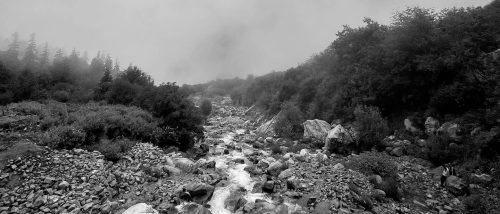
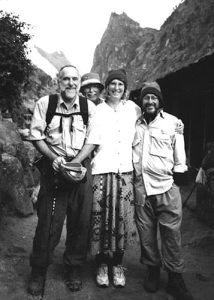
On November 4, I left my comfortable life in the DC suburbs to undertake the most out-of-character experience of my life. On November 7, I linked up in Kathmandu with the other trekkers—Skip and his girlfriend Julie, their hiking buddy Louie, and Bonnie. Three fun, touristy days later, we assembled at 5:30 a.m. in the hotel room of Peter, owner of the trekking company that organized our hike. He served us hot tea and buns, and, for unexplained reasons, played excerpts from The Pirates of Penzance and Cats DVDs. At 6:30 a.m., we and our Nepali crew boarded a bus to the village where we’d camp overnight and begin the trek the next morning.
A four-hour ride, with ever-changing views of fast-flowing streams, cascades, and terraced farmland, ended in Besi Sahar, a village about 2,600 feet above sea level. Our campsite, bordered by a soccer field, a pigsty, rice paddies, and a creek, was so close to village housing that it felt like we were camping in someone’s back yard.
Across the creek was a hill, maybe 500 feet high, that Skip and I decided to ascend. The sun was bright, the path was steep, and soon I was winded, dizzy, and disgusted.
If I couldn’t walk up a little hill at 2,600 feet, how would I handle 17,700 feet? But after sitting, cursing, and chug-a-lugging a quart of water, I recovered, and realized I’d been dehydrated. Continuing the climb, we encountered spiders the size of New Hampshire, their webs as thick as corded hammocks, or so it seemed to arachnophobic me, but we slashed our way through. From the peak, we saw our creek merging with a river, and in the distance, snow-capped mountains.
The climb had been fun, spiders or no, and I had relearned a fundamental lesson of hydration—drink before feeling thirsty. “I can do this damn trip!” I privately exulted.
If I knew I could do it, I was unsure about Bonnie. Based on persons I had known who were reared in Judeo-Christian traditions but became Buddhists, I’d feared she’d be a muddle-headed, ascetic, vegetarian mystic obsessed with her aura, but she wasn’t. Bonnie was funny, carnivorous, acquisitive, and had four college degrees including a PhD. I was quickly as comfortable with her as with long-time friends Skip and Julie, and very ashamed of my narrow-mindedness.
But here’s what else Bonnie wasn’t: physically and mentally prepared for the trek. Skip said Bonnie had always found excuses to avoid training hikes with him and Julie. Louie feared she was too out of shape to make the trip. Julie, who had to help Bonnie cross the shallow, narrow, easily fordable creek bordering our campground, worried about how she’d react when things got really tough.
“We all make our own journeys,” Skip said. “She’ll make whatever journey is right for her.”
Bonnie’s journey proved frighteningly brief. Overnight, she took a sulfa tablet for a UTI, developed a rash, and took Benadryl. When the trek began a couple of hours later, she seemed OK. The early going was easy, gently uphill on a smooth dirt trail we shared with other trekkers. Bonnie walked along steadily, keeping pace, enjoying our vistas—a boulder-filled river, the morning sun glistening off snow-capped peaks beyond verdant smaller mountains. But when we had to cross the river on a swaying suspension bridge about 50 feet above the water, she froze. With Julie’s help, she got across before collapsing. She lay on the ground, pale, her pulse erratic, feeling weak and dizzy. A physician in another trek group, suspecting a drug reaction and fearing she might go into shock, urged us to get her back to Kathmandu. Options were limited—a donkey back to Besi Sahar and a bus to Kathmandu … or a helicopter.
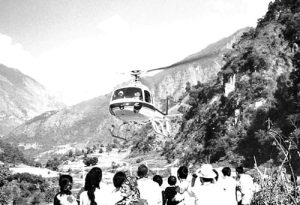
Luckily, we were near a tourist checkpoint with a phone, and, luckily, we reached Peter, who quickly arranged for a chopper and medical attendant. Within 30 minutes, the rescuers arrived, much to the delight of several Nepalis who gathered to watch.
Bonnie was not delighted. She was in pain, her heart rate was bonkers, a doctor had said she could go into shock, she was half-way around the world from home, strapped into a helicopter in the Himalayas, facing treatment by unknown doctors in unknown conditions, fearing she might die.
Protecting our ears from the brain-rattling sound of the rotors, the remaining four of us watched the copter carry Bonnie away, maybe shed a tear or two, then threw on our backpacks and continued our journey.

That night, we camped at the junction of two rivers. For dinner, our crew prepared pasta with turkey and cream sauce, plus cheesecake for dessert. While eating, we discussed our concern for Bonnie, and our personal concerns about the physical and psychological challenges ahead of us. When darkness came around 7 p.m., we crawled into our tents, and by 8 p.m., lulled by gentle river sounds, we slept.
A few days later, we reached a village that had phone service. We learned that Bonnie recovered quickly in Kathmandu, and after day trips to Buddhist sites outside the city, she returned to Florida.
Thus comforted, we continued our trek.
[Thanks to my wife, Joan, and to three members of Diane Scharper’s memoir class (you know who you are), for reading and commenting on early versions of this story. I couldn’t have done it without you.]
Back to the Table of Contents
Crossing the Bar by Myself
By Charles J. Fortin
 My denial could not reverse the switch. After decades of minding my own business, unconcerned, convincing myself that they had forgotten me, I received word categorically and irrevocably determining the precise day of my scheduled demise.
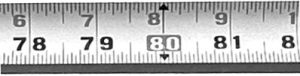
Time and urgency abruptly took on new meanings. The clock ticked faster and my mind focused. At midnight there was no turning back. Without consultation or approval, my two senior online dating sites stripped me naked and, coldly and indifferently, jerked me from 79 to 80—into a whole new world of anxiety, seasoned with more than a pinch of desperation.
From one nanosecond to the next the number of female prospect “hits” diminished drastically. Even among seniors just a few years less old, ageism showed its face, overwhelming and discounting the handsomely worded profile protestations of youthfulness, acuity, and recent photos highlighting health, vitality, financial stability, and hair. At 79, I could count on half a dozen daily curiosity seekers, even the occasional and coveted ego-boosting “smile” response. Where did they go?
Not surprisingly, my unavoidable graduation advanced me to an age cohort that I consider untimely and undeserving. But that’s what denial does to a person. Even before my designation upward, perils abounded in the “dating scene” and perceptions could always prove fatal. Was “not being alone” the new low bar and criterion for choosing a partner?
When I crossed the age bar (Tennyson’s passing to fatal ocean depths without return), married several times, divorced, living in a rental on a fixed income, the field of possibility narrows severely. Am I a “has been” (or a “never was”), a loser, a creep? Perception and prejudice weigh heavily. If requested, would my former wives furnish letters of recommendation on my behalf?
In my case, while believing that, ultimately, I would be better off partnered in some fashion, so far, I have been fortunate to manage and organize my life satisfactorily on my own. Many if not most women have also achieved and prize their independence unencumbered by extraneous expectations and commitments, anticipated or not.
At the same time, others in my cohort have endured adverse life trajectories and still hope for happiness (and partnership) soon and beyond. They express determination and would pledge fidelity to a future partner for the long haul (well, not that long). But at what price?
We all carry baggage from life experiences and learning. Starry-eyed we believe rough spots can be surmounted. Before those occasions present themselves, however, a prudent potential suitor will conduct patient due diligence. Several prospects often boast honestly and openly admitting to past decades of blissful marriage with deep and enduring love for their now-deceased spouses. Interested parties best be wary when the widow or widower seeks to replicate such a bond with a stranger with one stroke of the computer key.
Criteria for partner selection at 25 and at 80 may have similarities. But at 25 there is still plenty of time for hanging out and relationship experimentation not available and enjoyed by advanced seniors. For them, a frantic now-or-never mindset runs the risk of missing positive opportunities around the corner.
At the same time, previously non-negotiable rigidities and conditions may soften, even recede, with accommodations grudgingly acceptable given a shallow and shrinking pool of seniors. Of course, there are individual needs, desires, temperaments, and circumstances, but the NBA (“not being alone”) criterion may not be the wisest or most wholesome for everyone, either in the short or long run.
Still, it appears that many may settle for imperfect, even damaged, goods rather than forge ahead independently, continuing the pursuit of compatibility and contentment at a minimum. You get what you settle for. Shooting for less than passion and exhilaration seems inconsistent with a healthy strategy for happiness. I refuse to cross the bar without them.
Back to the Table of Contents
Hands Off NYC!
By Sugie Weiss
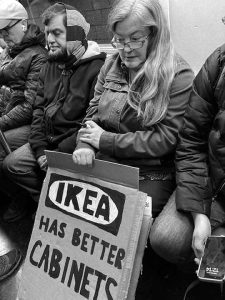
protestor.
As emails announcing countrywide and worldwide protests against our current administration, poured in prior to April 5th, I realized that this was the opportunity to actually take action. For too long I had allowed my thoughts to fester about how our democracy was being destroyed. In the 1960s, I had routinely demonstrated in New York and in “Washington DC” against the Vietnam War. As I have aged I have tended to avoid large demonstrations, but I now felt the need to move out of my comfort zone.
The Hands Off NYC protest was to start in Bryant Park, located in midtown Manhattan, and proceed down 5th Avenue to Madison Square Park.
Bryant Park is the site of the stately main branch of the New York Public Library, whose two magnificent stone lions imperiously stare out onto Fifth Avenue. The park stretches out to the west, behind the library. At this time of year, the large grassy areas are greening, along with an abundance of yellow daffodils and tulips.
April 5th dawned a chilly and grainy day. A misty drizzle enveloped my husband and me on our walk to the subway. On our trip on the F train from Brooklyn, we were clearly accompanied by kindred spirits. As we pressed ourselves into the car, a delightful poster caught my eye: IKEA HAS BETTER CABINETS. The yellow and blue Ikea logo was perfectly reproduced. People smiled as they saw it. The packed subway car virtually emptied out at the Bryant Park station. We exited at 40th street and Sixth Avenue where we were met with throngs of people filling the street and moving east towards Fifth Avenue. We made our way into the park and to our amazement, we were met by groups of Scottish bagpipers. The wailing sound of the pipes seemed so appropriate, although as we later discovered the clans were there to celebrate Scottish National Heritage Day.
We had arranged to meet up with our son Daniel, and despite the sea of people, we found each other and began to move out of the park, leaving behind the green grass and bright yellow daffodils to join a mass of people moving east on 42nd Street towards Fifth Avenue. The grayness of the day and the towering colorless skyscrapers loomed over us as we joined the march. In addition to the marchers filling the street there were cheering crowds lining the sidewalks. As we moved along, occasionally a roar would break forth creating a wave of sound washing over us. At each corner there were members of Indivisible and Move On, the march organizers, who would stop the group to allow for cross traffic to proceed.
The lack of a police presence was notable. It was an entirely peaceful protest made up of people of all ages carrying a myriad of signs, some pushing strollers, some using walkers, and some with dogs on leashes. Any fears that I had dissipated quickly. There was a real sense that our voices would be heard and our numbers would be seen.
On reaching Madison Square Park, after walking for three hours, we were asked not to gather as there were no speakers. Before leaving the march I turned to look north and all I could see was an enormous mass of fellow protesters standing up for their beliefs. Despite my trepidation, I am so proud to have joined this demonstration. The day had brightened, creating that special twinkling quality that sunlight on the windows of skyscrapers can create, and offering a sign of hopefulness that truth and decency could return to our diminished and divided nation.
Back to the Table of Contents
To Have and to Have Not
By Jerry Mulvena
In the 1960s, after spending most of that decade working as a programmer/analyst for IBM, I wanted a change. Instead of being a little fish in a very large pool, I wanted to work for a small company where everybody knew my name and where my contributions to the success of the company would be noticed and rewarded. Due to the rapidly increasing processing power of computers in that decade, many new companies were being formed in 1969. I chose Universal Systems, a start-up company that was established to provide services for the trucking industry. My job interview was not with someone in the personnel department but with Ralph, the President of the company. I liked Ralph. He exuded confidence. He said that the trucking industry had many inefficiencies and was fertile ground for automation and that, while I was working on the initial project, he would be hiring former trucking industry executives to assist him in planning for future work.
Truckers had to wait for an hour or more after the cargo was loaded while a manifest was prepared which listed and priced each item. They would then carry the manifest to the destination where they would receive payment. We would implement software which allowed the trucks to leave immediately after the truck was loaded and payment would be waiting when the truck arrived at its destination. Universal Systems would receive a small fraction of the value of each shipment. The data base would also provide a record of all business conducted by each trucking industry company. Since Universal Systems was the first to provide this service, Ralph expected that the service that his company provided would become an industry standard.
The project took eight programmers about six months to complete. After we finished, we had frequent visits from trucking company representatives who were impressed with the results of our work. All that remained was for the truckers to sign on the dotted line and for us to move onto another project.
There was a celebration dinner for all employees at which Stan, the Vice President of Universal Systems, told us that he had done a careful review and projected that each share of the company stock would be worth $240 in two years. The stock was currently selling on the local OTC market for around $13. I had been given 800 shares of restricted stock when I joined the company which meant that I could not sell the shares for two years. I remember thinking that even if Stan’s estimate was double the actual amount, it was still a nice piece of change. Stan convinced me to buy another 200 shares of the stock on the open market.
Six weeks later, Universal Systems was close to bankruptcy and looking for a company with which to merge. The company that appeared most interested in a merger was one that manufactured toilet paper. Some of the employees speculated on a name for the merged company. I suggested that we keep it simple and nominated “Universal Systems and Toilet Paper.”
I was given the task of writing a manual which described how our system worked and how easy it was to use. After it was finished, Stan had some questions about the manual and called me into his office for a conference. The first part of the meeting went normally. Suddenly, there was an awkward silence. Stan then started crying, not just whimpering but bawling like a newborn, while saying “Jerry, it’s not my fault.” This was the same person who had recently told me that my financial future was assured. I realized then that there was something that demanded my immediate attention. I had to quickly get to a phone, call my broker and sell the 200 shares of Universal Systems that I had purchased on the open market.
No one ever informed me why there was such a sudden adverse turn of events. I had to figure it out for myself. The trucking industry had decided that they didn’t need a middleman who would skim off a share of their profits. They knew enough about our system so that they could easily duplicate it within months. Ralph and Stan were honorable men but poor businessmen. The bankers were so anxious to get in on the next big thing that they financed something which they knew nothing about. Their love affair with new technology was a phenomenon that had happened before and will surely happen again.
Back to the Table of Contents
Why Middle America Likes Trump
By Maurine Beasley

I’ve never liked the “fly over” term applied to the middle part of the United States. It belittles vast parts of the United States, sees them as inferior to the East and West coasts where the really smart people supposedly live. And to me it implies a key reason why Donald Trump won the presidential election. People don’t like to be sneered at by other people who may or may not be more intelligent, but who definitely think they are.
Don’t get me wrong. I am not an advocate of President-elect Trump’s politics. But as I struggle to write a memoir of my eight decades that interests me, if no one else, I keep thinking of Mr. Trump’s election that dumbfounded many in the well-to-do Maryland suburbs where I live. They cannot understand why different groups of voters, not only blatant racists and selfish investors, cast ballots for a convicted felon from New York whose eccentric behavior and inconsistencies defy description.
But I think I know part of the reason—Donald Trump projected an image of not looking down on those in the “fly over” zone. He called them “beautiful people” and he referred to them as “American patriots.” I come from the “fly over” zone and can relate to some Trumpian rhetoric even though I shudder at the context.
I grew up in the 1930s, 1940s, and early 1950s in Sedalia, Missouri, a town of 20,000 billing itself as the “gateway to the Ozarks.” I was taught in the public schools there that we Sedalians represented the “heart of America” because we were privileged to live in the center of a great country. We learned Sedalia had produced outstanding individuals—like a former governor of the Philippines who placed curiosities from there on the second floor of our handsome Public Library. We were proud that Sedalia was a county seat with a thriving downtown, a women’s club that met in an historic residence, and even a symphony orchestra founded in 1935.
Only years later did I learn that outsiders saw it as a backward, racially segregated town that lacked municipal services like sewers and paved streets in poor neighborhoods, although it had an abundance of saloons in a red-light district near the railroad tracks. Sizeable numbers of citizens had little formal education, lacked indoor bathrooms, and worked hard for relatively little money in Sedalia’s sprawling railroad maintenance shops and small-scale factories. I do remember my maternal grandmother, a retired farmer’s wife, showing me a $10 bill when I was in grade school and saying, “Look, you don’t see many of those!” I assume she had not in her years of toil on a farm.
Today Sedalia still has about 20,000 residents, many from Mexico, documented and nondocumented, who do unpleasant work in a chicken-processing plant, one of the agribusiness operations that has replaced the long-gone railroad shops. It voted nearly one hundred percent for Donald Trump.
I first encountered the scorn of urban elites when I was in high school and thrilled to go on the train to the St. Louis suburbs with a classmate to participate in a youth orchestra. We stayed in the home of the orchestra director whose teenage daughter poked fun at my friend and me because we were from the country. My friend’s mother had knitted her a special hat to wear, and our host’s daughter thought that was the funniest thing she had ever seen. (My friend went on to have a rewarding career as a music teacher, married a college professor, and brought up two highly successful children. I doubt that the supercilious teen-ager who taunted us has had such a productive life.)
When I enrolled in Sedalia’s nearest college, Central Missouri State in Warrensburg, a school originally set up to train rural teachers, I wanted to do well. Rapid-reading courses were all the rage, so I went to the head of the English department to ask about them. A tall Ichabod Crane type who must have been from the East, he peered down at me after checking my IQ scores, “Dear me,” I still can hear him say, “You already do better than you are capable of!” Girls were not expected to do much except prepare to teach in elementary school.
That incident did shake me up individually, but the whole college, which had about 2,000 students, was shaken when Central Missouri State was written up in the St. Louis Post-Dispatch as an example of a deprived institution serving by inference a deprived population. The article, intended to show that the state legislature was not appropriating enough for former teachers’ colleges, was illustrated with a big picture of the school orchestra, in which I played, rehearsing with buckets placed between the sections to catch water from the leaky ceiling. As I recall, we students were more embarrassed than appreciative of the newspaper coverage. We thought we were getting a good education and we resented being presented as pitiful recipients of inferior status.
What do my memories have to do with Donald Trump’s electoral success? Times are far different now and social issues far more complex. My simplistic examples are offered to illustrate long-standing tensions between elites, as they see themselves, and non-elites who resent being written off as part of the “fly over” population.
Back to the Table of Contents
I Knew Exactly… A Poemoir
By Jim Herrell
During the civil rights revolution
in the early 60s,
I knew exactly how to end racism.
In graduate school working on a PhD in Psychology,
I knew exactly the causes and cures of mental illness.
On the days approaching my first marriage,
I knew exactly how to be a good husband.
Awaiting the birth of our first child,
I knew exactly how to be a good father.
During the Vietnam era,
I knew exactly how to end war.
Preparing to teach my first college class,
I knew exactly how to be a good professor.
When I began my first management position,
I knew exactly how to be a good boss.
During the Watergate years,
I knew exactly how to ensure the election of honest presidents.
When I hit 60,
I knew exactly how to settle gracefully into old age.
In my 80s now, I know none these things.
I guess memory does fade quickly
as we age.
Back to the Table of Contents
Memoir Writing in a Time of Chaos —Spring 2025
By Julianne Oktay
 To be honest, I’m having trouble getting my head into my Osher memoir-writing class this semester. Our class, made up of retirees who are interested in writing, meets weekly over the Zoom platform for reading and discussing memoirs, most importantly sharing our own work. Its members (usually 10–15 people) are both experienced writers and novices, all of whom have interesting experiences they want to share and pass on to families. Our instructor is a highly experienced writer who guides and encourages us. Some of us are interested in publishing, but most just aim to capture experiences and truths from their lives. When Donald Trump was elected in the middle of the Fall semester, 2024, I found the memoir class a welcome respite from my growing anxiety.
Since the Spring semester 2025 began in February, however, it has been harder and harder for me to focus on memoir writing. While my classmates are deeply engaged finding the best words to recreate a memory of the past, or even to vividly recreate a whole world that has been lost, my mind is wandering once again to the morning headlines. Whenever I sit down to write, I am easily jerked out of the world of memories and into a present of fear, dread, and anger. I start to ruminate about how these policies will affect those in our country and around the world who will be threatened by these changes, and also how they will affect my children and grandchildren in the future. I wonder how my classmates can focus on their memoirs when the world as we have known it seems to be rapidly coming apart?
As I clear a space on my kitchen table for my computer, getting ready for class to begin, moving today’s paper out of the way, I inadvertently glance at the headlines:
“Trump orders 10% tariff on all imports, plus extra levies on some 50 nations. Economic gamble risks a recession, experts say.” “Judge drops corruptions case against NY mayor.” “After heated exchange, White House takes aim at Maine.” “FDA veterinarians working on bird flu response are fired in HHS purge.” “Winter sea ice in the Arctic hits a record low, a worrisome sign for climate.”
I quickly divert my eyes, but it’s too late. Already, knots are forming in my stomach. My mind is jumping away from the class discussion before it even begins.
In the memoir class, members often share poems and examples of good writing that have been meaningful in their lives. In my elementary school in the late 1940’s, our teachers used to read poems to us, and later we were required to memorize and recite poems ourselves. In this moment of anxiety and fear, I find the lines of Rudyard Kipling’s “If” popping up in my mind.
“If you can keep your head when all about you are losing theirs and blaming it on you”
These lines speak to me now, as I am losing confidence in ideas and beliefs that I always thought were widely held, such as equality, diversity, democracy. These ideals have now been turned upside-down and are under attack. It seems that these ideals are actually being blamed for the problems the country is now experiencing.
“If you can bear to hear the truth you’ve spoken twisted by knaves to make a trap for fools, or watch the things you gave your life to, broken, and stoop and build ‘em up with worn-out tools”
Words I have cherished are being twisted. Things I have worked to achieve for over many years are being broken. Many of the things I have dedicated myself to—science, research, the rule of law, nature, education, universities, even behaviors like charity and kindness—can’t be built up again. Isn’t the climate already tipping past the point of no return?
Rudyard Kipling’s poem goes beyond reflecting what seems to be happening today and in the poem, he advises his son on how he should respond, like “[when] being lied about, don’t deal in lies, or being hated, don’t give way to hating”.
Today’s headline examples alarm me once again, even as I try to find words to describe what this moment is like.
“Trump eroding cyber defenses as peril grows: Threats to elections.” “Tariff barrage likely to push US to margin.” “White House wants a sixfold increase in spending for immigration detention.” “Fears rise as safety agencies hollowed.” “NIH layoffs are hindering cancer trial’s leap forward”. “Amid anti-DEI push, agency edits history exhibits.” “Trump orders expansion of logging on national forest lands.”
In the past when I felt my country was taking a path I opposed, I quickly jumped into action, joining marches, donating money, signing petitions. This time I feel like my usual ways to resist are not going to succeed. I try instead to focus instead on insulating myself from the constant onslaught. I stopped watching the nightly newscasts and started watching music performances instead. I am calmed watching our backyard birds, doing what they always do in springtime, finding mates, building nests, nurturing chicks. I take walks, reminding myself that even in terrible times, the basic life-force remains strong. I try to focus on my immediate family and my role in it, where I may still have some impact by “staying calm” and “carrying on.”
Kipling’s poem reminds me that times like these are not unique. I think again about my memoir writing class. Can I use the class to help me to think and write about other times when the kind of fear and despair I am feeling today was common? I see how one of my classmates’ memoirs delves into the diaries and poems of his long-deceased relatives, and I am reminded that taking a long view helps me see that time goes on and today’s crises disappear into the large cycles of lives lived and lived again through memories. Perhaps I can explore how my own ancestors survived similar chaotic periods and/or explore the theme of resilience in art and literature.
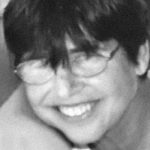
Although it is outside of my memory, I was born into a very dark time (1943). Hitler was rapidly advancing across Europe, rounding up Jews and others he found undesirable and putting them into concentration camps. How did my parents build a new home and raise a family at such a time? Did they too feel fear and obsess about what could happen to their four little Jewish children? I find myself wishing that I had access to their thoughts and feelings at that time. I start to realize how important memoir writing is. I can’t wait for fall semester to start, so that I can continue writing about my experience going through this chaotic time. Even if I do not find any answers, or find any advice for future generations like Kipling’s, I know that they too will experience chaotic times and will want to know what it was like for me in the Spring of 2025.
Back to the Table of Contents
Bee Doo Toys
By Jeanne Wills
 The jarring alert screams out at 2:30 from the darkness of the night, from the Israel Home Front Command. I see the warning, “Alerts are expected in your area. You need to find a better location that will provide the best protection.” My daughter, son-in-law, and I grope our way out of the bedrooms and meet in the faint light from the streetlamp, each of us staring at our phone. Bobby locks eyes with me. “We attacked Iran. You are not going home today.” Another alert hits his phone. “I’ve been called up. I have to go now.” My daughter immediately turns to me and says, “When the sirens go off, you come into my room and get Lev and take him down to the bomb shelter. I’ll get Harry and bring him down.” Then she opens the closet, pulls out her husband’s volunteer army bag and begins to add essential clothes to his self-purchased army gear. Another jarring alert sounds: “Rocket and missile fire In your area. Time of arrival to the protected room—15 Seconds. Enter the Protected Space.” The outdoor sirens go off in our little village and we hear the echoing sirens in each mountain village all the way down the mountains to the sea, down to Haifa on the Mediterranean Sea.
My daughter’s matter-of-fact instructions focus me on my job. Heading to the bassinet, I pick up my precious newborn grandson and wrap his blanket around him while I hurry downstairs, protectively encircling baby Lev close to my body. Lev Valory, named for his father’s close friend killed in a drone attack on Israel by Hezbollah from Lebanon 11 months earlier, sleeps soundly in my arms. We all come together in the bomb shelter, the “mamad,” enveloped in a sense of unity and responsibility for one another. Over the next 13 days from June 13, 2025, we meet in the mamad multiple times each night and day. We hear the explosions outside. Images posted by Hamas proudly burning Jewish babies alive on October 7, 2023, make me determined to protect my grandchildren with my life as numerous women before me have done.
Special “bee doo” toys stay in the mamad with food, water, and diapers. Bee Doo is the name my daughter uses for the sound of the sirens. Two-year-old Harry is only allowed to play with bee doo toys during bee doo time in the bomb shelter. Harry quickly begins to respond to the alerts and village sirens with, “Time to play with bee doo toys!” He stops whatever he is doing and heads for the stairway toward the special things awaiting him below.
Homes in our village keep a basement or garage door unlocked so anyone passing by can come inside to seek shelter. Essential services stay open; we can buy food, gas, pharmacy items, and visit the doctor. Our trips to the grocery store are interrupted when alerts warn us to seek shelter. The road to the market and shopping center offers public bomb shelters with attractive murals painted on the sides. People were murdered inside shelters like these on October 7. There is no door on public bomb shelters; everyone can enter including terrorists. The home mamad has handles on both sides of the strong door so rescue teams can get occupants out. Hamas used the handle to go inside and murder occupants.
Citizens volunteer their own vehicles to the Israel Defense Forces. The IDF does not have enough military vehicles to transport volunteers, not even all the active IDF troops. A sign is taped on the hood, roof, and doors to identify volunteer army vehicles. Women left without transportation must defend the children, home, and village without weapons. Strong metal gates have been installed at the entrance to the community after the barbaric October 7, 2023, massacre of Jews. Israel paid the US two billion dollars for weapons to defend herself, but the US would not release already purchased weapons to Israel after October 7. Over two hundred billion dollars had already gone to Iran and fed the October 7 Hamas attacks on Israel from Gaza. I wish people outside Israel understood what happens inside Israel when funds are given to Hamas and to Iran. Iran feeds its proxies with missiles, rockets, drones, and fuel for terror attacks on Israel. International funds go to Hamas, the government of Gaza chartered with the destruction of Israel.
Posters of the hostages displayed at the airport when I arrived May 21, 2025, weigh on my heart. I hear the cry “Bring them home now!” At the beach, I saw a long line of chairs with a photo of each hostage still held by Hamas. Villages display photos of their citizens still being tortured for more than 700 days and nights in the hands of Hamas.
A flat tire leaves Bobby stranded. The IDF comes but does not have a tire to fit his vehicle. A villager puts four new wheels and tires on Bobby’s 4×4. “I can’t pay for this,” Bobby protests. “Just go and help,” comes the reply.
On the way to Tel Aviv, I see cars pull off the road to park against concrete barriers when the sirens cry out. I see children jump out of a car and run to lie prone on the ground against the concrete barrier with their tiny hands covering their head. When bombs hit the ground, shrapnel flies into the air. It’s best to lie face down in a low spot. The missiles, rockets, and drones coming from Hezbollah in Lebanon, Houthis in Yemen, and Hamas in Gaza target high-rise apartments in dense population areas. Israel must intercept attacks before they land on citizens. City dwellers go to the basement or under a stairway for protection from shrapnel falling from the sky when a missile explodes overhead.

“Bobby, come to America.” I offer, “You can all live with me.” His parents and siblings moved to Israel from England because of growing antisemitism. “The world is not safe for Jews,” he replies. “In Israel, we can defend ourselves.” In Washington, DC, parents kept their children home from synagogues and schools after threats following October 7. Two young people were just murdered after giving a talk at a Jewish organization in DC. Antisemitism has thrived at universities for decades. I was threatened on campus. Israel is the only Jewish nation on the planet where Jews have self-governance. Jews come to Israel, put bomb shelters in their homes and leave doors open to provide shelter for others. Everyone learns to seek shelter or lie on their face next to a concrete barrier. And children learn to play with bee doo toys in the mamad.
Back to the Table of Contents
My Hispanophonophilia
By Randy Barker
My friend Don awakened a quest for the origin story for my hispanophonophilia (love of Hispanic language and life). The origin story for his own hispanophonophilia began in what I see as a thunder-clap moment or coup de foudre: A gifted Florida ophthalmologist, Don decided on the spot to learn Spanish when he imagined that a non-comprehending Cuban-American patient, told in English by another eye doctor “Don’t move! Don’t move,” was his own father. Don went on to become fully hispanophonophilic in ways that flowered throughout his life.*
My origin story is harder to find. I have decided to search memories of my life in hispanophonophilia, convinced that my origin story was part of an iterative process just as life-altering as Don’s and that I might be able to discover when and where I became deeply hispanophonophilic.
In the 1950s, in grades 9–12 in high school and freshman year at college, I chose Spanish. That was a time when most students chose French or German. Why Spanish? Possibly because the word was that Spanish was easier than French or German. As far as I can recall, no “philia” was in play then.
From the early 1960s, I recall liking Corral’s, a Baltimore Hispanic restaurant on lower Broadway, that appealed to me and other Hopkins med students. The arroz con pollo was different and delicious. But no particular “philia” there. Equally appealing was the Acropolis, also on lower Broadway, where one found Greek food and belly dancers.
Summer of 1963, following our grueling first year of medical school, my twin Billy and I flew to Paris, purchased Lambrettas, and spent one month each traversing Spain and Greece. He named his “Rocinante,” and at times we did the equivalent of tilting at windmills; and in lasses who bestrode the rear seats of our scooters finding our Dulcineas. We had both enjoyed our encounters with Don Quijote at college. A memorable lunge into the language came when we chanted with the crowds, “Uno de Julio, dos de Julio, tres de Julio, cuatro de Julio, cinco de Julio, seis de Julio, siete de Julio … San Fermin!” while participating in the running of the bulls at Pamplona. Another highlight was a stay with a bunch of white-cowled same-age Dominican frailes, hiking the hills of their monastic life at La Peña de Francia. Despite the chance to use our Spanish and our adventurous motor scootering, Spain, austere and backward and militaristic per the Franco regime, did not imbue me with an Iberian hispanophilia.
Summer of 1964, when I did field studies in Puerto Rico of the parasitic disease Schistosomiasis, shows up as a time when I was falling in love … with Hispanic life. Was it the “Moocha leche!” (“lots and lots of milk!”) on the radio? Was it the song I learned to hum and sing “Sombras … nada más … Entre tu vida y mi vida” (“Shadows … nothing more … Between your life and my life …”)? Was it the arroz con pollo all over again? Or was it what I have kept as my favorite utterance “Si Si Si Como No” (“Yes Yes Yes like No”)? Each of these touched me, touched me as if they were inviting me to keep them as my own. That is the best way I have to account for Puerto Rico’s pivotal place in my growing hispanophonophilia.
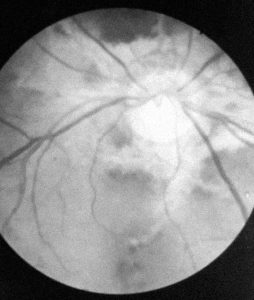
1966–1968, my first two years of medical residency at Bellevue Hospital brought me daily encounters with Spanish-speaking Puerto Rican New Yorkers. I think they were like booster shots, re-awakening my affection for my summer in their island home. One patient, Celso Falcon, got re-admitted almost every week with heart failure. He was always most obliging with his “Doctor Doctor, mis ojos!” (“Doctor Doctor, my eyes!”), letting me show colleagues the rare finding in the back of his eyes known as “angioid streaks” (see photo), signs of his rare connective tissue disease known as Pseudoxanthoma Elasticum, or PXE. Did I feel a special, somewhat paternalistic, affection for this man whose Puerto Rican provenance I appreciated personally?
Sabbaticals 1973 in Cali Colombia (3 months) and 1995–1996 in Barcelona (9 months) were times when I and Marie Claire, hispanophonophilic for reasons of her own, felt welcomed as members of multiple communities, social and professional. By now my hispanophonophilia was pretty fully flowered out.
The year 2005 brought a final celestial gift in the marriage of our youngest daughter Carolyn (Kiki) to Oswaldo Villena in Arequipa, Peru. In their sheer readiness to gather together, to eat, or to dance, the Villena family offered in abundance the soul of their Peruano heritage…and we embraced it con mucho gusto. At my hispanophonphilic best, I wrote a song in español for all to sing, “Coca Colita,” based on the well-known song “Cielito Lindo. “ The refrain went “Ay Ay Ay Ay!!/Casa y no llores/Porque casando/Se alegra Coca Colita/ Los corazones!!” (Ay Ay Ay/marry don’t cry/For marrying/brings happiness Coca Colita/to all hearts!!)
There is a back story, from 1993, that may be the origin story for Kiki’s own hispanophonophilia … and thereby for the Peruvian piece of my journey. As a teenager, Kiki joined me and a group of adults in a visit to the Guatemalan sister parish of our church in Baltimore, Corpus Christi. To this day, it is easy to recall the bright eyes and smiling faces of the little kids in Sepalau and to see Kiki towering over them as they danced to marimba music. I suspect that’s when Kiki embarked on her own hispanophonophilia.
In compiling this memoir piece, I have engaged in what my friend Don, in his own memoir, refers to as the “Scattergun” memoir technique. He says, “One day your just-written memory will release a new, unexpected visitor … a new memory. She begs you to write her story.” My iterative scattergun process has been a lot of fun. And sure enough, as memories of my Puerto Rican summer showed up, I think I discovered the wake-up part of the origin story of my hispanophonophilia.
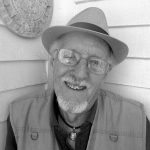
* Don became utterly proficient in Spanish (and Portuguese). He developed a hugely successful bilingual CME program, El Curso Interamericano de Oftalmología Clínica, attended by 7000 Spanish-speaking ophthalmologists in 2021. And most important, in 1985 became el esposo of Magda, his devoted Cuban refugee partner to this day. Together they have widely visited and savored Latin America and Iberia through the years.
Back to the Table of Contents