Sam Apple: A Career Creating Compelling Writing and Writers
Published October 24, 2025 | Request Information
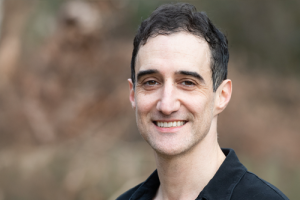 Leave it to Sam Apple – a lover of and lecturer in language – to bring both figurative and literal meaning to the idiom “the apple doesn’t fall too far from the tree.”
Apple is a program coordinator in Johns Hopkins MA in Science Writing and MA in Writing programs and the son of successful novelist and professor Max Apple. He credits his love of writing, and ultimately his life’s work, to both his father’s example and the positive feedback of English teachers throughout his high school and college career.
“If I had been getting better feedback from my math exams, I probably would have been a mathematician,” Apple quipped. “Some people don’t think of writing as a career, but I had a model for it in my father, so writing was always a possibility.”
After following the “Apple family tradition” of enrolling at the University of Michigan – the alma mater of his grandfather, parents, and sister – he majored in English and creative writing. He went on to complete a Master of Fine Arts in creative nonfiction at Columbia University.
“I had some great instructors and started to enjoy it more and more, and since my dad was primarily a fiction writer, I like to joke that my rebellion was going into nonfiction,” he said.
Apple’s undeniable love of the craft extended beyond writing for himself. He developed a love for teaching writing along the way and found that this combination allowed him to forge a fulfilling professional path. He spent 10 years as an adjunct at the University of Pennsylvania and has been a senior lecturer at Hopkins since 2020.
“I have been drawn to different genres at different stages of my life, and I have been lucky that I have been able to go off in different directions as a freelancer,” said Apple, a father of three who grew up in Houston and now resides in suburban Philadelphia. “It may not have always been the best thing for my writing career, but it has been fun.”
Apple is the author of three books, including his biggest project Ravenous: Otto Warburg, The Nazis, and the Search for the Cancer-Diet Connection. He has published short stories, personal essays, satires, and journalistic features on a wide range of topics. In recent years, he has primarily written about science and health. His work has appeared in The New York Times Magazine, The New Yorker, The Atlantic, Wired, The Los Angeles Times, The Financial Times Magazine, ESPN The Magazine, The MIT Technology Review, and McSweeney’s, among many other publications. In 2006, his book Schlepping Through the Alps was a finalist for the PEN America Award which goes to first works of nonfiction. Apple, a football and basketball enthusiast, also writes books for young children, including a two-book series with NBA star Jayson Tatum titled Baby Dunks-a-Lot.
“A lot of the skills that I teach in science writing and creative writing are the same,” he said. “They include learning how to develop scenes and to add context. We focus on core skills, like writing concisely and clearly.”
Science writing, in particular, has appealed to Apple as a nonfiction writer because it allows for the communication of two different types of truths – the scientific truth and what researchers are working to discover, and the literary truth about the human condition, that is, what people are like and what it is like to go through an experience.
“When you are writing about science for a popular audience, the tricky part is finding ways to simplify complicated topics while remaining accurate,” he said. “That’s the work of translating science. But I also think it’s important for young science journalists to appreciate that the job of the science writer isn’t merely to make science more accessible for the public. Science journalists, like all journalists, also need to serve as watchdogs. That means learning to distinguish between hype and meaningful findings and being critical, when appropriate.”
And in the often serious work of science writing – that requires an understanding of the rigorous side of reporting and fact checking, arranging multiple interviews, and then communicating in a way that doesn’t overwhelm the reader – Apple also infuses humor.
“Through my course, ‘The Funny Side of Science,’ students learn about humor as a really important communication skill to engage with and build an audience,” he said. “There are a lot of scientists who are doing serious work but who also have interesting quirks or idiosyncratic senses of humor. We introduce the students to all different people, including folks who do science-based standup comedy, someone who draws science comics or graphic novels, and journalists who are very good at adding humor to their reporting.”
In both the MA in Science Writing and the MA in Writing programs, Apple also points to his love of teaching the residency courses. In the summer of 2025, he was among a Hopkins group that traveled to Krakow, Poland, where his students were paired with a Ukrainian refugee. These interviews were captured as individual stories that shared the personal recollections of those who emerged from the ongoing conflict between Ukraine and Russia.
“This trip was an amazing experience, and one of the highlights of my teaching career,” he said.
“I feel very fortunate to be collaborating with my colleagues in AAP, with so many people with such a broad array of talents from so many different backgrounds,” continued Apple. “And I feel lucky to have students who are so passionate about science and writing and so motivated to improve their craft.”