Alexandra Kron-Daleo: Preserving History in a Digital World
Published September 30, 2026 | Request Information
It was only fitting that Alexandra Kron-Daleo wore a work of art to collect her diploma when she completed the Johns Hopkins MA in Museum Studies program in 2018.
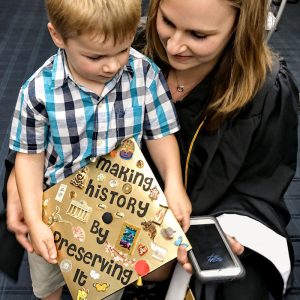 Her personalized graduation cap was bedazzled with colorful objects and images on a shimmering gold background, representing her love of museums, art, and history. It also contained a powerful message in bold, black lettering that would come to define not only her graduate studies but the career and teaching that followed – “Making history by preserving it.”
Her career now sits at the intersection of cultural heritage, technology, and digital preservation – and the challenges that are inherent in these areas. Through her role as the community manager at Terentia, a technology company serving cultural heritage organizations, she helps museums and other institutions ensure that the stories they collect today remain accessible to future generations.
Additionally, Kron-Daleo serves as a lecturer in the Museum Studies program and also in Johns Hopkins’ MA in Cultural Heritage Management program. She is also the 2026 recipient of the programs’ Excellence in Teaching Award.
For Kron-Daleo, preservation is about far more than protecting objects. It is about preserving the stories behind them – and making sure the stories of communities that have historically been overlooked are not lost.
“Art is humanity. It is who we are,” Kron-Daleo said. “How we document and interpret history and culture is so fascinating and important.”
Kron-Daleo did not grow up surrounded by museums, but a school field trip to the Autry Museum of the American West made a lasting impression. She initially considered becoming an art teacher, but a course in Latin American Art history at California State University, Fullerton changed the trajectory of her education.
“It blew my mind,” she said. “I loved it. I love the analysis of artwork and how artists interpret historical events through their lens. I changed my major to art history.”
 Out of college and newly married, Kron-Daleo relocated with her husband, a Marine, to Virginia. She volunteered at the Fredericksburg Area Museum and worked for a federal contractor providing services to the National Museum of the U.S. Marine Corps. A new military assignment took Kron-Daleo, then eight months pregnant, and her husband to Okinawa, Japan. She enrolled in the Johns Hopkins Museum Studies program from there when her son was less than one year old.
The experience allowed her to explore museums throughout Asia, while the Johns Hopkins program helped her build a global network of cultural heritage professionals.
After her husband was stationed stateside in San Diego, Kron-Daleo secured an internship with the Balboa Park Online Collaborative, a non-profit consultancy that provides support, development, and strategy for museums and cultural institutions. There she met director and CEO Nik Honeysett.
“Nik was such an amazing mentor,” she said. “I wouldn’t be where I am without him.”
At BPOC, Kron-Daleo helped cultural institutions evaluate collections-management systems, workflows, and digital asset management platforms.
She quickly saw a common problem: Many institutions were relying on outdated technology that made it difficult to search collections or draw connections between information scattered across hundreds of thousands of records.
“It was frustrating from both an end-user perspective and as a professional,” she said. “The inaccessibility also gave me such a sense of injustice.”
At Terentia, Kron-Daleo helps institutions adopt and understand new technologies. She also develops educational resources and hosts webinars on topics ranging from collections management and digital asset management to artificial intelligence.
Her work has reinforced an important distinction: Digitization creates a digital copy. Digital preservation makes sure the copy survives. A museum can scan a historic photograph and put it online. Digital preservation asks what happens 10, 25, or 100 years later.
Will the file still open? Will its format still be supported? Will its metadata remain connected to it? Can researchers verify its authenticity and provenance?
“It is all about risk,” Kron-Daleo said “You do nothing, there’s risk. You do something, there’s risk.”
Those challenges can be particularly daunting for smaller institutions without the staff, funding, or technical expertise to continually manage their digital collections.
Kron-Daleo also points to increasingly sophisticated search tools, artificial intelligence, 3D scanning, virtual reality, and immersive experiences that are transforming how audiences experience museums and connect to objects, people, and historical events.
AI, she said, is “really changing the game.”
But new technology creates new preservation challenges. As AI-generated and altered images become more pervasive, cultural institutions must think about how to authenticate digital materials and establish their provenance. Emerging standards such as those developed by the Coalition for Content Provenance and Authenticity are helping address those questions.
“We’re hearing about institutions that have had images from their websites being altered by AI,” Kron-Daleo said. “That’s where digital preservation is going to be so incredibly important – managing all of that information and proving authenticity.”
For Kron-Daleo, however, the most important questions surrounding preservation are ultimately human ones.
“If we are not preserving unheard stories or cultures that are oppressed, if we are not talking about Indigenous communities or Black history – if we don’t preserve and talk about these things, in the future it will look like it never existed,” she said.
That conviction is reflected in her ongoing collaboration with North Carolina’s Junaluska Museum that is working to share the rich history and culture of the Eastern Band of Cherokee Indians and helping to preserve the Cherokee language. With a limited number of speakers remaining, documenting the language provides a resource that can help support teaching and learning within the community. The project illustrates how preservation can serve not only researchers and institutions but also the communities whose knowledge is being preserved.
“Being a part of it and helping to make a difference is really what has made me love this sector and work so much,” she said.
Kron-Daleo ’s commitment to making preservation meaningful and accessible also shapes her teaching. She welcomed the opportunity to bring her experience as a museum professional, technology consultant, and cultural heritage practitioner back to the Johns Hopkins classroom in 2023, where many of her students are already working in museums and can immediately apply course assignments to their jobs. Her professional experience allows her to connect broad concepts to the practical decisions students will face in their careers.
In fact, Kron-Daleo ’s teaching has become another form of preservation.
It is a way to pass knowledge, expertise, and responsibility to the next generation of museum and cultural heritage practitioners.
And to bring her mortarboard message full circle, ensuring that the past has a future.