Building Field Experience into a Fully Realized Framework
Published February 4, 2026
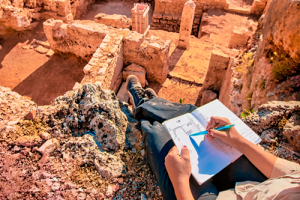 Are you ready to advance as a cultural resource management professional who has spent time excavating and documenting cultural heritage sites? Your undergraduate degree and valuable field experience as a working archeologist provide merely the foundational knowledge necessary to take you where you want to go next.
Recognizing the desire for CRM professionals to upskill — without having to step away from the immediacy of their field work in the public or private sector — Johns Hopkins University has uniquely positioned its MA in Cultural Heritage Management program to equip students with a deeper understanding of the legal, ethical, and theoretical framework and digital innovation that shape 21st century cultural heritage stewardship. Through an integration of academic rigor and applied relevance, JHU provides students with the professional skills that the industry increasingly demands for career advancement. These components also help students meet benchmarks required for federal certification.
“Our flexible online program is aligned to industry standards. We work with students to customize their plan of study to ensure that those with the necessary field experience, who are interested in pursuing a career in CRM, gain the essential skills and competencies they need,” said Program Director Sarah Chicone. She also noted that the JHU Cultural Heritage Management program has been recognized by the American Cultural Resources Association for preparing students well for a career in CRM.
“It’s a great time for students who are looking to get into the field. Students can enhance their program curriculum with elective courses from complementary disciplines – such as public land management, GIS, or even organizational leadership – to take their career in a new direction,” Chicone added. “They also have the advantage of learning alongside peers from across the cultural heritage sector – not just in archeology, but in historic preservation and community outreach – which helps them see how they fit in the broader professional landscape. We need practitioners at the graduate level who can meet the qualifications that this growing field requires.”
Students interested in a career in CRM benefit from the expertise of a diverse JHU faculty of archaeologists, anthropologists, conservation architects, curators, preservationists, and historians who bring an active awareness of the field’s evolving challenges. Faculty help students bridge the gap between practice and the multidisciplinary study of heritage, emphasizing an understanding of not just what is preserved, but why – and for whom. The program places a strong focus on emergent technologies, such as 3D laser scanning and digital curation, and its impact on heritage conservation, preservation, and engagement.
“The Johns Hopkins Cultural Heritage Management program has been a pioneer in providing a professional master’s degree program that responds to what the industry truly needs,” said Associate Program Director Angela Labrador. “We are committed to cultivating critical thinkers who approach the field holistically. Our online modality serves students who are in the field right now and who want to move up the ladder. It allows CRM professionals to maintain their working schedules while earning a master’s degree that will ground their fieldwork and provides leverage to advance their professional qualifications for management and leadership roles in the CRM sector.”