For 10 days in April 2026, the world watched as NASA’s Artemis II astronauts looped around the moon and safely returned to Earth, completing a history-making mission that reignited inspiration with human spaceflight around the globe.
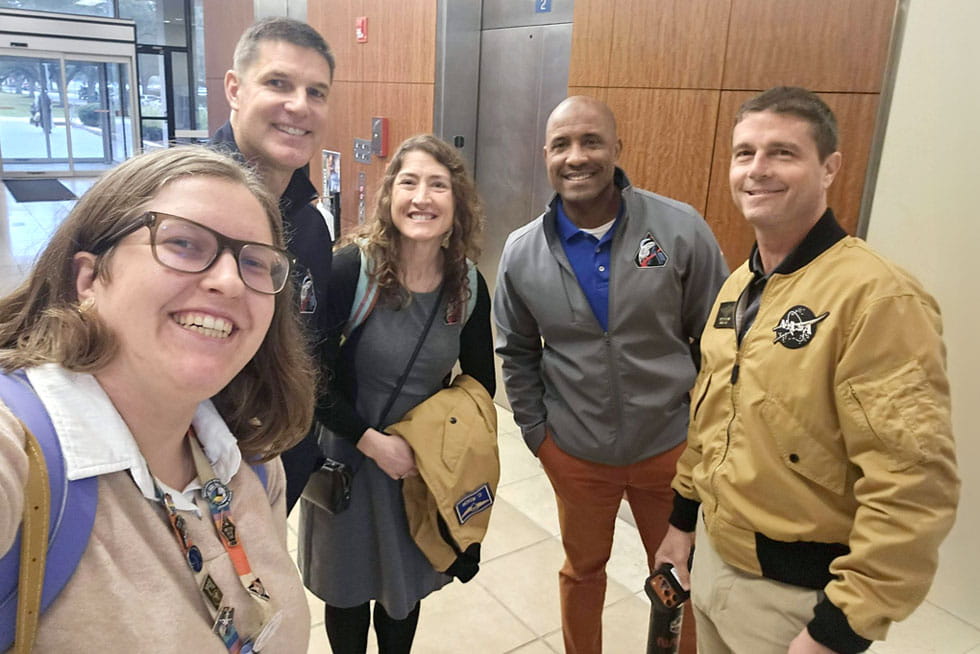
Alum Andrea Lloyd (far left) with the Artemis II crew (left to right), Jeremy Hansen, Christina Koch, Victor Glover, and Reid Wiseman.
Millions followed every milestone: the launch, the lunar flyby, the tense communications blackout before splashdown, and even lighter moments – from discussions of “moon joy” to jokes about the spacecraft toilet.
While the four astronauts – Reid Wiseman, Victor Glover, Christina Koch, and Jeremy Hansen – traveled hundreds of thousands of miles from Earth, another team worked around the clock to bring the mission down to human scale.
Among them were three graduates of the Johns Hopkins University MA in Science Writing program: Andrea Lloyd, Madison Tuttle, and Thalia Patrinos – science communicators tasked with helping the public understand not only what Artemis II was doing, but why it mattered.
Their work reflects a modern reality of space exploration: missions are no longer experienced only by astronauts and engineers, but by millions of people following along in real time. Theirs is the work of translating highly technical science into stories that resonate globally across cultures, age groups, and digital platforms.
For Lloyd, the path to NASA began with a childhood fascination with worlds beyond Earth.

“When I was seven years old, I started a little journal where I collected information about the planets from books I was reading,” she said. “I was fascinated by things beyond our planet.”
Growing up near Houston, Lloyd originally imagined herself becoming an astronaut or scientist. But math proved challenging, leading her toward communications almost by accident.
Everything changed when a NASA public affairs officer visited one of her college classes.
“He talked about explaining science to the public,” Lloyd said. “I remember thinking immediately: that’s what I want to do for the rest of my life.”
She has been pursuing that goal ever since.
After internships and communications work across NASA programs and the United States Geological Survey, Lloyd joined NASA’s human spaceflight communications efforts, eventually helping support Artemis outreach initiatives and future lunar mission planning.
During Artemis II, Lloyd spent much of her time engaging directly with the public.
“It was so much fun to see people’s excitement,” she said. “You are bringing the public personally on the journey, and that is something we haven’t really seen before.”
That enthusiasm became one of the defining emotional notes of the mission. In reaction to the astronauts’ excitement about the Moon, Science Officer Angela Garcia responded, “I copy your Moon joy.” Jacki Mahaffey, the chief training officer for the Artemis II crew, then relayed it to the astronauts, and that’s how “Moon joy” made its way into live coverage commentary – providing a rare moment of collective excitement in a social media landscape often dominated by anxiety and negativity.
“Instead of doomscrolling, people were hope-scrolling,” Lloyd said.
For Tuttle, who grew up outside Des Moines, Iowa, Artemis has been nearly a decade in the making. After joining NASA through internship and co-op programs, she eventually joined the communications team at Kennedy Space Center supporting Artemis public affairs full time.
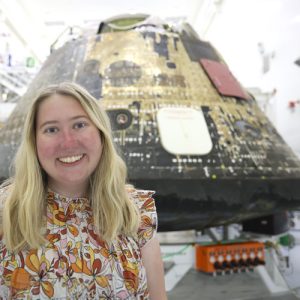
During Artemis II, she served on the recovery team responsible for coordinating media coverage aboard the recovery ship at splashdown.
“I was basically a fixer that day,” Tuttle said. “Supporting photographers, videographers, broadcast crews – making sure everyone had access to capture the moment.”
She had also worked recovery operations for Artemis I, but Artemis II carried a different emotional weight because astronauts were onboard.
“Seeing the parachutes deploy and hearing the sonic boom is always incredible,” she said. “But this time, knowing four people had just taken that ride around the moon – everyone on the ship was cheering.”
Even after years of preparation, she said the magnitude of the mission never faded.
“There’s a communications blackout during reentry,” she explained. “You just have to trust that everything worked.”
For Patrinos, the mission represented the culmination of a winding path that eventually led to helping direct communications for one of the most closely watched space missions in modern history.
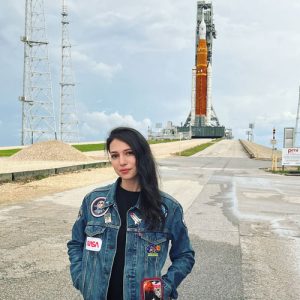
Now a communications specialist at NASA headquarters in Washington, D.C., Patrinos oversees social and digital communications strategy for the Artemis missions, coordinating outreach, engagement, web content, podcasts, video strategy, and augmented reality experiences across platforms that collectively reach more than 400 million followers.
“It’s a careful balancing act,” she said of writing for NASA’s social platforms. “You need to be formal enough to be the authoritative source of information, but not so formal that you sound dry or stale. We have to toe a very careful line between being fun and interesting and being taken seriously.”
Patrinos graduated from Johns Hopkins with dual undergraduate degrees in English and environmental science, but said she initially felt directionless compared to classmates heading into internships and professional careers.
“I felt really far behind,” she said. “I was working in a warehouse painting furniture.”
Her career path meandered through a Fulbright teaching experience in South Africa, work with the American Meteorological Society, and teaching middle school math and science outside Philadelphia before she realized she wanted to combine her interests in science and writing.
“When I discovered science writing was an actual degree, it felt like the perfect marriage,” she said.
Patrinos joined NASA after applying for an internship “on a whim” while teaching middle school. In 2018, she arrived at Johnson Space Center to intern in the Safety and Technical Operations Directorate.
“My first day on the job, I was like, ‘Yeah, this is what I want to do. I want to be here forever,’” she recalled. “This is endgame for me.”
After two internships, she was hired full time and eventually moved to Washington, D.C. where she now helps oversee sprawling communications operations involving hundreds of contributors across NASA teams.
“I have spreadsheets of spreadsheets,” she joked.
During Artemis II, Patrinos worked from Kennedy Space Center alongside fellow alumna Madison Tuttle, helping coordinate NASA’s digital rollout just miles away from the launch pad.
As milestones unfolded, her job was to ensure blog posts, livestream updates, social media posts, and video assets were published instantly across NASA’s digital ecosystem.
For the mission, she built what she called the “Big Ol’ Spreadsheet” – a massive second-by-second communications roadmap tracking every planned milestone across the 10-day mission.
“It’s a dynamic mission,” she said. “You have to be extremely flexible.”
When fueling operations successfully completed on launch day, the reality of the moment suddenly hit.
“That’s when it became very real for me,” she said. “Like, ‘Oh my God, this is a huge deal.’”
She described the atmosphere at the press site as “electric.”
“When the countdown started, everybody ran outside to get a good view,” she said. “It was one of the top five moments of my life.”
But the emotional celebration lasted only seconds.
“As soon as the rocket left the planet, we had to go back to work,” Patrinos said. “We wiped our tears and ran back to our desks.”
For the next 10 days, she monitored the mission nearly nonstop, following every livestream moment in real time.
“I was there when the astronauts woke up and when they went to sleep,” she said. “Then I rolled back into bed, and I did that for 10 days.”
Splashdown brought another emotional crescendo, especially during the tense six-minute communications blackout before contact was restored.
“When we heard Reid’s voice come back on the radio, it was awesome,” she said. “The overwhelming feeling was just relief that the astronauts came home safely.”
“Human spaceflight is inherently dangerous,” Patrinos added. “If you want to explore the stars, you have to accept a certain amount of risk and learn how to manage and prepare for those risks.”
Patrinos emphasized that Artemis II represented the work of thousands of people behind the scenes who stepped up and dropped everything at a moment’s notice.
“Our astronauts are the best of us,” she said. “They’re smart and brave, but also selfless, resourceful, and incredible teammates. The reason they are able to do what they do is because they constantly train so that when they get to space, everything becomes second nature. But they are only as good as their teams. That’s true for our communications teams, too. We don’t just train for everything going right. We train for contingencies.”
All three said the Johns Hopkins program sharpened their ability to make complex science accessible through narrative storytelling – an increasingly important skill when communicating with a global audience.
The work is intense and demanding, but also deeply personal and now inseparable from their own identities.
“This isn’t just a job for me,” Patrinos said. “NASA isn’t profit-driven. We study science to benefit humanity. As communicators, we’re trying to bring people along for the ride. There’s something really pure about that work that I find very noble.”
“To see Artemis go from a word on a page,” Lloyd said, “to literally going around the moon and back – it’s been incredible. It is such an honor to serve my country in this way, to share the stories beyond our planet so that everyone can experience them, and everyone can have a piece of space with them.”
“We are performing these bold, exploratory missions,” Tuttle said. “But at the end of the day, when the astronauts started sending back images of Earth, that’s what it is all about. It is about us looking inward and getting a new perspective of how precious our Earth is and how important this work is.”
To hear more about the alumnae’s perspectives, you can enjoy a recording of a conversation, moderated by Program Director Joe Fassler, about their roles in shaping the public narrative around one of NASA’s most ambitious missions in decades.