Osher at JHU members toured the Baltimore Museum of Art with instructor Nora Hamerman on Friday, August 8, and were treated to a one-day print media show with original woodcuts, engravings, etchings, and lithographs.
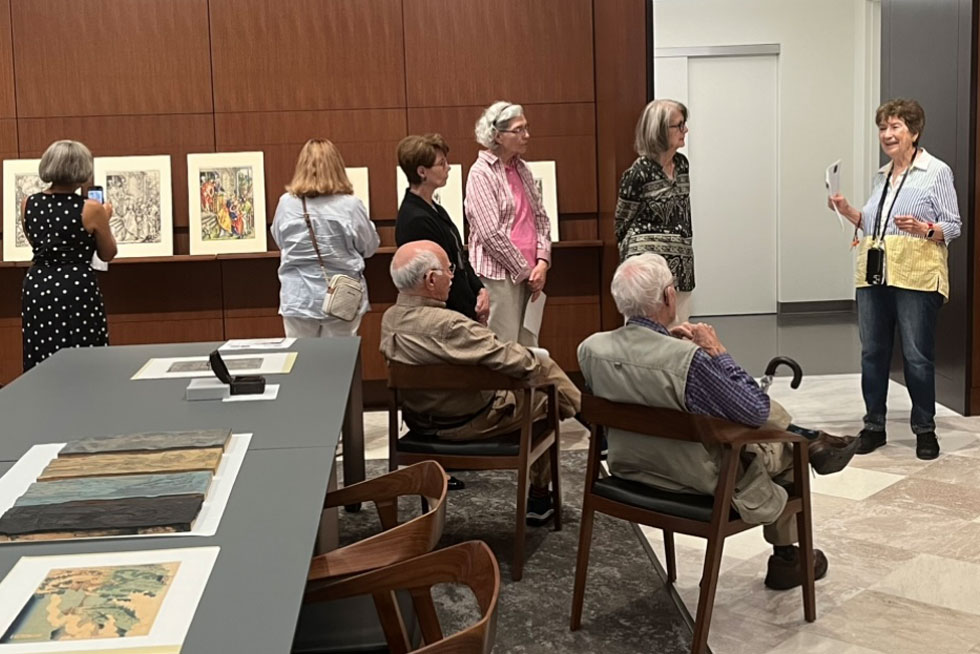
(Osher instructor Nora Hamerman guided members on a private tour through the Study Room in the Baltimore Museum of Art where they had an archival viewing of works from collections set to be within exhibits throughout the museum. These pieces ranged from unframed historical artwork and wood prints to copper plates and lithographs.)
“It was extraordinary,” said lifelong learner Randy Barker.
“Nothing compares to a visit to one of our outstanding museums in Baltimore and Washington. The National Gallery of Art, The Walters Art Museum, and the Baltimore Museum of Art have unique treasures on view from civilizations all over the world,” said Hamerman.
“There are three advantages to seeing artworks in a museum beyond what you will find in books, slide shows, and the ever-richer trove of online photographs,” Hamerman explained. “First is texture and three dimensionality. Even though a television series, like the recent PBS program on Leonardo da Vinci, will zoom in closer to the master’s paintings than it’s possible to get in person, in general,” Hamerman said, “viewers miss the surface texture that varies from painting to painting.
“Second is scale. Presentation slides make everything look the same size. It is often a shock to see the actual size of a familiar work of art,” she continued.
“Third, and most important, is variety.”
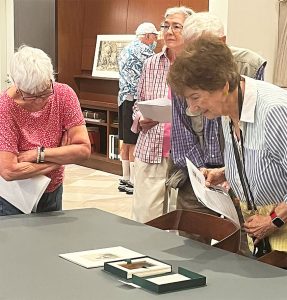
According to Hamerman, textbooks and TV focus on the “important” works of art. Real museums are like families that include delinquent teenagers and eccentric uncles. They include paintings and sculptures by so-called second-rate artists whose work fills out the picture of an era, and sometimes great works by little known artists. Walking around a roomful of Renaissance Madonnas, some by lesser-known artists, you learn by comparing them. How is space handled in this one? What is the expression on the faces (or is there none)? How does the color palette differ? What details are included here and left out there?
A special experience that goes beyond the usual museum visit is a pre-arranged trip to the print room like the Baltimore Museum of Art where thousands of artworks are kept in careful storage.
“At our recent visit there, our group was able to see examples of woodcuts, engravings, etchings, aquatints, and lithographs dating from the 14th to the 19th century. Besides the prints—arranged for our viewing unglazed, as you would never see them in a public show—we also saw an example of a woodblock and a copper plate (this one etched by Rembrandt) to gain insight into the physical process of producing the prints,” said Hamerman.
“We were amazed at the presentation and organization [of the art] and the deep knowledge and obvious hard work by Nora and the museum staff. It was a most enjoyable day,” said Gene Fisher, who attended with his wife, Adrienne.
In previous tours of the National Gallery, Hamerman’s students viewed a range of objects through a particular lens, which Hamerman said makes it easier to absorb and look closely at art works that can frankly be overwhelming. Instead of a museum highlights tour, they may choose to look at portraits, or pictures that contain images of architecture, or scenes that include musical instruments, for example. “My tours this fall will be themed to match my course The Age of the Gothic Cathedral and another will center on Leonardo da Vinci,” she said.
Hamerman’s tours are planned to make a museum visit less overwhelming. Both Hamerman and her students appreciate that these tours offer an opportunity to get together physically, in the presence of art and friends, and offer an especially valuable time for those who take classes by Zoom.
To learn more about Osher at JHU, visit our website
Email Osher: [email protected] or call 240-595-2219