Science and Storytelling Redefined in “hyper_object”
Published July 2, 2026 | Request Information
When Graham Sack arrived as a lecturer in the MA in Film and Media program at Johns Hopkins University six years ago, he came with a question that had guided much of his creative career:
What kinds of stories become possible when emerging technologies fundamentally change the relationship between audiences, performers, and media?
For years, Sack had been exploring that question through groundbreaking experiments in virtual reality, immersive media, and interactive storytelling. He produced one of the first adaptations of a novel into virtual reality with The New York Times and created an innovative 360-degree production of Hamlet with Google Arts & Culture that pushed the boundaries of theatrical storytelling.
Yet despite his time spent working with emerging technologies, Sack believed an even more ambitious frontier remained unexplored.
“I became very interested in what could be done at Johns Hopkins that would be impossible to do anywhere else,” said Sack, who currently serves the university in two capacities. A lecturer in the graduate program’s Immersive Storytelling and Emerging Technologies concentration, he is also an Assistant Research Professor at the Berman Institute of Bioethics. “Hopkins has world-class expertise in neuroscience, medicine, engineering, ethics, and the arts. The question was: what happens when you bring all of those disciplines together in a single creative project?”
That question ultimately led him to create hyper_object, an immersive neuro-theater experience that brought together artists, engineers, scientists, physicians, and students from across the university to explore how brain-computer interfaces and artificial intelligence could transform live performance.
Presented June 4 at the Hopkins Bloomberg Center in Washington, D.C., the production drew more than 200 attendees and represented the culmination of years of interdisciplinary research and experimentation.
“Before anything, it had to be an emotional story,” he said. “At the end of the day, theater is about making people feel something.”
Building a New Form of Theater
Created, written, and directed by Sack, hyper_object blended live performance, wearable neurotechnology, artificial intelligence, responsive video projection, and generative sound design into a theatrical experience unlike anything most audience members will have previously encountered.
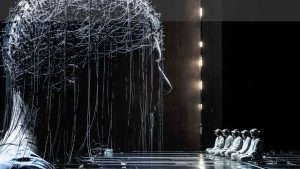
The story follows a team of astronauts aboard an international space station orbiting a mysterious exoplanet known as the hyperobject—a sentient planetary intelligence capable of perceiving and responding to human thought. During the crew’s scientific mission, the planet evokes visions, memories, and unconscious fears, forcing the astronauts to confront the possibility that the intelligence they are studying may understand them more deeply than they understand themselves.
Inspired by classical science fiction, environmental philosophy, and contemporary debates surrounding AI, the production explored the relationship between three forms of intelligence: human intelligence, artificial intelligence, and planetary intelligence.
“The production is really a metaphor for where we find ourselves as a society,” Sack said. “We’re interacting with two enormous systems – artificial intelligence and global climate change – that often operate in ways that feel alien to us. They challenge our traditional frameworks for understanding the world. The question becomes: what happens to our humanity when we’re confronted by forces that seem larger and stranger than ourselves?”
What made the production truly unique was that audience members and performers –David Skeist, Catherine Gowl, T Ryder Smith, and Jess Barbagallo – were not merely watching the story unfold.
They were actively shaping it with their minds.
Theater Powered by Brainwaves
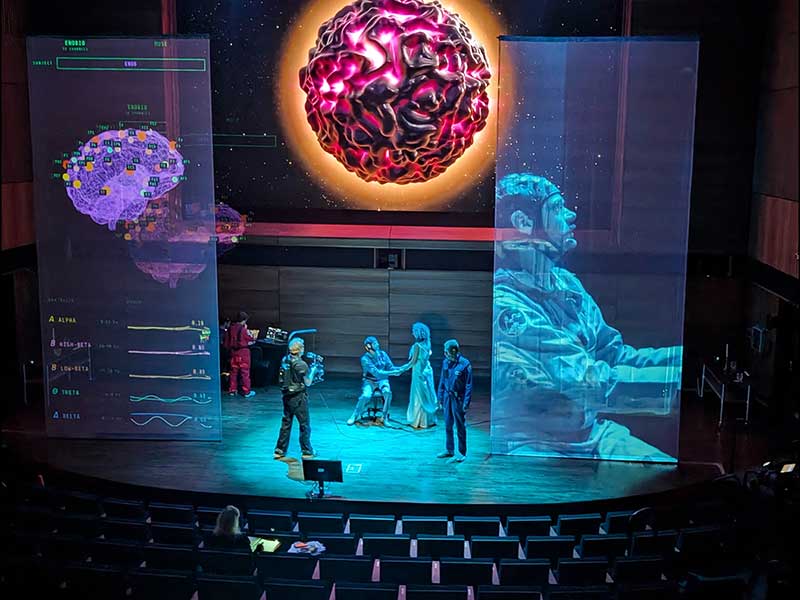
Seven participants wore electroencephalogram headsets during the performance. Lead actor Skeist was equipped with a research-grade headset containing 32 electrodes. Additionally, lighter EEG headsets containing four electrodes were worn by six audience members, selected from a pool of volunteers. Together, their brain activity became a creative input that continuously transformed the theatrical environment in real time.
The production focused primarily on alpha waves, brain signals associated with attention, concentration, imagination, meditation, hallucination, and certain forms of internal reflection.
Those signals influenced several major elements of the show.
First, they controlled a massive digital representation of the planet projected behind the performers. The virtual world continuously shifted in response to the neural activity, changing its color, brightness, movement, and visual characteristics throughout the performance.
Second, the audience’s brainwaves shaped the musical score.
Composer and sonification artist Matt McCorkle created 20 original pieces of music for the production. Each composition contained six instrumental layers or “stems” that responded dynamically to the EEG data being generated inside the theater by the six audience members wearing headsets.
“If an instrument suddenly became louder or changed pitch, that’s because it was responding to someone’s live brain activity,” Sack explained. “The audience was literally participating in the composition of the score.”
Perhaps most remarkably, brainwave data also influenced dialogue.
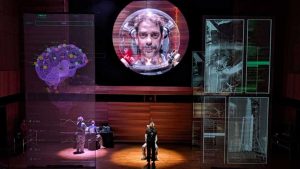
Skeist’s neural activity was translated into parameters that informed an AI language model responsible for generating the dialogue of another character, Eva, who was a manifestation of the protagonist’s deceased wife as interpreted by the sentient planet.
As Eva, actress Catherine Gowl rehearsed the dramatic arc of each scene, but she never knew exactly what lines would appear on her teleprompter.
Every response was generated instantaneously based on a snapshot of her scene partner’s brainwave activity.
“There was a script and a dramatic structure,” said Sack. “But the specific language was different every time. It became a form of improvisation between the actor, the AI system, and the audience.”
The result was a performance that could never be replicated exactly. Each presentation became a unique encounter shaped by the collective cognitive activity of everyone in the room.
A Johns Hopkins Collaboration
The production, that included the contributions of producer Quentin Little and production and video designer Simon Harding, emerged from a Nexus Research Award received two years ago, one of only four projects selected from nearly 200 applications.
That support empowered an ambitious interdisciplinary Nexus research team to proceed, including faculty and researchers from the graduate film and media program (Sack and program director Sig Libowitz), the School of Medicine (Nathan Crone, MD), the Whiting School of Engineering (Griffin Milsap), the Berman Institute of Bioethics (Debra Mathews), the Dracopoulos-Bloomberg iDeas Lab (Lauren Arora Hutchinson), the Center for Digital Humanities (Tom Lippincott), the International Arts + Mind Lab (Susan Magsamen), and the Center for Advanced Media Studies (Bernadette Wegenstein).
Ultimately, more than 50 people helped advance this project, including special contributions from Mathews, who is current President of the International Neuroethics Society; Arora Hutchinson, who leads Berman’s bioethics and storytelling initiative; Crone, a Johns Hopkins neurologist and epilepsy specialist; and Milsap, whose work includes brain-computer interface research and neural implants.
For Sack, these collaborations demonstrated one of the most exciting aspects of working at Johns Hopkins.
“Many of these researchers don’t often get opportunities to participate in artistic projects,” he said.
“Creative work creates a different kind of conversation. It becomes open-ended and exploratory. People can come together from very different disciplines and begin asking questions they might never ask within their own fields.”
The project also served as a hands-on learning opportunity for students.
In fall 2025, Sack taught a graduate course titled Production for Creative Technology: AI, Neuroscience, and Performance. Students explored many of the technologies and storytelling methodologies that eventually informed hyper_object, including interactive media systems, AI-driven performance tools, and real-time visualization platforms.
Several students later contributed directly to the production, including graduate film and media program alumni Lee Whitman ’25, who programmed the live visual effects, and Conor James ‘26, who served as a live camera operator during the performance and programmed the EEG-driven AI teleprompter system.
“It was important that students weren’t just learning about these technologies theoretically,” Sack said. “They were working inside a live production environment and helping build something that had never been done before.”
Exploring the Future of Storytelling
Although hyper_object showcased sophisticated technologies, Sack views the project less as a demonstration of technical innovation and more as an experiment in how technology might reshape human experience and storytelling.
As artificial intelligence becomes more embedded in everyday life and audiences increasingly expect participation rather than passive observation, he believes storytellers will need to rethink the relationship between creators, performers, and audiences.
“What does it mean when technology can respond to signals that we ourselves may not fully understand?” he asked. “How does that change the relationship between performer and audience? Between mind and machine? Between individual experience and collective experience?”
Audience members appeared eager to explore those questions.
Following the performance, attendees participated in an extended talkback about both the artistic and technical dimensions of the work. Many were fascinated by how actors learned to perform alongside systems that introduced genuine unpredictability into the production.
The conversations reinforced Sack’s belief that audiences are hungry for thoughtful engagement with emerging technologies.
“A lot of people told us they had never seen theater presented like this before,” he said.
The team is currently analyzing audience feedback and survey data as part of ongoing research efforts that may contribute to future academic publications.
Looking Ahead
For Sack, hyper_object represents one milestone in a broader body of work exploring the intersection of neuroscience, media, and storytelling.
Over the past three years, with support from the Dracopoulos-Bloomberg iDeas Lab at the Berman Institute of Bioethics, he and his collaborators have developed multiple projects investigating how brain-computer interfaces can influence narrative experiences, including an experimental film, NeuroPlastic, examining neural implants and an interactive museum installation, and NeuroCinema, that allows visitors to alter the editing and musical score of a movie using their brainwaves.
Together, those projects form part of an emerging field of “neuraesthetics” that Sack and colleagues like Magsamen believe will play an increasingly important role in the future of media and performance.
His hope is that hyper_object is only the beginning.
The project recently received a Johns Hopkins Sesquicentennial Arts Award, creating opportunities for future performances as part of the university’s 150th anniversary celebration. Sack also hopes to bring the production to theaters, universities, and cultural institutions across the United States and internationally.
“I’ve been dreaming about doing this show for years,” he said. “What excites me most is that it demonstrates what can happen when artists, scientists, engineers, and scholars work together toward a common creative vision.”
In many ways, hyper_object serves as a case study for the kind of interdisciplinary innovation Johns Hopkins seeks to foster.
It is simultaneously a theatrical performance, a technological experiment, a research project, and a philosophical inquiry into what it means to be human in an age increasingly shaped by artificial intelligence and advanced computing.
For Sack, that convergence is precisely the point.
“The technology is fascinating,” he said. “But ultimately we’re using it to ask very old human questions – questions about memory, identity, connection, loss, and understanding. The goal isn’t simply to build new tools. It’s to create new ways of understanding ourselves.”
Interested in pursuing a graduate degree at Johns Hopkins University?
Request information to learn more or apply here.