Marly Hernández Cortés: Shaping Stories and Storytellers
Published December 23, 2025 | Request Information
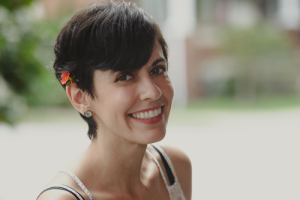 A future biopic chronicling the life of filmmaker Marly Hernández Cortés might open with a wide shot of the secluded Peña Blanca beach, also known as “Wishing Well Beach,” in Aquadilla, Puerto Rico. Pan over to a small child as she keeps one foot on the dazzling, white sand and dips the other into the clear, turquoise water. The wish that she casts into the ocean that day, all those years ago, is destined to come true.
“My passion for film has always existed. I fell in love with film at a very early age, even though I grew up in a small city that, at the time, didn’t have a film industry. I always knew I would be in film because I set that goal, and I wasn’t going to stop until it happened,” Hernández Cortés said.
Years later, Hernández Cortés’ credits include a BS in marketing from the University of Puerto Rico, and a pair of master’s degrees from New York University, one in the business of film from the Gallatin School and an MFA in film producing and directing from the Tisch School of the Arts. She has spent the last three years as the Assistant Program Director in Johns Hopkins’ MA in Film and Media program, a program that recently earned a No. 20 ranking in the U.S. on the annual list of the Top 50 film schools from TheWrap, a leading Hollywood publication.
Hernández Cortés, a narrative film director, producer, screenwriter, editor, and actor, received a Panavision Production Grant for her first feature film, “stealing cars,” that she co-directed and co-produced alongside her husband, Stephen Schuyler, who is also part of the JHU Film and Media faculty. In 2020 and 2021, she became a Saul Zaentz Innovation Film Fellow and Production Grant recipient at Johns Hopkins. In 2021, she received a Mayor’s Individual Artist Award from the Creative Baltimore Fund on behalf of the Mayor and the City of Baltimore. She also is the recipient of a British Academy of Film and Television Arts scholarship, National Hispanic Foundation for the Arts grant/scholarship, and Alfred P. Sloan Foundation grant. Her thesis film “Mala” was made with the support of a Panavision Production Grant and received an award grant from the Hollywood Foreign Press Association, having its world premiere at the Austin Film Festival.
“I moved to New York not knowing anyone,” Hernández Cortés said. “I felt very compelled to try something new, at that time acting, which was admittedly scary. I went to a couple of acting conservatories, but as I kept meeting film people, I realized that being on a set was the only place I wanted to be. I fell in love with directing, because I love actors, and I love the intersection of filmmaking and collaborating with actors. Moving to Baltimore and venturing into teaching has been the best experience. I became a better filmmaker when I became a better teacher because you are constantly keeping up with industry trends and innovations and are in a place to better challenge your own students. This is how I came to these two worlds. I love that I get to do both of them together. It is a lot of fun, and it never gets old.”
Since arriving at Hopkins, Hernández Cortés has been working to elevate the student experience, integrating a lot of pedagogy, skills, and tangible takeaways. In tandem with Program Director Sig Libowitz, she introduces state-of-the-art technology, attracts accomplished faculty, and builds out experiential learning opportunities. The program, which attracts a diverse student population, also puts a lot of focus on the business side of the industry, how to pitch a story, how to schedule and budget a film, and how to seek out creative funding sources.
“We have worked hard at Hopkins to give students opportunities to take what they are learning in the classroom and elevate it through real-world experiences,” she said. “They are developing under a ‘strong team’ of faculty who have vast industry experience, who love teaching and mentorship, and who care about our students and their success. Our students are working with real clients, in film-set roles, and taking master classes with directors and producers through film festivals partnerships that we have developed. We are equipping our students with a lot of production-heavy skills and having them apply them to other areas in the University – whether it is on documentaries, immersive and augmented reality experiences, or other projects with the history, neuroscience, medicine, or planetary health departments – in a safe environment where they can learn and perfect those skills. In our program, collaboration is a huge element, and I love that it is, because no one succeeds on their own. In cinema, you have to be part of a team. My goal with all of my students is to be able to say to them, ‘I want to be your peer when you graduate.’ I look forward to having my students excel and surpass me, because it means that I did a really good job as a teacher.”
Hernández Cortés, in fact, incorporated the talents of seven of her former students into the creation of “stealing cars” and also worked in her Puerto Rican roots and culture through the film’s main character.
“It was so personally gratifying to see my former students in action,” she said. “That was the best experience to be able to be in a crowd with the people who made the film and in the City of Baltimore that helped me make it. It was the most surreal film experience that I have had, and I am looking forward to the next experience. That’s why I am a filmmaker. Because I love community and just want to keep creating community.”
Hernández Cortés, whose cinematic tastes include a love of everything from horror films to “My Cousin Vinny” to “Moonlight” and “Jurassic Park,” has a few personal projects on the horizon and the dream of filming at least one of them in Puerto Rico.
“As I tell my students, film making is about storytelling,” she said. “Every person has a story. You carry a story with you every single day. I am here to amplify their voices and to show them what can happen if they open up their creative boxes and have stamina and passion to provide the fuel to the engines of their own trains.
“Film is about humanizing people, making connections, building relationships,” she continued. “You have a voice, and your voice matters. You just have to create. Don’t wait for someone to say yes, just do it. I think we make films because we need to tell stories. Every moment is an opportunity to follow a dream and move your art forward, even if it is just a little bit.”