David Buyze: Swimming Through A Liberal Arts Life
Published July 8, 2026 | Request Information
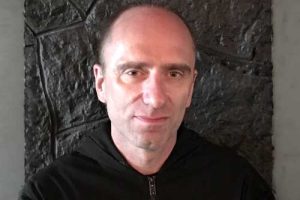 Long before David Buyze became a scholar of conflict, culture, and ethics, he spent countless hours alone with his thoughts in a swimming pool.
As a nationally competitive youth swimmer growing up in Regina, Saskatchewan – and later a Big East Conference champion in breaststroke at Syracuse University – Buyze learned early how discipline, solitude, and repetition could sharpen reflection. Even today, he sees a connection between swimming and the thoughtful approach that defines both his scholarship and teaching.
“When I get in the pool, it’s a great way to process thoughts,” said Buyze, a lecturer in the Master of Liberal Arts program at Johns Hopkins University. “You are always in your head.”
Born in Canada to Dutch immigrant parents who had lived through the Nazi occupation during World War II, Buyze initially arrived at Syracuse on an athletic scholarship with little sense of where his academic interests might lead, but knowing he was very interested in existential questions.
He found his academic footing when he encountered courses in literature, philosophy, and religion, along with the mentorship and friendship of professor, theologian, and philosopher Charles Winquist.
“He was the one who impacted me the most, at the earliest,” Buyze said. “He was most interested in continental philosophy and psychoanalysis as critical modes of inquiry, and I loved studying with him. He really further spurred my interest in thinking differently about human existence by providing me with rigorous critical tools of expression.”
What began as intellectual curiosity evolved into a lifelong pursuit.
Buyze earned a BA degree in English and religion and an MA degree in religion from Syracuse before completing a PhD in religion at the University of Toronto. “At that time, these programs were highly interdisciplinary,” he said, “and at Toronto I worked closely with my dissertation adviser, Rosa Sarabia, in the Department of Spanish and Portuguese, and in that sense, my lens of inquiry was already liberal studies.”
His doctoral work on questions of identity, conflict, and marginalization has since spanned religion, philosophy, literature, critical theory, and postcolonial studies globally. His research examines race, religion, nationalism, colonialism, and cultural conflict across Latin America, Europe, South Asia, Africa, and the Middle East.
For Buyze, the liberal arts are not simply an academic discipline, but a way of learning how to inhabit the world more thoughtfully. Over decades of teaching, he has guided students through questions of ethics, nationalism, identity, conflict, and global engagement.
Since joining Johns Hopkins in 2021, he has designed the courses Ethics in a Diverse World and Intimacies of East-West which examine how colonialism, genocide, Orientalism, and nationalism continue to shape contemporary political and cultural tensions. He has also worked closely with students through independent studies on such topics as: Muslim Women & Identity; Art, Identity & Culture in Venice and Istanbul; Antisemitism & Jewish Identity, and Existentialism, The Stranger & Becoming.
“These courses allow students to think through different ways of experiencing the world and to develop a stronger ability to inhabit contrapuntal narratives – different ways of thinking about one issue from multiple perspectives,” he said.
His interest in conflict, memory, and human experience also extends beyond the classroom.
Recently, Buyze, who also serves as a research scholar at Manhattan University, is working on a rare collection of Holocaust drawings hidden for decades inside a satchel once belonging to Dr. William Epstein, a U.S. Army physician. Epstein treated survivors after the liberation of the Nazi concentration camp Langenstein-Zwieberge, a subcamp of Buchenwald.
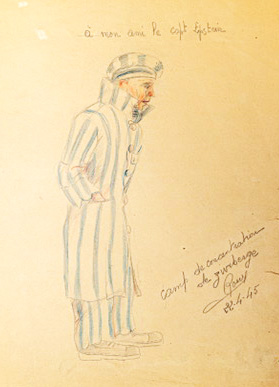 Working alongside longtime colleague Dr. Mehnaz Afridi, the Director at Manhattan University’s Holocaust, Genocide, and Interfaith Education Center, Buyze helped identify the 22 sketches as the work of Holocaust survivor and French Resistance member Marcel Roux. Created in the days immediately following liberation, the drawings depict starvation, forced labor, violence, extermination, and survival inside the camps.
“The drawings are a very unique artistic and visual testimony of the Holocaust,” Buyze said. “What makes them so extraordinary is that they were rendered in this compressed period of roughly two weeks after liberation.”
He is now collaborating on developing a digital archive and traveling exhibition centered on Roux’s work and hopes to incorporate ideas on the collection into discussions in his Ethics in a Diverse World course at JHU. The opening exhibition “Lost Stories of the Holocaust: Featuring the Work of Marcel Roux” was held on March 24, 2026, and can be viewed through August 1, 2026, at Manhattan University.
Through the Arolsen Archives and in consultation with numerous other archives and avenues of research, Buyze and Afridi traced Roux’s movement through several concentration camps and uncovered fragments of his life in the French Resistance. Many questions remain unanswered, however, including what became of Roux after the war and upon his return to France.
“There is this huge missing puzzle,” Buyze said. “We are continuing to research deeply on the life of Marcel Roux and his story.”
Buyze also maintains a deep passion for music and culture. He writes regularly for Atwood Magazine, blending philosophy, memoir, and criticism, and has taught courses on David Bowie, British music memoir, and music and style.
“I’m very passionate about the power of music in enabling people to experience the world vibrantly and think about existence in transcendent ways,” he said.
He is also beginning work on a book, in a more popular writing vein, that explores the importance and significance of friendship in human existence.
At Johns Hopkins, Buyze says one of the greatest rewards of teaching in the MLA program is the intellectual engagement of the students.
“My students are so immediately and independently engaged and are fully ready to immerse themselves in the material and the issues,” he said. “They are such a diverse group of students from around the world – different countries, professions, a variety of ages and interests – who want to be here. When you mix that together, it makes for such a unique and dynamic learning community. I find this is what sets the MLA program at Johns Hopkins apart in a special way.”
For Buyze, that spirit of inquiry traces back to long hours in the pool. Across disciplines, he continues to pursue questions that deepen understanding of ourselves, one another, and the world we share.
“I love to read, research, write, travel, and most especially to teach,” Buyze said. “In many ways, it all feels connected now – like something I was moving through long before I understood where it was leading. It has been a life – an interesting one – shaped by the liberal arts.”