Adam Chambers: Tough Questions Create Thoughtful Discourse
Published June 3, 2026 | Request Information
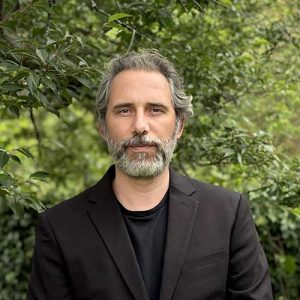 In one of his courses, Adam Chambers, a lecturer in the Johns Hopkins Master of Liberal Arts program, asks students to sit with a question most people spend their lives trying to avoid: What does it mean to live authentically?
There is no rush to answer it. In fact, that’s the point.
“To study the liberal arts, you have to slow down,” Chambers said. “You have to read closely, think carefully, and sometimes sit with ideas that don’t resolve right away.”
It’s a deliberate contrast to the world outside the classroom – a world of instant responses, compressed attention spans, and increasingly, artificial intelligence systems designed to deliver answers before a question has fully formed. Chambers has built his teaching around resisting that speed.
His courses, which he describes as “the antithesis of AI,” ask students to do something harder: to think.
That impulse traces back to an early moment of intellectual disruption. Raised in Hamilton, Ontario, along the shores of Lake Ontario between Toronto and Niagara Falls, Chambers grew up in a culturally rich household shaped by his Czech-born mother and Canadian father. That awareness of language and perspective deepened during his undergraduate years at McGill University in Montreal, where he improved his French and began exploring literature and philosophy – fields he pursued before fully knowing where they might lead.
 A single course changed everything. As a freshman, Chambers enrolled in an introductory film class that fundamentally reshaped how he understood art and academia itself. Watching Federico Fellini’s 1960 classic La Dolce Vita opened up a new intellectual world.
“It was unlike anything I had ever seen,” he recalled. “It made me want to understand film not just as entertainment, but as a serious art form.”
What began as curiosity became a way of thinking – one that resisted clean divisions between disciplines. Literature, philosophy, and film became overlapping ways of asking the same questions: about meaning, perception, history, and the shape of a human life.
Chambers followed that instinct across continents. After studying literature and philosophy as an undergraduate, he pursued graduate work that combined both fields before moving to Amsterdam to complete a PhD in comparative literature. At the University of Amsterdam, and the Amsterdam School for Cultural Analysis, his research brought together world literature, film, and philosophy, with a focus on aesthetics and the philosophy of history. Teaching at Amsterdam University College, he found he could design courses the same way he thought – across boundaries, organized less by discipline than by central questions.
“That experience gave me the freedom to build courses around what I’m most passionate about,” he says. “And I’ve found that when you teach from that place, students respond.”
 At Johns Hopkins, where he began teaching in 2024, that approach shapes courses like The Philosophy of Beauty and Existentialism, Philosophy, and Social Critique. They begin with difficult theoretical texts but quickly move beyond them. Students read novels, watch films, and test ideas against lived experience.
In his existentialism course, that means pairing the philosophical and literary works of Albert Camus and Jean-Paul Sartre – writers who treated fiction itself as a mode of philosophical inquiry. The questions don’t stay abstract for long.
“These are questions students are already asking,” Chambers says. “What is the purpose of a life? What does it mean to live truthfully? How should we relate to other people?”
The challenge is not introducing these questions, but taking them seriously.
Many of Chambers’ students are working professionals, arriving after long days in law firms, hospitals, offices, and labs. They are not there out of obligation or even immediate career advancement, but for intellectual enrichment – and because something in those questions has stayed with them.
“What I love most about this program is the diversity of the students,” Chambers said. “They come from so many different professional and academic backgrounds, and they bring those perspectives into our discussions. The level of scholarship and engagement is incredibly high. That’s what makes the program so meaningful. It is deeply rewarding to guide students who are genuinely interested in pondering these central questions of life.”
The structure of his courses reflects that commitment. In The Philosophy of Beauty, Chambers traces aesthetics back to its Greek origins – aísthēsis, perception – then pushes outward, asking what beauty has to do with truth, with ethics, and the experience of a life fully lived. In other courses, he pairs canonical texts with contemporary responses, placing Camus’ The Stranger alongside Kamel Daoud’s The Meursault Investigation, which reimagines the novel from an Algerian perspective. Films like Winter Sleep, a Turkish exploration of existential themes, further expand the conversation.
What connects these works is not medium or period but the demands they place on the reader or viewer – not just to interpret, but to respond.
Chambers returns often to that idea: that the most enduring works of literature, philosophy, and film do not simply present ideas – they ask something of us.
It is a demanding model of education, and an increasingly unusual one. In a culture on speed – scrolling, skimming, reacting – the sustained attention he asks for can feel out of place. That is precisely why it matters and why, in his estimation, the liberal arts have enduring relevance.
“They require us to think,” he said. “That kind of engagement is increasingly rare, but it’s incredibly valuable.”
 Alongside his teaching, Chambers continues to pursue his research, with current projects focused on the Chilean novelist Alejandro Zambra, and the Czech-French writer Milan Kundera, both of whom explore questions of authenticity, memory, and the purpose of literature. He also hopes to develop a course on the art of the novel, exploring how writers across history have redefined the form.
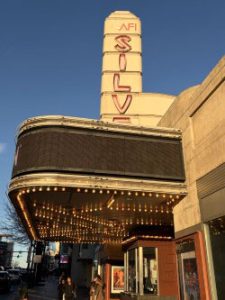
From his Adams Morgan neighborhood in Washington, D.C., Chambers practices the same habits outside the classroom he encourages in his students – seeking out films, literature, and art not as distractions, but as extensions of an ongoing conversation. The boundaries between work and life, like those between disciplines, are porous. The questions endure.
“I don’t see these subjects as separate from everyday life,” he says. “They’re different ways of asking the same fundamental questions we all face.”
In an age increasingly defined by fast, frictionless answers, Chambers is interested in something else: the conditions under which a question can still matter, and what it takes to stay with it long enough for it to change how we think.
“My courses are designed to help students navigate this world,” he said, “and think critically about how they want to live in it.”