Using Science Writing to Shape a Future in Medicine
Published October 15, 2026 | Request Information
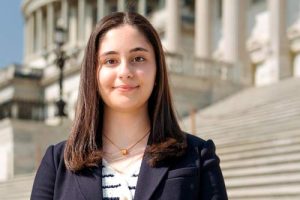 Hours before Nada Fadul was named the recipient of the 2026 David Everett Award for Outstanding Thesis in the Johns Hopkins MA in Science Writing program, she was sitting beside her father in an intensive care unit as he prepared for major heart surgery.
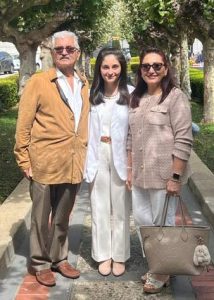
“He told me, ‘I want you to go and do your thesis reading for me’,” said Fadul, whose father is a retired family practice doctor. Jamal Fadul, MD, and his wife, Maha, immigrated from Iraq before raising three American-born daughters. “He knew how important and meaningful this program had been to me, and how much it changed me for the better. I just remember really being so emotional when my name was announced because I now had some good news for my dad.”
She returned to the hospital with word of her recognition and the science writing faculty’s validation of her outstanding thesis, deemed the most promising for publication.
“He was so, so proud, and I’ll never forget his reaction because it was such a dark and scary time for our family,” she said. “This award was so meaningful to me not just because it reflected my work in the program, but also because it helped to heal my father’s heart.”
For Fadul, the award also represented the two worlds that have shaped her: medicine and storytelling.
Her thesis, Modern Medicine: Mapping the Human, Scientific, and Systemic Forces Shaping Health Care in the United States, grew from a question that has followed her for years: How can a health care system built to help people sometimes make it difficult for them to get the care they need?
Fadul explored that question through stories about drug costs, physician shortages and burnout, caregiving, aging, dementia, and artificial intelligence in medicine. Her reporting took her from patient experiences to researchers, physicians, policymakers, and national health care organizations.
“Every story I’ve written has started with a question,” she said.
Fadul grew up in Prince George’s County, Maryland, observing her father’s interactions with patients in his family practice. She saw firsthand that being a physician meant more than diagnosing illness.
Knowing his daughters’ aspirations – her two older sisters, Naja and Nora, are fourth-year medical students at the George Washington University School of Medicine and Health Sciences – her father often reminded them, “Your job as physicians is not to moralize care. It’s to provide care.”
That lesson stayed with her as she pursued a bachelor’s degree in physiology and neurobiology at the University of Maryland. She conducted research on glioblastoma, worked in clinical settings, and began exploring medicine as a career.
But she also became increasingly interested in the questions behind patients’ experiences.
When she encountered people struggling to navigate health care, she wanted to know: “How can this be possible? Why is this happening? Why does inequitable access to care exist?”
Science writing gave her a way to investigate those questions.
At Hopkins, she learned to combine rigorous research with the human stories behind scientific and medical issues. Her sources often trusted her with deeply personal experiences, reinforcing what she sees as the responsibility of a science writer: to listen carefully, report accurately, and make sure those stories reach people who can learn from them and advocate for change.
“Science writing gave me the tools to understand people,” she said. “And I think that will make me a better physician.”
That perspective will travel with her into her next chapter.
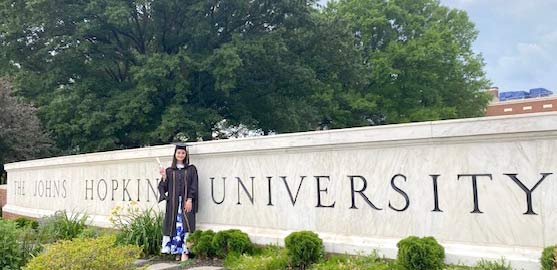
Fadul has begun medical school through the University of California, Berkeley – University of California, San Francisco Joint Medical Program, where she is pursuing an MD at UCSF along with a master’s degree in health and medical sciences at the UC Berkeley School of Public Health.
She hopes to become what she calls a “physician-writer” – someone who can move between the exam room, the research community, and the broader conversations shaping health care.
“I had eight medical school interviews,” she said, “and oftentimes the first thing they would ask me is about the work I did in the Hopkins science writing program.”
She is particularly interested in geriatric medicine and movement disorders, with a broader passion for serving older adults and helping them regain their independence, quality of life, and autonomy. Her graduate research will explore questions surrounding AI literacy and access in medically underserved communities, including how emerging tools are introduced into clinical settings and what they mean for patient trust and privacy.
“I sat down with a lot of older adults and their caregivers and learned about their stories in the science writing program,” Fadul said. “This is an extremely vulnerable population that is unfortunately very underserved. They have spent decades investing in society, and now they can’t afford the medication they need to survive. That’s not the fault of the provider. It’s the fault of our health care system. I’m very driven and passionate about improving not only their quality of life, but also using this big movement towards innovation and medicine to help them maintain their independence.”
Those conversations also reinforced a lesson that runs through Fadul’s approach to both writing and medicine: When something seems wrong, the first step is to listen closely to understand why.
“If you see something wrong, there’s always something you can do about it,” she said. “But you have to understand people’s lived experiences and then figure out, okay, what can I actually do to address those issues?”
That instinct – to question, investigate, and act – was shaped by time spent in her father’s practice, where she saw how systemic problems could surface in the exam room and how physicians could respond with compassion and creativity. Through science writing, she learned how to look beneath those individual experiences to understand the larger forces driving them.
She also learned the power – and responsibility – of giving people a voice.
“When someone opens their life and their family and shares the challenges they face, they’re trusting you,” she said. “From that, for me, comes a very big responsibility. I feel compelled to fight, on their behalf and with the tools I have, for equitable access to care.”
Fadul has already begun carrying those skills into medical school. Recently, an education supervisor at the UCSF Benioff Children’s Hospital Oakland asked her to draw on her science writing background to lead a workshop for residents on how to pitch the stories emerging from their own work. It is one way she is paying forward the mentorship and community that she gained at Johns Hopkins – and sharing the tools that helped her shape her own voice.
Medical school will teach her the technical knowledge to diagnose and treat patients. Science writing taught her to slow down, listen, investigate, and ask what lies beneath the surface. And her father taught her that understanding people – their experiences, backgrounds, challenges, and perspectives – is itself a form of care.
“Medicine,” she said, “should be uncompromisingly human.”
Attention: Students and Alumni
Are you a current AAP student or alumni and want to share your accomplishments?
Interested in pursuing a graduate degree at Johns Hopkins University?
Request information to learn more or apply here.