Physician Writes a New Chapter with JHU Graduate Program
Published April 8, 2026 | Request Information
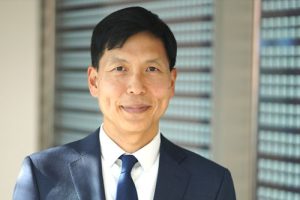 For David Wu, understanding who a patient is as a person is as significant as treating their medical ailment.
Now two decades into his medical career, that belief has brought him back to where he began – the written page. Wu is completing an MA in Writing at Johns Hopkins University – a full-circle moment for someone who first fell in love with stories long before he ever wore a white coat.
A second-generation Taiwanese American who grew up in the Midwest, Wu was drawn early to books and narrative. As an undergraduate at Yale University, he majored in English, imagining a future as a writer. But he ultimately chose a different path, attending Baylor College of Medicine, drawn by the immediacy of human connection and the opportunity to help people in real time.
“I didn’t think I had enough life experience to be an interesting writer,” he said. “Medicine gave me that experience.”
As a physician, leader, and educator, Wu has built a career defined not just by clinical expertise, but by a deep belief in narrative and an attentiveness to the stories his patients carry.
After starting out as a general internist in Seattle, Wu discovered the relatively new field of palliative care and returned to training mid-career, completing a fellowship at the University of Washington.
The shift was transformative.
“Palliative care brought me to the heart of why I became a doctor,” Wu said. “To offer presence, relief, and peace to people who are suffering.”
Focused on improving quality of life for patients at any stage of serious illness, palliative care centers on essential – and challenging – conversations about values and priorities. It sometimes asks patients and providers alike to face a difficult truth: that every life has a final chapter. Too often, Wu says, healthcare avoids these conversations, leading to interventions that may misalign with patients’ values and priorities.
“If we don’t talk about what matters most,” he said, “we risk missing the story entirely. It is a privilege to enter someone’s story through palliative care. It is an intimate, individual experience that can be both beautiful and profound.”
At Johns Hopkins, Wu turned that philosophy into innovation. As director of the Bayview Palliative Care Program for nearly eight years and a faculty member at the School of Medicine, he developed an arts-based narrative approach to a curriculum for “goals-of-care” conversations. Using a three-act framework inspired by literature, the program teaches clinicians to ask open-ended questions, listen for threads that may be tied into decision-making, and frame options in terms of patient values, as well as the medical facts at hand.
The approach created culture change by incorporating tools to sharpen attention and deepen empathy. Clinicians trained in the model often described it as “paradigm-shifting,” noting how other approaches to medical communication – which tend to be more rigid and doctor-driven – can leave patients unheard. Role-playing as both patient and provider revealed the gap, while narrative reflection also created space for clinicians to process the emotional weight of their work.
“That’s the power of the arts,” Wu said. “They help us access our hearts and souls, not just our minds. That’s too often missing in healthcare.”
In July 2025, Wu brought that philosophy to a broader stage. Leading a new statewide palliative care education initiative in Maryland, he stepped into the role of Senior Advisor for Education and Outreach with nonprofit provider Gilchrist.
The position has also allowed him to return more fully to writing. His experience in the MA in Writing program has reshaped his approach to storytelling, giving him new tools to build scenes, refine structure, and explore multiple perspectives.
“The program was a great fit because it offered both rigor and flexibility,” Wu said. “My professors – including Susan Muaddi Darraj, Steven Wright, Elise Levine, and Sam Apple – were really formative and invested in me beyond the classroom. The faculty has a sense of literary citizenship and are passionate about building a literary community. Gaining confidence and validation as a writer has been a beautiful thing.”
Influenced by writers from Marilynne Robinson to Charles Yu, Wu is now developing a novel of interconnected stories centered on a multigenerational Asian American family. The work explores identity, illness, and inheritance – an effort to weave together medicine and narrative, presence and imagination.
“I think my career trajectory has been hope coming to fruition,” Wu said. “Caring for patients and telling stories have always been part of who I am. Now I have the experience and the tools to bring them together in a new way – to express my voice and finally bring to life the novel I always knew was in me.”
Attention: Students and Alumni
Are you a current AAP student or alumni and want to share your accomplishments?
Interested in pursuing a graduate degree at Johns Hopkins University?
Request information to learn more or apply here.