From Student to Preservation Advocate
Published July 2, 2026 | Request Information
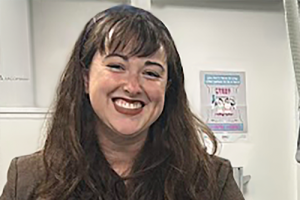 When Katharine Rubinetti first began searching for a career path that combined her interests in international relations and archaeology, she never imagined it would lead her to a centuries-old Scottish mansion connected to Bonnie Prince Charlie.
Now a Johns Hopkins University Advanced Academic Programs graduate with an MA in Cultural Heritage Management degree and a certificate in Digital Curation, Rubinetti said the program has transformed both her professional direction and confidence.
“The Cultural Heritage Management and Digital Curation program has completely changed the trajectory of my life for the better,” she said.
Rubinetti, who graduated this spring, said she discovered the cultural heritage field after participating in a professional development course on cultural heritage, crime, and security offered by the United Nations Interregional Crime and Justice Research Institute and the University of Rome.
“That was my first exposure to cultural heritage as a specialty,” she said. “I absolutely loved the course, and that is when I knew I wanted to get my master’s in cultural heritage management.”
She chose Johns Hopkins because of the online program’s flexibility, which allowed her to continue working while temporarily living in Grenada, West Indies, during her husband’s medical school studies. She also valued the program’s required in-person seminar experiences.
One of those experiences led her to Bannockburn House, a 17th-century mansion in Stirling, Scotland.
Rubinetti traveled to Scotland as part of a reality capture course in which students used terrestrial laser scanning to digitally document the historic property. She quickly became involved with the Bannockburn House Trust, later volunteering with the organization and assisting with grant funding efforts for historic preservation work.
“It felt very natural moving from a student role to a contributing role at Bannockburn House,” she said.
Her connection to the site deepened when she secured a $10,000 scholarship from the St. Andrew’s Society of Washington, D.C., allowing her to return to Scotland in 2025 for an internship focused on digitizing and archiving the trust’s artifacts.
Working alongside Douglas Pritchard, a lecturer at Johns Hopkins and an associate professor at Scotland’s Robert Gordon University, Rubinetti documented artifacts using digital photography and laser scanning. During the process, she also helped investigate a long-standing local legend tied to Prince Charles Edward Stuart, better known as Bonnie Prince Charlie, who stayed at Bannockburn House in 1746.
The trust had discovered a bullet hole in a wall near the room where Bonnie Prince Charlie reportedly slept, supporting the oral history of an assassination attempt in January 1746. The Trust suspected a bullet was also hidden inside the room’s historic headboard.
While documenting the artifacts at RGU, Rubinetti advocated for access to the university’s X-ray lab to examine them without damaging them.
“After a lot of advocating and logistics, we got a spot in the X-ray lab at the last minute and were able to scan the headboard,” she said. “When we finally got to the location of the bullet and could see it within the headboard, it was a thrilling moment.”
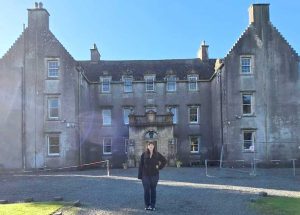
The scan revealed a lead bullet consistent with an 18th-century musket or pistol ball. The discovery later received coverage from the BBC, including mention of Johns Hopkins.
Beyond fieldwork, Rubinetti said the program pushed her far outside her comfort zone as she began building a digital archive for Bannockburn House using open-access software, a process that required new coding skills.
“I have never coded anything in my life,” she said. “Throughout the process, I lost count of how many errors I kept getting from the site. However, dealing with all of those errors is what helped me get to know the code.”
She credited faculty members, including Pritchard, Angela Labrador, and Sarah Chicone, for guiding her through the experience.
“The hands-on work I had the opportunity to do, all thanks to this program, I would not have gotten anywhere else,” Rubinetti said.
As a recent graduate, Rubinetti said she now feels confident entering the cultural heritage field, with practical experience in preservation, digitization, metadata management, and grant writing already under her belt.
“I feel confident in my ability to contribute to the management of cultural heritage resources because I have the experience to show for it,” she said.
Attention: Students and Alumni
Are you a current AAP student or alumni and want to share your accomplishments?
Interested in pursuing a graduate degree at Johns Hopkins University?
Request information to learn more or apply here.