A Science Writer is Born Through Training and Networking
Published October 21, 2025 | Request Information
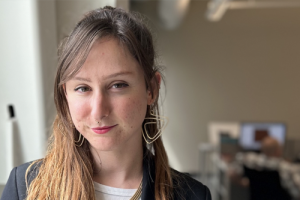 With more than 300 bylines under her belt, Hanna Webster finally and proudly feels like a science writer. Still, she identifies as so much more. “Multihyphenate” might be the better descriptor for Webster, as she is a 2022 graduate of the Johns Hopkins University MA in Science Writing program, as well as a journalist-photographer-poet-essayist-artist who thrives in all of these pursuits.
Since assuming her full-time role as a health reporter at the Pittsburgh Post-Gazette shortly after collecting her master’s degree, Webster’s efforts in journalism have garnered accolades and awards. Her work covering the opioid crisis, the Supreme Court Dobbs decision ending the federal right to an abortion, and a Pittsburgh teenager’s advocacy for brain cancer awareness earned Webster the 2024 Lenfest Institute’s Emerging Journalist Award, as part of the Pennsylvania NewsMedia Association’s Keystone Media Awards. She was also honored for her excellence in reporting on diversity, equity, and inclusion with a 2025 second-place distinction from the same organization for her work covering gender care restrictions and the rights of transgender people.
Webster’s interest in science writing is no surprise. A lifelong fascination of science documentaries and a consumption of National Geographic and Scientific American articles as a child growing up outside of San Diego, CA, fueled her undergraduate studies. At Western Washington University in Bellingham, WA, on the northern edge Puget Sound and near the Canadian border, she completed her degree in neuroscience and minored in creative writing.
“I just loved learning about the brain and about people and why they do the things they do,” Webster said. “I worked in cognitive psychology research and then in a neuroscience lab studying cannabis.” She worked there under mentor Josh Kaplan, himself a science writer, who encouraged her to co-author several articles and consider the field. While working in a Bellingham-based lab following graduation and throughout the pandemic, Webster continued freelance science writing, eventually deciding to apply to the JHU program.
“I got my acceptance letter and cried and went outside and ran a couple of laps. I was so excited,” she said. “Hopkins gave me everything I have, including my job which I secured through Hopkins networking.
“There is such a sense of nurturing about the program,” she continued. “The professors know that you are starting out, and they let you experiment with different kinds of science writing. They let you try a lot of different things, and the curriculum reflects that versatility. From the ‘Nature of Nature’ class to the ‘Funny Side of Science’ class, to the multimedia course, you can really dive into what you think you are passionate about. Professor Marianne Amoss really taught me a lot about storytelling and how to tell science in a way that elevates human stories. I loved Nancy Lord’s course on personal science essays. I learned a lot about journalism ethics and about writing and reporting science. I knew I had found the right path.”
After submitting a few science articles to the Post-Gazette as a freelancer, Webster was hired on full-time.
“My parents and I packed everything I owned into a truck and drove across the country in five days,” she said. “I arrived in Pittsburgh on Friday, July 29, went to IKEA and bought a bunch of furniture, and started my job on Monday.”
Webster has thrived as a science writer in her new home thanks to relationships she has built with her editors and colleagues, with media professionals at local hospitals, and with innovators at the University of Pittsburgh and Carnegie Mellon University, among other area colleges and universities.
“There is world-class research happening here, and it is great to be able to break those stories,” Webster said. “Carnegie Mellon students used artificial intelligence and automation to make a spotted-lantern fly-killing robot. That was a fun story to write. There are facilities that do so much cancer research, and I also enjoy a lot of creative freedom to do more in-depth, people-centered storytelling, which I love. It has been a playground for me.”
Beyond her day job, Webster has found artistic expression outside of journalism. An avid photographer, she recently had a solo exhibition – “DON’T LOOK AT ME,” a query on the male gaze – at Pittsburgh’s Wick Monet Art Gallery. She is a published poet who earned a seat in the Orion Magazine poetry workshop taught by T. Bambrick and has poems in multiple print- and online literary journals, including HAD, Bellingham Review, ONE ART, and Epiphany Magazine. She is dabbling in painting and continues to take creative writing and poetry courses at night.
“All of these things engage a different part of my brain,” said Webster who has developed both a stamina and a rhythm for her artistic pursuits. “Writing is creative, but it so much more grounded. Poetry, photography, and art are a way for me to process and work through what is happening in the world. Poetry is iterative, and I am mining my own psyche, whereas journalism is a different flavor. I am well aware of the huge responsibility of my job. I have to consider whether what I am writing is accurate and fair, and I can’t take shortcuts.”
What would she say to a writer who wants to follow in her footsteps?
“As a science writer, you can’t take the easy way out,” she said. “Journalists can’t take the easy way out. You must put in the work. It takes time to learn how to communicate the context of science and data to readers, to hone those skills, but then you are rewarded with a really compelling piece of journalism.
“While you want to ensure you’re being accurate,” said Webster, “you can trust in your training to craft a good story. Hopkins gave me great training, and that motivates me to put impactful writing, creativity, and art out into the world.
“It is work, but I couldn’t live without it.”
Attention: Students and Alumni
Are you a current AAP student or alumni and want to share your accomplishments?
Interested in pursuing a graduate degree at Johns Hopkins University?
Request information to learn more or apply here.