A Liberal Arts Perspective Opens Doors to Opportunity
Published September 30, 2026 | Request Information
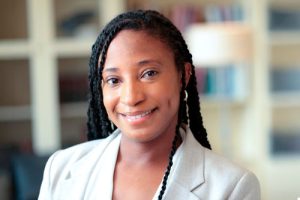 Savannah Miller has built her career around a simple but powerful idea: Sometimes the first step toward opportunity is knowing that the opportunity exists.
As Associate Director for Access in the Johns Hopkins Office of Undergraduate Admissions and a recent graduate of the JHU Master of Liberal Arts program, Miller works to connect students from communities with fewer resources to limitless opportunities in higher education. She partners with community-based organizations across the country, leads workshops, and helps students see Johns Hopkins – and themselves – as possibilities.
For Miller, access is about more than recruitment. It is about helping students recognize that they belong in places they may never have imagined themselves.
“There are very brilliant students out there that just don’t know they have access to opportunities like Hopkins,” she said. “If I can be that person that says, ‘Hey, actually, you should be looking into this,’ that’s really my goal.”
Her own path to higher education was hardly predictable.
Growing up in Washington, D.C., in an Army family, Miller initially considered becoming a music teacher. She had been singing since she was three and was a jazz vocalist in high school. Instead, she followed her parents’ advice and took a “more practical” route, studying business administration and marketing at the University of Vermont.
It was there that she discovered admissions. A friend who worked in UVM’s admissions office encouraged her to apply, and she got an internship after graduation. Within her first week, an admissions officer left the office, and Miller was offered a full-time position.
She quickly discovered that higher education gave her a chance to work with students while helping them navigate a process that had once been unfamiliar to her, too.
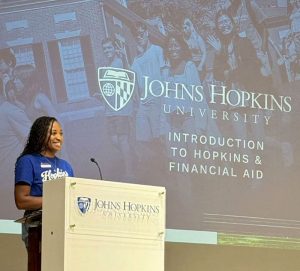
After joining Johns Hopkins in 2020 as an admissions officer, Miller began focusing increasingly on access. Her experiences recruiting students across Connecticut showed her how differently the same message about college could resonate depending on a student’s background and resources.
Miller began asking a bigger question: How could she make sure students weren’t simply hearing about opportunities at Hopkins, but actually seeing themselves in them – feeling that they belonged?
That question ultimately led her to access work – and, in 2021, to the MLA program, where she sought to broaden her perspective while continuing her career.
Coming from a structured business background, she was drawn to the MLA’s interdisciplinary flexibility. Rather than following a predetermined course of study, she could pursue questions that interested her and explore subjects far outside her professional experience.
One course in particular, Black Queer History with Tristan Cabello, challenged her assumptions and introduced her to new ways of thinking about identity, context, and intersectionality. “I learned that where people are pulling their experience from can really impact how they see the world, and how the world sees them.”
“I knew my entire four-year schedule as a first-year student,” she said of her undergraduate experience. “To be able to be part of a graduate program where I had the flexibility to just take classes that sounded interesting or could maybe provide a little bit more insight for me in the role of education – it all just kind of made sense. I gained tools for access work, sharpened critical thinking, and found confidence in research and reflection.”
The program gave Miller permission to follow her curiosity and provided a new lens through which to understand her professional work and how students might experience Hopkins differently based on their identities, backgrounds, and circumstances.
“Now when I’m thinking about the ways I interact with students, if I’m proposing new diversity initiatives or recruitment, I try to be a lot more thoughtful about how our messaging and how the way we show up in front of students may impact them,” she said.
Balancing graduate school with a demanding admissions career also taught Miller something about herself as a learner: She thrives when she can connect what she learns with how she leads.
That practical application became one of the most valuable aspects of the MLA experience.
Today, Miller collaborates primarily with community-based organizations that support students from underrepresented communities. Many supplement the work of schools where college counseling resources may be limited, providing additional advising, exposure to colleges, and connections with admissions professionals.
She has also participated three times in College Horizons, a nonprofit program serving Native American, Native Hawaiian. and Alaska Native students. The program brings students together for intensive college preparation and connects them with admissions professionals who serve as coaches and counselors.
“These students just have so many big goals and aspirations and a strong desire to help better the world around them,” Miller said. “We have a responsibility as educators to affirm those aspirations and to position these future leaders in ways that will help achieve their goals.”
That may be the most meaningful part of her work: not deciding who belongs, but helping students understand that they have the agency to decide what they want for themselves.
Miller is careful, however, not to suggest that college is the right path for everyone. She wants students to have accurate information about their options and the opportunity to reflect on what will help them build meaningful lives.
For those who choose higher education, she believes deeply in what the experience can offer – not only in career opportunities and long-term financial outcomes, but in the chance to encounter diverse people, ideas, and perspectives they might never otherwise experience.
“The MLA program transformed how I think, lead, and advocate,” she said. “I’m excited to enter my next chapter as a more intentional, empathetic, and curious changemaker.”
That curiosity is now taking her into a new academic chapter. In 2026, she began a Doctor of Education program in Educational Leadership and Administration at Drexel University.
Her emerging research interests focus on local recruitment and the complicated relationship between Johns Hopkins and Baltimore, including the ways history, identity, and community pride may influence how local students perceive the university.
It is a natural extension of the questions that have guided her career. Who gets to see themselves in those opportunities? How can institutions make opportunities more visible? And what happens when a student realizes that a door they assumed was closed might actually be open?
For Miller, curiosity is not simply a way of learning. It is a way of leading – and a way of creating change.
“I want to make an impact,” she said. “But I don’t think you can impact as many communities as possible unless you are curious to know more about them.”
She wants students to recognize their own potential, too.
“I just want students to know that they are stellar and that they can thrive at Hopkins,” she continued. “Just because you were dealt different cards and you faced certain barriers doesn’t mean that you don’t belong in this space. As a leader, I strive to identify and explore ways to dismantle these barriers on the front end and to empower other leaders at the table to do the same. Be yourself, tell your story, and put your best foot forward. Challenge yourself to find out where your own curiosities lie.”
Attention: Students and Alumni
Are you a current AAP student or alumni and want to share your accomplishments?
Interested in pursuing a graduate degree at Johns Hopkins University?
Request information to learn more or apply here.