Manifesting a Childhood Horror Film Fascination
Published August 27, 2026 | Request Information
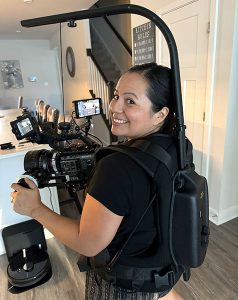 Chucky, Jason, Freddy, Candyman, and more.
These horror characters ironically inspired joy in Araceli Frias-Ohane as a child. Growing up in Yakima, Washington, she was captivated by more than these movies’ signature jumpscares; she was drawn to the eerie lighting, unsettling sound, and unforgettable final scenes.
“I really don’t know why I fell in love with horror,” Frias-Ohane admitted with a laugh. “I just have always loved it.”
Her hours engrossed in these films quietly planted the seeds for a passion she wouldn’t fully pursue until decades later when she earned her MA in Film and Media degree from Johns Hopkins University.
Today, Frias-Ohane also serves as assistant dean for diversity, equity, and inclusion for the Krieger School of Arts and Sciences at Johns Hopkins. She leads initiatives that help recruit, support, and foster belonging among graduate students and faculty.
For someone whose career has centered on educational opportunity and access, she has nurtured natural connections between her professional work and this degree – rooted in representation, empathy, and helping people see the world through someone else’s perspective. But the master’s degree also represents something deeply personal – the rediscovery of a creative dream she once believed was out of reach.
Growing up in a working-class Mexican-American family, filmmaking never seemed like a realistic career path.
“I thought I needed to pursue something where I could support myself and have financial stability,” she said. “Film was something you loved as a hobby.”
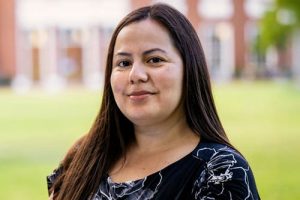 Instead, she studied psychology, earning bachelor’s and master’s degrees from Eastern Washington University before completing a PhD in education, with a specialization in cultural studies and social thought in education, from Washington State University. Along the way, she became deeply committed to helping students from historically underrepresented backgrounds succeed in higher education.
Her own experiences shaped that commitment.
As a first-generation doctoral student and McNair Scholar, Frias-Ohane experienced the importance of representation, mentorship, and community.
“Sometimes students who are underrepresented – first generation, limited income, from an unrepresented racial group, or underrepresented by gender in their field – just need someone who understands where they have come from and what they’re experiencing and who reminds them that they belong here and can be successful.”
The more she reflected on her work, the more she realized that the qualities she valued most in higher education – listening, connecting, and understanding people’s diverse, lived experiences – could also be a catalyst for her creative pursuits.
That realization prompted her to audit an introductory film production course while serving as assistant dean of diversity at the University of Utah.
“That class ignited a fire,” she said. “Every time I went, I felt complete joy.”
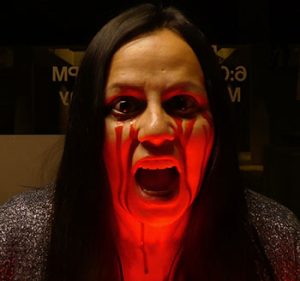 She continued taking classes in lighting and visual effects before arriving at Johns Hopkins, where conversations with colleagues led her to the graduate film program.
“It felt like it was meant to be,” she said. “I have always been so analytical most of my life. This creative side of me was just dying to come to the forefront.”
What she found in the Hopkins program was far more immersive than she expected. Rather than simply analyzing films, students learned by making them. From writing scripts and operating cameras to recording sound, editing footage, and collaborating on productions, every course emphasized hands-on experience. Although she enrolled hoping to make horror films, she quickly became fascinated by every stage of production, especially sound design.
“Horror lives and dies by sound,” she said.
One of her favorite classes was Rich Isaac’s sound course where she and her classmates were challenged to recreate every sound in a trailer for The Mummy using Foley techniques, a sound library, and ProTools, a digital audio workstation. The meticulous work perfectly suited her attention to detail.
She also spent three days working alongside Emmy Award-winning sound mixer Lorenzo Millan as a production assistant.
“How many people can say that they worked side by side with someone like that? Sig Libowitz and Marly Hernández Cortés do a wonderful job ensuring students have these phenomenal opportunities to learn and network,” she said of the graduate program’s leaders. “They bring in industry leaders for master classes and give students the opportunities to gain insights from professionals who are thriving in the field.”
For her capstone, Frias-Ohane wrote a proof-of-concept screenplay titled The Association, a horror story about a couple who moves into a brand-new housing development controlled by a homeowners association. She is refining the screenplay with plans to produce it as a short film.
Until then, she intends to continuing investing in her personal filmmaking equipment, honing her craft, and following the advice of faculty: “Don’t let fear get in your way of getting started. Just create, create, create.”
“When I started the program, I would have considered myself successful if I finished a horror short that I was really proud of – one with more camera movement, more intentional work with lighting and sound than the first one I ever did with a handheld camera in high school,” she said. “My plan is to put my horror shorts on YouTube and submit them to film festivals. If Hollywood comes knocking after seeing one, great! I would welcome a happy pivot. If not, that’s okay because when I shoot, edit, and do sound design for a horror project, I experience such creative joy. As long as I am engaged in something that I love and can easily spend hours on, what more can I ask for?”
Attention: Students and Alumni
Are you a current AAP student or alumni and want to share your accomplishments?
Interested in pursuing a graduate degree at Johns Hopkins University?
Request information to learn more or apply here.