Applications Now Open
Master's in Energy Policy and Climate (MS)
MS in Energy Policy and Climate Program Overview
With a foundation in climate science and a firm grasp on energy law and policy, you can make an impact now—and for future generations.
Start or advance your career in one of the fast-growing sectors in the world with a master of science in energy policy and climate degree from Johns Hopkins University. Learn the science behind renewable technologies and fossil fuel-based energy systems, explore the challenges climate change poses to people and the planet, and discover how strategic policy and sustainable energy can play a transformative role.
Pursue Your Degree On Your Terms
Our energy policy and climate master’s program was designed for working professionals. Take classes on campus or 100% online, and choose to attend full- or part-time. You’ll also have the flexibility to take courses that best fit your career goals; we offer multiple tracks and a variety of electives.
Immersive Field Courses
While there is no residency requirement, you may be interested in field courses. Participate in experiences that combine energy, climate, and environmental science through elective courses with destinations such as: Egypt, Costa Rica, Cuba, and Europe.
Master’s in Energy Policy and Climate Related Events
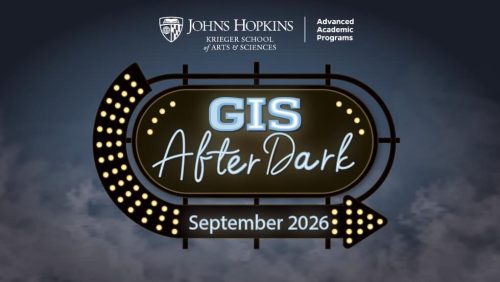
What It’s Like to Study Energy Policy and Climate at AAP

Emily Barkdoll MS in Energy Policy and Climate GraduateHaving courses with people who work for renewable energy companies, big oil companies, climate think tanks, and all types of nonprofits provides additional depth to class discussions, which I find invaluable.
Why to Pursue an MS in Energy Policy and Climate at Hopkins
Whether you study online or on-campus, our Washington, D.C. location gives you access to experts and organizations on the front lines of climate change research and policy.

Leading Experts and Climate Scientists
A renowned research university, JHU is home to top energy technology experts and climate scientists. Our faculty members are scholar-practitioners, sharing their first-hand experience in climate change and energy policy from time with federal agencies, NGOs, the private sector, and abroad.

Specialize Your Studies
Deepen your expertise within one of the five focus areas: Energy, Climate Change and Extreme Environmental Impact, Policy, Modeling and AI, and Social Perspectives in Climate and Energy. Focus your studies more on the issues surrounding climate change, or explore renewable energy technologies, or consider developing effective policy solutions for the future.

Wide Array of Electives
Enrich your studies with electives such as Solar Energy: Science, Technology, and Policy, Global Energy Policy, Adaptation to Climate Change, The Electric Grid: Technology and Policy, and Understanding Public Attitudes for the Communication of Climate and Energy Policy.

Immersive and International Experiences
Participate in field studies around the country and world. Recent trips explored climate change and energy issues in coastal Louisiana, California, China, Luxembourg, and Australia. In your capstone project, you’ll solve a real-world environmental problem.
News in Energy Policy, GIS, and the Environment





Ready to Take Action?
Join one of the fastest-growing industries in the world and use your expertise to work toward global and societal change.
Contact Us for More Information
Advanced Academic Programs Admissions
Master’s in Energy Policy and Climate FAQs
Johns Hopkins University’s MS in Energy Policy and Climate program is a 10-course, 30-credit STEM-certified professional master’s degree program – often completed within 12-24 months, though students have up to five years for degree completion. Courses are offered online, in-person at the Hopkins Bloomberg Center in Washington, D.C., or through a combination of both modalities.
The admissions criteria for the MS in Energy Policy and Climate program includes a bachelor’s degree from a regionally accredited U.S. college or university, or an equivalent international credential, with a minimum grade point average of 3.0 on a 4.0 scale. Additionally, this program requires certain prerequisite courses. The application can be completed online and requires supporting materials, including resume, transcripts, and more.
Tuition and fees for the MS in Energy Policy and Climate program currently range from $50,650 – $51,650 USD. The cost per course is $5,065. Students may be eligible to access federal loans, employer tuition assistance, military and veterans benefits, or partner-organization benefits to offset the cost of the degree. Learn more about financial aid options.
Students can select from one of five curated focus areas: Climate Change, Energy, Policy, Social Perspectives in Climate and Energy, and Modeling.
Yes. Students have the opportunity to participate in intensive 1-2 week field studies. Recent courses explored climate change and energy issues in coastal Louisiana, California, China, Luxembourg, or Australia. Students may incur additional costs associated with these experiences.