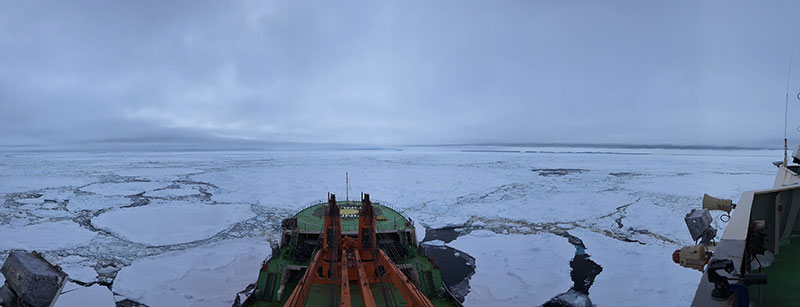
MS in Environmental Sciences and Policy lecturer Emanuele Kuhn shares the experiences of her once-in-a-lifetime research expedition in Antarctica.
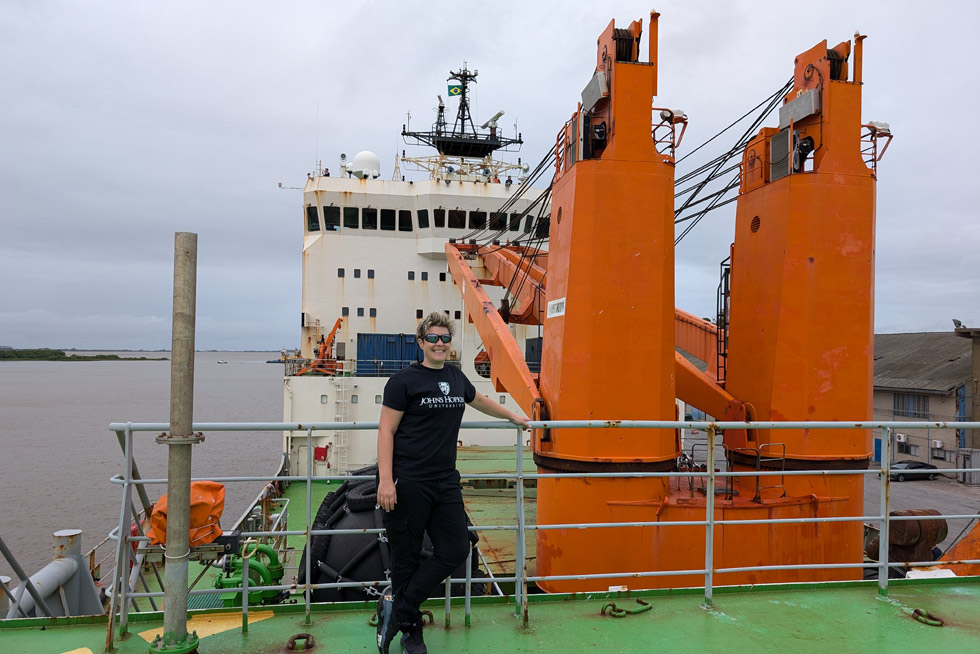
Polar Biologist and Microbiologist Emanuele Kuhn, a San Paolo, Brazil-based researcher and a lecturer in the Johns Hopkins MS in Environmental Sciences and Policy program, recently shared her personal reflections from a 70-day circumnavigation voyage around Antarctica abroad the Russian ice-breaking vessel, the Akademik Tryoshnikov. The voyage, which Kuhn joined along with 56 fellow researchers and a crew of 60 as part of a BRICS international collaboration, followed a clockwise path along the edge of the continent’s sea ice from November 23, 2024, to January 31, 2025.
 “It was an amazing and spectacular experience to be working alongside all these researchers – from Brazil, India, Russia, China, Argentina, and Chile – on such a rare expedition collecting data to analyze the connection between ocean, land, ice, and sea ice in Antarctica,” said Kuhn, a biochemistry and molecular biology PhD and Fulbright scholarship recipient who has amassed nearly two decades of academic research in the region. “All of the research we are going to be doing going forward will be related to the changes we are seeing in the environment, not just temperature, but also pollution related to the area, microplastics, and different organic pollutions from atmospheric systems. It takes an international effort, and lots of resources, to convene a group like this. It was a once-in-a-lifetime experience for me. Period. I don’t know if it will ever happen again, or if I will have an opportunity as extraordinary as this in my lifetime.”
As Kuhn explained, studies in the region, where the Antarctic Ice Sheet reaches the coast, are fundamental to understanding the linkages between Antarctica and the global climate system. The research will be used to fill critical knowledge gaps to predict the future of the Antarctic Ice Sheet. Tasked with collecting samples from the water and air to gauge the degree of glacial melting and other adverse changes to the continent, some researchers also made visits to three Russian field stations (Novolazarevskaya, Progress, and Mirnyy) as well as to Indian (Maitri) and Chinese (Zhong Shan) stations. Teams of researchers were also transported from the ship via helicopter at various points to conduct research both on permafrost land and on glaciers.
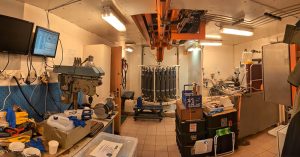 As part of her research on microbes and the ultra-small microbial cell assemblages which are essential to a modular level of life in the ocean and on the planet, Kuhn conducted water research in the Southern Ocean from the boat. On three occasions, she ventured off the vessel for land research in temperatures dipping below -10 Celsius. Equipped with food, tents, and radios for communication, her team of six were prepared to set up camp on site should adverse weather conditions or wind prevent the helicopters from retrieving them from their scheduled six-hour field study and transporting them back to the ship as planned.
“Studying microorganisms is very important, especially in our ocean waters because of the cycling of nutrients in the ocean and the raptly changes in the environment,” she said of the great lengths that researchers go to continue these studies. “My team is working to better understand the diversity and community of these microbes and how this community is functioning in the Southern Ocean. We are trying some culturing to bring these microbes to life in the lab and playing around with the nutrients and conditions that we give these cells so they can grow. Our research will show the dynamics of what is happening with the base of the food chain in the Southern Ocean. It is where everything starts. It is important to connect this data with the information on physical and tenacle parameters – temperature, salinity, carbon dioxide intakes, ocean acidification – to understand the changes that are taking place. When physical chemistry and attributes of the ocean and the environment change, this affects the very base of life. As soon as you affect the base of life, you affect the cascades that come later on. The pattern of changes in this area is literally transforming the rest of the planet and vice versa because everything that happens in the atmosphere is also related to the ocean. Everything is connected, and I am studying just one piece of the puzzle.”
Her team has launched the painstaking process of sequencing the seawater and sediment samples and is now focused on culturing and isolating the microbial cells. Once the processing and analysis is complete, Kuhn will be sharing not only the results of her research but also some incredible life experiences with her Johns Hopkins students. She also will continue her work to craft a field study course that will eventually allow the students to experience the place where she “feels most at home” firsthand.
“My life’s goal is to launch that course so our students can experience Antarctica and the Arctic, a place that I have been also visiting with more frequency,” Kuhn said. “I want out students to experience 24 hours of sunlight, where the sun just moves up and down in the sky but never really dips below the horizon. I want them to see, as I did on this trip, a colony of emperor penguins whose chicks would soon be making their first dive into the ocean, or the southern-most mammal on the planet, the Weddell seal, or the Ross seal, the ‘Antarctica unicorn’ that is rarely seen. I would love to bring students to study polar bears, which I have also developed a love for, in the Arctic. As I tell my students, and the guests that I take on my expedition voyages, you have to feel the environment to become part of it, to understand our responsibility in preserving it as our home. Your day-to-day actions matter, and you are not just responsible for your own backyard. You are responsible for the entire planet. Someone said to me recently, ‘Ema, you are becoming obsessed with these polar regions.’ Yes, that’s the word! I want to be obsessed. I want my students and anyone I can reach to be obsessed with Antarctica and the Arctic.”