Mark Washington: Seeing the Bigger Picture Through GIS
Published September 28, 2026 | Request Information
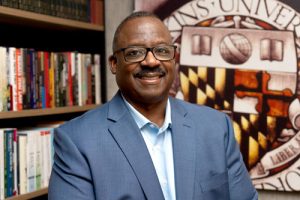 The first computer Mark Washington ever took apart at age 15 – and successfully reconstructed – wasn’t just a computer.
It was a lesson that would shape his life’s work.
Growing up in West Philadelphia, Washington was still in high school when he took a job in the mail room at the University of Pennsylvania. There, he met a faculty member, Dr. Ellen Fuller, who took the time to show him the inner workings of a computer and explain how the technology worked.
“I fell in love with technology right then and there,” Washington said.
More than 30 years later, that curiosity has taken Washington from IT support and database development to enterprise technology, cybersecurity, and geographic information systems. Along the way, he earned degrees from Penn’s Wharton School and Rutgers University, as well as a DSc in information technology with a specialization in cybersecurity from Marymount University. He has built technology systems for universities, managed teams and infrastructure, and become an educator dedicated to helping the next generation of technology professionals solve real-world problems.
Today, Washington serves as director of information technology for the Johns Hopkins Bloomberg Center in Washington, D.C., what he describes as “one of the crown jewel buildings” of the Hopkins portfolio. There, he leads the IT and audiovisual operations supporting the technologically sophisticated facility. His team of 10 keeps the building’s Ethernet and Wi-Fi networks, audiovisual systems, and security cameras working optimally across the 10-story, state-of-the-art facility, which includes 35 classrooms, a theater, and multiple event spaces.
“I have a great team that buys into my philosophy that preparation is always the key to success,” Washington said. “Their expertise is very evident to everyone who comes here, and our goal is to exceed all expectations.”
He also brings his decades of experience – including more than five years of previous college teaching experience in information technology – into the classroom as a lecturer in the Johns Hopkins MS in Geographic Information Systems program, where he designed and has taught GIS for Infrastructure Management since 2019.
For Washington, GIS is about far more than creating maps.
“GIS is not just about the map,” he said. “It’s about gathering information that informs other decisions.”
He discovered that power while working in facilities information technology at Princeton University. When he arrived in 2006, the university did not have a GIS system, so Washington architected one, integrating geographic information with the systems used to manage campus buildings, land parcels, utilities, and other assets.
The map became the foundation connecting everything else.
Maintenance workers could now use mobile devices to locate work orders, find where they needed to go, and update their progress in the field. University leaders could see where infrastructure was located and use that information to make more informed decisions about operations and planning.
When Washington joined Johns Hopkins Facilities and Real Estate department in 2016, he brought that same vision with him. He helped develop the university’s enterprise GIS, connecting information about buildings, land parcels, utilities and maintenance with a growing universe of geographic data. The system has since expanded to include information such as green roofs, solar panels, bike racks, transportation routes, tree canopies, and other campus features.
He also helped launch a drone program that uses aerial imagery and sensors to capture information about building conditions, construction progress, heat loss, and other infrastructure needs.
Washington’s valuable real-world experience made him a natural fit for the classroom.
His goal is to move students beyond simply learning the technology and toward understanding how it can help solve problems. Through hands-on projects, students explore how GIS can inform decisions involving facilities management, real estate, architecture and construction, sustainability, utilities, and strategic planning.
Many of his students are already working as GIS practitioners, giving Washington the opportunity to build on their professional experience while challenging them to think differently about the information they collect – and the decisions that information can inform.
That commitment earned Washington the 2026 Excellence in Teaching Award – a recognition he said was particularly meaningful because teaching represents a way to give back.
He knows firsthand how much a mentor can influence a career. After serving four years in the Marine Corps following high school, Washington enrolled at Penn, where he worked multiple jobs while studying part time and eventually managed IT operations at the Wharton School. Along the way, he encountered people who recognized his potential and helped set him on his path.
“The Marine Corps allowed me to grow up and gain discipline, and when I returned to Penn, I was surrounded by these really great, smart people who saw something in me and supported me.”
Now, he hopes to do the same for his students.
“I really want my students to be able to tap into their own creative thinking using these advanced tools,” he said. “I love teaching, and I think I will always teach.”
Whether it is urban planning, sustainability, emergency management, or autonomous vehicles, Washington believes geographic data can help decision-makers see connections that might otherwise remain hidden.
After all, he said, the real power of a map isn’t what you see on its surface. It is the information underneath it – and what that information makes possible.
“I can be a map junkie,” Washington laughed. “But the maps that really excite me are the ones that are filled with data. GIS is the glue that ties everything together. I hope to continue expanding my role as an educator as GIS increasingly intersects with artificial intelligence, cybersecurity, data analytics, enterprise technology, and other emerging technologies.
“We are living in wonderful times when we have access to all this information,” he continued. “I really want to give my students a foundation, a thought path, and the confidence to get from where they are now to solving larger problems that have real impact.”