Lama Elhatow: Listening to and Fighting for the Planet
Published January 20, 2026 | Request Information
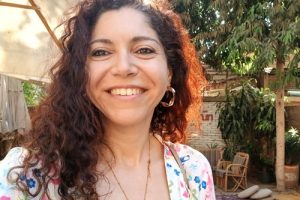 Lama Elhatow’s recent recognition as one of the Top 100 Middle East “Energy Addition” Sustainability Voices for 2026 not only “surprised, honored, and left her humbled,” she stated, but reminded her of her incredible professional journey that began in the region. The honor is designed to reflect “trusted expertise, real-world impact, and cross-sector credibility,” and celebrates peer-nominated policymakers, innovators and industry leaders. Their collective work ensures the Middle East can supply abundant energy to meet rising global demand while advancing decarbonization.
Now a program coordinator and lecturer in both the MS in Energy Policy and Climate and the MS in Environmental Sciences and Policy programs at Johns Hopkins University, Elhatow traces the trajectory of her career back to a single professor she encountered as an undergraduate studying construction engineering at the American University in Cairo.
“Dr. Moshira Hassan opened my eyes to climate change and sustainability, and I was hooked from the get-go, particularly in terms of marine biology and ecology,” said Elhatow, who was born and raised in Kuwait and relocated to Egypt following the Gulf War. “Then I took a series of elective courses from her, outside of my discipline, and I determined that this was where I wanted to go. It was one inspiring professor who shifted everything for me.”
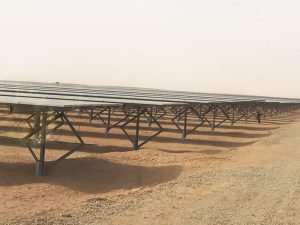
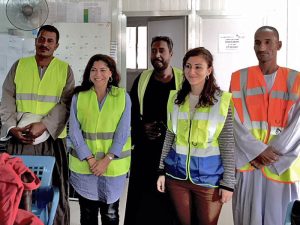
After earning her bachelor’s degree, Elhatow pursued a master’s degree in environmental engineering and later completed a PhD in climate and sustainability at Erasmus University Rotterdam. She went on to spend 15 years with the World Bank Group as an environmental and social specialist, navigating complex infrastructure and renewable energy projects across the globe. Her portfolio included hydropower development in Pakistan; wind and solar projects in Jordan, Mozambique, and Nigeria; and work at Benban in Aswan, Egypt -home to the world’s largest solar park. Her experience with green hydrogen took her to Chile and Barbados.
“I was very privileged to have been able to travel and work with multi-ethnicities and cultures around the world,” said Elhatow, who is fluent in English and Arabic. “You begin to see both commonalities and differences in environmental challenges worldwide. These lands are beautiful, but they also carry deep and sometime traumatic stories. That is why listening – truly listening – is so important.”
Beginning in 2009, Elhatow deepened her global engagement through the UN Climate Change Conference of the Parties, attending more than 15 COP conferences and working with climate negotiators across the Arab world. These meetings, she said, allowed her to collaborate with government representatives, academics, financiers, members of NGOs, and influential decision makers from the private sector and Indigenous communities.
“Participating in the COP meetings has provided great networking opportunities and a chance to connect on a grass-roots level with others on the ground who you would otherwise never have an opportunity to meet,” she said.
In 2020, Elhatow made the move to the United States to pursue a lifelong dream of teaching. Since joining Johns Hopkins in 2022, she strives to create the same transformative learning environment that once inspired her. She credits the support of program leadership and colleagues for helping her thrive.
“I have always believed that impacting a student, the way Dr. Hassan impacted me all those years ago, would be such a rewarding, beautiful, and noble thing to do,” she said. “I feel so blessed to be at an institution like Johns Hopkins and, as a Muslim Arab woman in academia where I am a minority, to have the support of incredible program directors in Dan Zachary and Cassie Hansen. They have always uplifted and believed in me in a way that I have never previously experienced in my career, allowing me to grow, like great leaders do, into my true potential. I couldn’t be more grateful to collaborate with my colleagues David Guggenheim and Rachel Issacs. We make a great team.
“The students at Hopkins are very bright, truly some of the smartest people I have ever seen in the world,” she continued. “My pedagogical philosophy is designed to make sure that my lectures are not one-way, but that there is an interactive space for peer-to-peer learning. As someone who was not born and raised in the United States, I have learned so much about climate action domestically from my students and colleagues in both programs through their collective experiences with the Environmental Protection Agency, in other government institutions, and in the private sector. This cross pollination is invaluable for all of us because it allows us to see and hear different perspectives and voices. It sparks crucial dialogues and broadens our understanding. Hopkins is a great place to feel settled in and belong.”
In Fall 2026, Elhatow will be bringing Hopkins students on a newly designed field course to Egypt. The 10-day experience will follow the “beautiful and spiritual” Nile River – from the agricultural Northern Delta south to Aswan – offering students a firsthand look at climate change impacts on agriculture, coastal zone management, and greenhouse gas mitigation in a developing country context.
Bringing Johns Hopkins to Egypt represents a full-circle moment for Elhatow, who describes herself as a “global citizen.”
“I am so excited to offer this opportunity to our students,” she said. “I have found a balance between the important and impactful work that I am doing in the United States and my continuing efforts to give back to the Middle East. Sustainability is not work we can do alone. It requires collective vision and collaboration to prepare the next generation of environmentalist specialists. This work can be very disappointing, disheartening, and even a little depressing and when that happens, we need to take time to rest and rejuvenate, reassess and recalibrate, and then come back with a refreshed light.
“I am so passionate about the ecosystem and this beautiful planet that we have been blessed to receive,” she added. “Listening – to people, to communities, and to the planet itself – is essential. Only then can we work collectively to bring stakeholders together, increase climate ambition, and create meaningful, lasting change. I have learned to be a listener to anyone and anything, and I hope to impart that to my students.”