Kathryn Schubel: Loving Mother Earth, One Grain of Sand at a Time
Published October 14, 2025 | Request Information
 Misunderstandings frequently arise from sedimentary geologist Kathryn Schubel’s decades-long obsession with rocks, mud, and sand, but this confusion is what fuels her ongoing interest to increase appreciation, education, conservation of the natural world, both marine and terrestrial.
Schubel, a popular, passionate, and veteran instructor in the Johns Hopkins University MS in Environmental Sciences and Policy program, first fell in love with geology when she met a literal rock star in Dr. Bruce Simonson, a Johns Hopkins graduate, during her physical geology class while a freshman at Oberlin College.
“I went into college with the intention of becoming some sort of engineer, and then I met Bruce Simonson and decided I wanted to be him,” Schubel recalled. “He was laid back, but very demanding. He showed us slides from his work all over the world, and that was it. I was full-on into it, and history was written. The idea of looking at modern environments and applying your findings to ancient rocks was really fascinating to me. It is amazing that you can look at the way things work now, and you can interpret things that happened hundreds of millions or billions of years ago. How cool is that?
“I was Bruce’s field assistant in Western Australia the summer of my junior year and for a few years after that,” she continued. “We studied ancient (2.6 billion-year-old) carbonate rocks all day and slept under the stars in the Outback at night.”
After completing her MA in Geological Studies program at Binghamton University, Schubel enrolled at Johns Hopkins to pursue a master’s and PhD from the Department of Earth and Planetary Sciences, the same program from which her oceanographer father Jerry Schubel had earned his PhD 28 years prior. Her master’s studies took her to Western China to study deposition in salt lakes on the Tibetan Plateau, and her PhD studies took her to Western Maryland, Northern Italy, and Sweden.

Science has also taken her to other interesting places across the globe. This spring semester, Schubel will be making her sixteenth trip to Andros Island, the sparsely populated and largest of the Bahamian Islands situated 125 miles southeast of Florida, where she directs a field course for current JHU master’s students based out of the Forfar Field Station. Students explore the world’s highest concentration of blue holes, water-filled cave systems, both on land and in the sea, and access cays and reefs in the Atlantic, just mere feet from their cabins. They take trips to carbonate mud flats where they all become “lovers of mud,” and journey to Joulter’s Cays where they are introduced to tiny spherical sand particles – ooids – that Schubel has been known to ooh and aah over.
“Ooids are these rare, tiny spherical particles, that are half a millimeter to a millimeter across, the best sand grains on the planet,” she said. “They are very well sorted, which means there is not a lot of size variation. They are so smooth under your feet. They feel fantastic. The students are like, ‘Oh, she is a little wonky with this sand thing. Oh, she is a little weird. She seems to love this mud.’ And then they see and experience it, and it is unbelievable, and I say, ‘Welcome to my world’!”
Her world, which she eagerly shares with her students, also includes exploration of the third longest barrier reef in the world and the Tongue of the Ocean, a deep water embayment that extends thousands of feet deep.
“Andros is probably the best-studied modern carbonate depositional environment in the world,” said Schubel whose connections with local Bahamians now extend to a second generation because of the frequency of her visits. “It is the perfect place to go to look at modern carbonate processes. I also have added more and more interesting projects to our visits here over the years. Students are now involved with citizen-science outreach activities, everything from reef and coral bleaching surveys to bird surveys that are uploaded as data sets for scientists to further study.”
Schubel also has students creating naturalist journals to visually document and provide sketches of their locations and observations.
“It is fun to watch students working on their journals as an interesting way to juxtapose things they are learning about and begin asking questions that engage a different part of their brains,” she said. “Sometimes people are surprised by the intensity of the work in the week – often up before the sun and working well past sundown – but we are ruled by the weather and the environment in these settings, so you must also pack your flexibility. These studies give students an opportunity to interact with Bahamians and each other in profound ways. Our students are at all different stages of life – from fresh out of college to mid-career, wanting to advance, to later career and wanting to reboot and do something different. Each of them brings something different to the experience. It is an honor to share what I love with them, to suspend your life for a week and immerse yourself in scientific exploration. They work really hard, but it is fun.
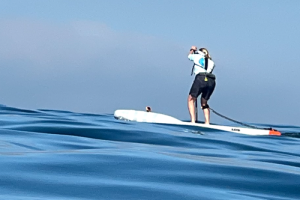
“My life is such a delight,” continued Schubel, an avid stand up paddle boarder who has lived in Carlsbad, California since 2008 and recently ended a decade-long venture in aquafarming with her husband, Thomas Grimm. “The Carlsbad Aquafarm hosted the first Blue Economy field course. I am hoping to bring this course back to life in another location. Hopkins students are awesome, amazing people, and it really is a gift to be able to work with them and to make these in-person connections, particularly in field courses.”
And if some loose sand or special rocks return home as mementos – along with souvenirs like locally harvested sponges, amazing woven baskets, or batik from the Androsia batik factory – as has “been known to happen” – she is okay with that too. It might even mean that she is passing along the inspiration that she once received.