Jason Linde: Building Better Advocates for Democracy
Published October 29, 2026 | Request Information
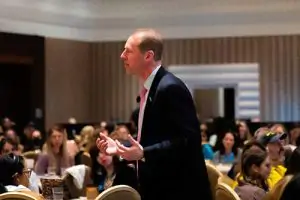 The power of public policy comes down to a simple goal and a lifelong mantra for Jason Linde: changing lives by changing laws.
Growing up in a small, one-stoplight town in the northernmost county of Appalachia in upstate New York, Linde became aware early on of the disparities between people living in the same community. Cross-country road trips to visit his parents’ families in South Dakota also gave him a lasting appreciation for the people and places that make up the country.
“I recognized at an early age where I grew up that there was a real difference between the haves and have nots,” said Linde, a lecturer in Johns Hopkins MA in Government program and a former recipient of the program’s Excellence in Teaching award. “I also grew a great appreciation for, and became a fan of, the people of this country during our cross-country drives. I realized that I wanted to make a difference in the lives of others, especially those who had more challenging circumstances than I did.”
After earning a bachelor’s degree in English from Syracuse University, Linde spent a year in law school before pivoting to a master’s degree in political management at The George Washington University and to work on a presidential campaign.
“The candidate won. I shook his hand, and I realized campaigns would be an excellent way for me to get involved, to effect change,” he said. “I realized that it is a lot easier to change the laws through democracy and government than it is to change them through the legal system.”
The realization launched a 25-year career spanning political campaigns, congressional offices, and nonprofit advocacy. His work has helped advance more than 35 state and federal laws affecting millions of Americans. Today, he brings that experience into the classroom, preparing students to navigate government and advocate for change.
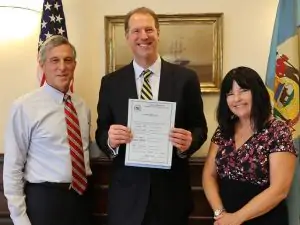
“I want to demystify government,” Linde said. “I want my students, and people in general, to understand that, from all walks of life, they can effect change in any way they seek. It just takes time and effort.”
One of his most significant accomplishments came during his tenure as senior vice president of advocacy at Food Allergy Research & Education, where he helped lead the successful effort to pass the FASTER Act. Signed into law in 2021, the legislation added sesame to the list of major food allergens that must be identified on packaged food labels. It was the first federal food allergen labeling legislation in 17 years.
The issue was personal. The grandson of a dairy farmer, Linde grew up with a dairy allergy, and his son later developed a shellfish allergy. He understood the uncertainty families face when they cannot easily determine whether a food contains a potentially dangerous ingredient.
Working with advocates, lawmakers, and partner organizations, Linde helped move the legislation through Congress in just two and a half years, significantly faster than the seven to 10 years such efforts can typically take.
“There are upwards of 33 million Americans living with life-threatening food allergies to ingredients found in everything from salad dressing to ice cream and protein bars,” Linde said. “That’s 10 percent of the U.S. population. This was one of those rare jobs where my personal story and the mission of the organization meshed. I’m very happy that I was able to be part of that effort.”
The experience reinforced a lesson Linde carries into his teaching: Facts and statistics matter, but personal stories can help lawmakers understand how policy decisions affect the people they represent.
In Introduction to Advocacy and Lobbying, Linde asks students to choose a real organization and a legislative issue to champion throughout the semester. They research the organization’s priorities, develop talking points, and practice lobbying both a congressional staffer and a member of Congress. They also create grassroots advocacy plans and draft communications designed to mobilize supporters.
The assignments mirror the work of professional advocates, challenging students to understand their audiences, anticipate difficult questions, and make a persuasive case for their positions.
“You have to understand who you’re talking to and what matters to them,” Linde said. “Facts and figures are great, but it’s that emotional story that often makes the difference.”
His Running for Office – Managing Campaigns course takes a similarly hands-on approach. Students develop campaign strategies, research opponents, write announcements, practice fundraising calls, and deliver campaign speeches. They even rehearse asking a voter for support.
By the end of the course, students have more than a theoretical understanding of politics. They have practical experience they can discuss with prospective employers and skills they can apply in their communities.
Linde also draws on his leadership experience to help students understand the importance of trust, teamwork, and continuous improvement. He speaks candidly about his own mistakes and remains available as a mentor long after students complete their degrees.
“I want my students to know I’ll be a resource for them now, six months from now, six years from now,” he said.
That commitment has yielded results: Two former students have gone on to win elected office after taking his courses.
Today, Linde serves as director of the Congressional Excellence Program at the U.S. House of Representatives. Working with management consultants and executive coaches, he helps members of Congress and their staff from both sides of the policial aisle build more effective teams, strengthen leadership, improve office operations, and foster healthier workplace cultures.
The work addresses the organizational challenges of governing, from setting priorities amid competing demands to managing small teams under intense pressure and improving coordination between congressional and district offices. For Linde, effective government depends not only on the policies lawmakers pursue but also on the people and teams responsible for carrying them out.
That belief underpins his teaching and his broader commitment to public service. He wants students to recognize that government is not an abstract institution operating beyond their reach, but a system they can engage with to advocate for their communities and influence decisions that affect everyday life.
Ultimately, Linde hopes students leave Hopkins with practical skills, the confidence to use them, and a stronger sense of their role as citizens.
“I want our students to be better citizens, whether or not they ever do this work, and I want them to be empowered by government rather than intimidated by it or angry at it or, worst of all, apathetic to it.
“I think Hopkins provides one of the best training grounds and launching pads for students to be prepared to do good work, make an impact at federal, state, or local government, and to excel in a career of service,” he continued. “I love being a soldier for democracy, and I love being at Hopkins.”