Brian Hoover: Listening to Seabirds, Tracking Ocean Health
Published August 14, 2026 | Request Information
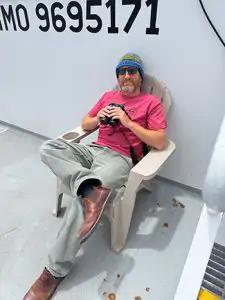 If you could join Brian Hoover at sea on a research expedition from California to Alaska, you would hear the distinct calls of gulls, terns, murres, shearwaters, and phalaropes around you. If you are especially fortunate, you might catch the “really cute chatter call” of Hoover’s favorite seabird, the Leach’s storm petrel. A tiny ocean wanderer built for the big waves and high winds, it was once nicknamed the “Jesus bird” by fishermen because of its unusual ability to appear to walk on water.
Listen closely, and you’ll hear something else.
That’s Hoover playing his banjo.
After hours scanning the horizon through binoculars as principal scientist at the Farallon Institute, where he studies the behavior and spatial ecology of seabirds across the North Pacific, Hoover has been known to answer the birds’ calls with music of his own.
A lecturer in Johns Hopkins University’s MS in Environmental Sciences and Policy and Energy Policy and Climate programs, Hoover has spent nearly two decades sailing aboard NOAA research vessels, Coast Guard cutters, fishing boats, and icebreakers. Some expeditions last just over a week. Others extend nearly a month across waters that have carried him through the Bering Sea, across the Aleutian Islands, and hundreds of nautical miles offshore. The bulk of his current research is now conducted off the California coast. Some days, he counts tens of thousands of birds and hundreds of whales. Other days, almost nothing.
 “It’s long moments of boredom with little bits of excitement when you are far at sea,” Hoover said with a laugh. “Then suddenly, an albatross appears in the middle of nowhere, or you find a patch of birds in the open ocean. Birds tell us how the ocean is doing. If they disappear from places they’ve always been, or they’re struggling to find food, they’re telling us something about what’s happening beneath the surface.”
By tracking where birds feed, migrate, and nest, Hoover helps scientists better understand ocean ecosystems and how they are changing in a warming world. During the quieter stretches at sea, he passes the time listening to an array of podcasts, playing his banjo or mandolin, and waiting for the next sign of life on the horizon.
Growing up in Colorado Springs, Colorado, Hoover always knew he wanted to work with animals. He enrolled in Colorado State University to study zoology, drawn to courses in wildlife biology, ornithology, and marine science.
He credits much of his career to a mentor who looked beyond his grades.
“I wasn’t setting the world on fire academically, and I really didn’t know what I wanted to do,” Hoover said. “But my professor, Dr. William Wright, saw curiosity and creativity. He invited me to work with him studying sea slugs for a few years at UCLA and Chapman University. When I decided to consider graduate school, he handed me the keys to his car and a list of colleagues up and down the coast. I met people who studied larval fish, marine mammals, and coral reefs. He believed in me and gave me a chance.”
Hoover’s visit to Moss Landing Marine Laboratories, part of the California State University system, turned out to be his favorite stop. He enrolled and launched on a long master’s journey that had him studying marine lipids and snails in the rocky intertidal zone, tracking turtles in Mexico, and flying air surveys for whales. When a friend asked him to assist with a seabird project in Alaska, three years into his graduate studies, he found his calling and switched his focus to seabird ecology. He later earned a PhD in Ecology at the University of California, Davis, where he studied the genetic and olfactory components of mate choice in seabirds.
Today, Hoover spends several weeks each year aboard research vessels counting birds within a standardized survey area. He then combines those thousands of bird observations and ocean measurements – including temperature, chlorophyll levels, oxygen, and other environmental data – to build models showing where biodiversity hotspots emerge and how those hotspots are shifting as ocean conditions change.
“It’s incredibly difficult and expensive to measure everything happening below the ocean’s surface. The birds integrate a lot of that information for us,” he said. “They’re predators at the top of the marine food web, so changes in what they’re doing tell us something about everything below them. They are using smell, sight, hearing, wind, waves – everything available to them – to find food. When we follow the birds, we are really following the ecosystem.”
For Hoover, the ocean is a “tough place to make a living” – a constantly changing environment where survival depends on adaptation. If fish populations shift, seabirds shift. If warming waters alter plankton communities, seabirds respond. Long before scientists venture beneath the waves, the birds often reveal that something has changed.
Hoover brings those real-world experiences directly into his Johns Hopkins classroom. During his first two years teaching, he delivered lectures via satellite internet and gave students live tours of the ship while at sea. The university’s flexible online format allows him to continue conducting research while teaching working professionals pursuing careers in climate and environmental science. His courses blend ecological science with real-world conservation challenges, helping students understand how scientific research informs environmental policy.
“I really love teaching AAP students,” he says. “They’re students who know what they want, who want to learn, who have goals, and who are very driven. I hear what excites them and build my courses around those interests. I couldn’t realistically be a full-time researcher and teach in a traditional classroom, but the Hopkins model lets me do both. I think I am a happier person – and a better scientist – for it. If I weren’t teaching, I wouldn’t be scratching an itch, and I wouldn’t be having fun. Now I can do research and teach in a way that accommodates me and the students. I am really grateful for that.”
Hoover also hopes to pay forward the mentorship that shaped his own career.
“When someone believes in you early on, it can change your life,” he said. “I try to do the same for my students. I encourage them to find what matters most to them, and what they love, and to pursue it. It will work out.”
Despite long expeditions, grant deadlines, and weeks away from home, Hoover never loses sight of why he chose this life.
“As scientists, we tend to put our heads down and think from funding to funding,” he said. “It is really important to pick your head up sometimes and acknowledge that we get to see really cool parts of the world, meet great students, ask fascinating questions, and teach interesting things. I feel fortunate that I work at the Farallon Institute with a small but familial group of scientists who have empowered me to run a lot of my own studies. I feel lucky that I’ve landed in the middle of the Venn diagram – working where I want, with people I enjoy, and teaching at Hopkins.”
Perhaps that is why Hoover sometimes reaches for his banjo. The music isn’t for the birds. It’s a reminder to appreciate where curiosity has carried him – and to keep listening to what the birds and the ocean still have to teach him.