Using Data and Empathy to See the Person Behind Every Crisis
Published April 2, 2026 | Request Information
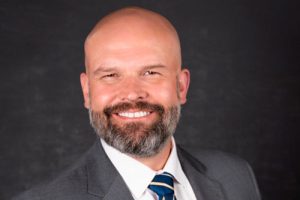 Joe Wankelman often jokes that his life today would have sounded impossible to his younger self.
Now, he serves as South County Fire Commissioner for District 1 in Lynnwood, Washington, reviewing emergency response data and looking for ways to prevent the next crisis. He also leads the Foundation for Stable Housing in Seattle as executive director, building systems to help people find stability before they ever dial 911. He credits much of that work to a master’s degree in Data Analytics and Policy from Johns Hopkins University, completed in 2025.
“If you told me as a kid I’d end up there,” he said, “I wouldn’t have believed you. Attending Johns Hopkins has been one of the greatest gifts of my life. It’s a program that emphasizes the importance of data-driven decisions while always considering the person whom the decision impacts.”
For someone who once struggled just to read, the degree still feels surreal. His path to policy leadership didn’t start in a classroom. It began growing up in Fort Collins, Colorado, with undiagnosed dyslexia and ADHD, which made learning feel out of reach for him. He didn’t read fluently until seventh grade.
“I didn’t understand myself as a kid. You start playing these tapes in your head – ‘what’s wrong with me?, why am I different?’ I just wanted to be seen and to matter.”
 In search of structure and belonging, he enlisted in the Army after high school and was trained as a forward observer. After September 11, he deployed to Baghdad and later reenlisted as an AH-64 Apache helicopter pilot, flying multiple tours in Iraq and Afghanistan.
His high-stakes work demanded emotional distance. “You detach to do the job,” he said. “But you can’t turn that off at home.”
After 17 years of service, the weight of combat – PTSD, depression, and anxiety – followed him back. In 2016, he reached a breaking point and attempted to take his life.
“When I woke up, I thought, how did I get here?”
Recovery brought clarity and perspective. He was finally diagnosed with dyslexia and ADHD and received treatment for trauma and depression. In therapy, he began recognizing the same patterns he’d lived –shame, rejection, self-medication –in people experiencing homelessness and addiction.
“Hurt people hurt people,” he said. “Most of us are trying to escape pain.”
That realization led him back to school – first to the University of Washington and eventually to Hopkins – where he learned to pair lived experience with evidence. His capstone research – how taxes impact poverty – focused on the hidden economy of homelessness in Snohomish County, Washington. His research on housing costs and poverty revealed fragmented systems and policies that often miss the people they’re meant to help.
“My research reminded me of when I was struggling with my own mental health, when I was desperate and didn’t know where to turn,” he said. “Amidst the struggle, insecurity and anxiety, trauma shrinks a person’s cognitive capacity. Then we expect people in crisis to navigate complicated systems. It doesn’t work.”
Today, Wankelman applies that lesson on the ground. At the Foundation for Stable Housing, he builds person-centered, data-informed approaches to address both housing and healing. As fire commissioner, he focuses on how prevention and community health supports can reduce repeat emergency calls that drain valuable time and community resources.
“The numbers are never just numbers. They’re people on their worst day.”
“Every single semester at Johns Hopkins, I had a course that blew my mind,” he said. “The Text as Data course really helped me with the qualitative side and with using words as a unique form of data. My database management course and the machine learning courses were so powerful in providing an understanding of the complex, ethical challenges of forecasting – clean data in, better answers out. The conversations I was fortunate to have with program director Collin Paschall were so impactful. Just hearing him speak was a learning experience.”
The child who once felt invisible, the soldier searching for purpose, the pilot bearing the emotional weight of protecting others, Joe Wankelman is now a leader using data and empathy to build systems that work for the people inside them, systems that don’t just manage problems but work to change them.
“We judge people by how they fit into our systems rather than for who they are,” he said. “I was almost someone the system missed. My life experiences have shown me that the people who feel rejected, abandoned, or betrayed are the same incredible people who could change the world. Because of my own journey and because of Johns Hopkins, I am better equipped to learn about the human who experienced the trauma and make changes that provide a pathway to stability and productivity.”
Attention: Students and Alumni
Are you a current AAP student or alumni and want to share your accomplishments?
Interested in pursuing a graduate degree at Johns Hopkins University?
Request information to learn more or apply here.