Unlocking Brain Science Through a Curiosity in Biotechnology
Published June 8, 2026 | Request Information
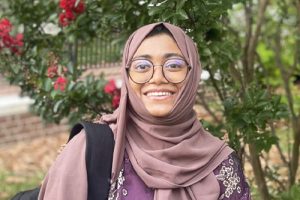 For Monalia Sadia Rahman Chowdhury, science has opened a world of possibilities and allowed her to explore new disciplines by following the questions wherever they led.
After completing a rigorous five-year undergraduate pharmacy program in Bangladesh that exposed her to nearly every corner of the life sciences – pharmacology, therapeutics, biotechnology, hospital practice, pharmaceutical industry work, and community care – her curiosity took her abroad and to Johns Hopkins University.
In May 2026, Chowdhury collected her MS in Biotechnology degree and received second prize in the Patrick Cummings Award competition for outstanding graduate research for her project, Nutrient-Based Modulation of Auditory Function, Behavior, and Neurodegeneration in a Mouse Model. The honor came during a record-setting year in which 68 students completed thesis or independent research projects.
Conducted under the mentorship of Amanda Lauer, George T. Nager Professor of Otolaryngology–Head and Neck Surgery at the Johns Hopkins School of Medicine, and with the guidance of Sergio Vicencio Jimenez, Postdoctoral Research Associate, the research explored an unconventional question: could antioxidant-rich nutrition combined with prey-directed hunting activity influence hearing and neurological decline?
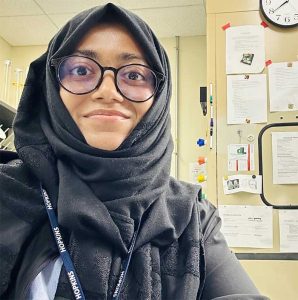
To investigate, Chowdhury trained mice to hunt live crickets – an activity that provided them both physical enrichment and a nutrient source rich in antioxidants. She then evaluated changes in movement, exploratory behavior, hearing thresholds, and brain tissue pathology.
“We know that with diseases like Alzheimer’s, there is a higher tendency to develop plaque and tau protein tangles that affect memory and brain functions,” she said. “I wanted to connect different systems together – behavior, auditory physiology, tissue analysis. I wanted to see how they all influenced one another in affecting the disease progression.”
The interdisciplinary nature of the project required her to reach constantly across fields and techniques. She conducted behavioral testing, hearing assessments, tissue processing, and pathology analysis while learning new laboratory methods along the way.
The strongest early findings appeared in locomotion and exploratory behavior.
“The mice became much more active,” she said. “Their movement and speed improved significantly and was consistent in both young and old cohorts of mice.”
She also found preliminary evidence suggesting that mice involved in the hunting intervention maintained better hearing sensitivity than non-hunting groups.
This ongoing project reinforces something Chowdhury already suspected about herself – she is most energized when she is learning something unfamiliar.
That mindset has shaped much of her experience at Hopkins.
“What interested me about biotechnology was how innovative it felt,” she said. “You could take a biological system and completely rethink what was possible with it. I hope to eventually branch out into neuropharmacology, and I knew that Johns Hopkins, and its reputation as the best research university, would be a great place for me to start.”
At Hopkins, she took courses across multiple concentrations, studying everything from protein bioinformatics and coding software to high-throughput screening and laboratory cell culture techniques. Some experiences clarified what she enjoyed. Others simply opened new doors.
“I didn’t want to limit myself,” she said. “Every course introduced me to something different. I learned a lot, and it was a great experience.”
In one laboratory course, she gained hands-on experience in cell culture and sterilization techniques. In another class, she became fascinated by computational biology and how protein mutations alter biological function.
“Those courses really stayed with me,” she said. “They changed how I think about biology.”
She credits faculty members Christopher Skipwith, Lakshmi Rajkumar, Michael Leobwitz, Bob Lessick, and Sara Sowden for helping shape her graduate experience.
“After seeing the whole roster of independent projects, I honestly didn’t expect to win this award,” she said. “I am really grateful that I had the opportunity to participate in the program.”
Chowdhury will continue as a research specialist in Dr. Lauer’s lab, carrying forward her interests in neurodegenerative diseases, and age-related hearing loss studies.
“We sometimes think that after a certain point in life, we shouldn’t keep changing,” she said. “But as long as you’re learning, you continue discovering new parts of yourself – things you didn’t know you were interested in, or things you might actually be good at.”
That philosophy continues to guide her approach to science.
“We all – physicians, biotechnologists, pharmacists – have our place in the pipeline,” she said. “At the end of the day, the goal is to help humanity. As long as the patients are healthy and are living better lives, that’s what matters most.”
Attention: Students and Alumni
Are you a current AAP student or alumni and want to share your accomplishments?
Interested in pursuing a graduate degree at Johns Hopkins University?
Request information to learn more or apply here.