Sharpened GEOINT Skills Help Response to Humanitarian Crises
Published November 24, 2025 | Request Information
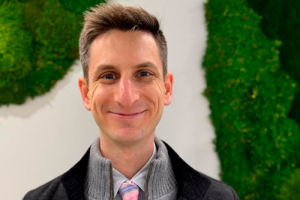 “I love being the dumbest person in the room,” said Brian Perlman. In fact, the 35-year-old Houston native and Fulbright scholarship winner is anything but uneducated. He has intentionally and purposefully challenged himself throughout his life. Fulfilling a childhood dream, he took his first flight lesson when he was 14, soloed on his 16th birthday, and obtained his pilot’s license the following year. After completing an undergraduate degree in international studies at Texas A&M University, he was commissioned as an officer in the military and served for four-and-half years before earning a master’s degree in journalism at the University of California, Berkeley. In May, he graduated with an MS in Geospatial Intelligence degree from Johns Hopkins University.
“I think I am smart enough to know that I don’t know anything, because the people who I look up to are people who admit to the limitations of their knowledge,” Perlman said. “I try to surround myself with world-class thinkers, people who really know what they are talking about and who have deep experience. I have been privileged and lucky to learn from people throughout my life – in aviation, the military, academia, and in my professional roles – who have tons and tons of experience.”
It was while studying at Berkeley and through his involvement at the Human Rights Center at Berkeley Law, under the guidance of Alexa Koenig, JD, PhD, that Perlman really found the footing of his professional path. After graduating from Berkeley in 2020, he worked for a nonprofit, the Global Investigative Journalism Network, then at a private investigations firm, before accepting a Fulbright scholarship in Berlin, Germany. Perlman’s decision to enroll at Johns Hopkins further expanded his toolkit.
“I went to Berkeley because I wanted to do something that was alleviating struggling and suffering in the world. I went to journalism school to learn how to better tell the stories of people who were suffering abuse of their human rights, civilians caught in conflict zones, people who were being imprisoned without due process and whose lives and livelihoods were being taken away,” he said. “I learned to use open-source intelligence to investigate human rights there and in Germany, where I partnered with European Union-based war crimes investigative units focused on accountability for war criminals in Europe. While I was still in Germany, I applied to Hopkins because I wanted to get a technical degree in satellite-based remote sensing for applied humanitarian research.”
Perlman credits JHU program director Jack O’Connor with connecting him with military veterans who had successfully completed the program and provided insights on the experience.
“At Hopkins, I learned the huge value on going deep and becoming a technical expert in one specific area,” Perlman said. “Taking the drones in remote sensing course was a great experience because we received hands-on training and learned how to apply drone-based remote sensing analysis to study vegetation and thermal anomalies. It was so beneficial to be in-person for instruction, learning from your peers, and interacting in informal settings. When you get into high-level human rights and journalism spheres, you really rely on people who have deep domain expertise, especially as methods change with the influence of artificial intelligence and machine learning,” he said. Moving forward, he envisions “remaining in an investigative capacity, using my remote sensing skills, my investigative video forensics skills, my journalism skills, and the other adjacent skills that I have been building up over the past seven years.”
While studying at Hopkins, Perlman leveraged many of those abilities to perform a detailed geospatial analysis on the damage of water, sanitation, and hygiene (WASH) infrastructure in the Gaza Strip. Working with an inter-institutional research group, the Decentralized Damage Mapping Group, he co-authored a public health paper published in February 2025, establishing the scope of one of the most critical projects necessary to facilitate rebuilding the region following a ceasefire in the war between Hamas and Israel.
“Water touches every aspect of human life, and looking at the damage to the water infrastructure in Gaza had been understudied,” he said. “We had access to a corpus of very high-resolution satellite imagery from Planet Labs and used it to investigate the damage to the region’s sites to create a central repository of data. I collated all these different data sources, over 1,000 points of WASH infrastructure locations, looked at pre-October 7, 2023 imagery (before the escalation of hostilities) to first determine if these points, which indicated if water infrastructure existed in that location, were accurate. Once we compiled an accurate list, we went systematically through the imagery after October 7 to see if these sites had been damaged. We found that in the first four and a half months after October 7 (until the study period ended on February 22, 2024) roughly half of the water sites were damaged or destroyed. Access to safe water was really curtailed during the conflict, and all of the rebuilding will have to take place over decades and will take approximately $2.7 billion for the WASH sector alone, according to the World Bank. There is no type of water infrastructure – storage facilities, wastewater treatment plants, pumping stations – that I know of that was untouched.”
Following his Hopkins graduation, Perlman completed a three-month fellowship with The Washington Post through the Military Veterans in Journalism organization. He is now working for Spatial Informatics Group, an environmental think tank based in California that provides remote sensing data analysis on food security and climate vulnerability mapping.
“With a lot of the research funding currently pulled, it is a really hard time for the environmental research sector,” Perlman said. “I am working to increase my remote sensing skills with the goal of being able to return to my passion, to work on humanitarian issues and play my small part of alleviating the suffering of people who have been treated the worst. Knowing what I know about how armed conflict works, and how civilians are treated in those contexts, I decided that I don’t want to do anything else. I am drawn to research because we need to have empirical facts that we can all agree upon. The stronger the evidence we have, the better foundation we have to build upon to pursue accountability for people in power who trample on civilians and their human rights,” he said.
“I don’t have a choice to become despondent, throw up my hands, and say, ‘There is so much wrong in the world. I have to give up.’,” he said of his resilient approach to the work. “There is always going to be bad stuff in the world, but I think the people who have the ability to stand up and put their knowledge and skills to use are sort of obligated to do it. I am trying to build cross-sectoral skills so I can be useful to those efforts when the funding does come back around.”
Reflecting on the challenges of working in human rights, Perlman acknowledges that “it is difficult to be a humanitarian, but I think the work will continue because armed conflict is only increasing and the numbers of civilians affected by it are increasing. It is really important to keep the reason for the work in context and at the forefront, to be empathetic to the struggles of others who are without food, water, and housing. I try to be conscientious, to not just get focused on data with blinders on and lose the humanity of the work. Morally, there is no other choice for me than to do this work, and I am grateful that all of my experiences, including my studies at Johns Hopkins, have equipped me to assist organizations and individuals who are pursuing justice and accountability efforts for human rights violations across the globe.”
Attention: Students and Alumni
Are you a current AAP student or alumni and want to share your accomplishments?
Interested in pursuing a graduate degree at Johns Hopkins University?
Request information to learn more or apply here.