Giving Voice and Impact to Women Leaders Across Generations
Published October 21, 2025 | Request Information
 Recent Johns Hopkins MS in Organizational Leadership graduate Bevin Burns credits a background in sociology, sound advice from her parents, and theoretical and practical insights gained from her graduate curriculum with helping her to conceptualize a unique capstone project that is drawing praises from project contributors, mentors, and program director Frances Wu.
Only One Throne? The Generational Dynamics Behind Women’s Competition and Collaboration at Work is an eight–part podcast series, each episode approximately 45–minutes in length, that Burns created seeking answers to the questions, “What really shapes the way women compete, collaborate, and lead across generations? And what systems are shaping these dynamics?” The project blossomed into a field investigation, rooted in theory and shaped by lived experience. It shares the bold voices of 12 women from differing cultures, three each from four generations (Baby Boomers, Gen X, Millennials, and Gen Z), on topics such as power, envy, jealousy, and entitlement in the workplace.
“My undergraduate degree in sociology from Wake Forest University gave me the lens to look at things from a larger, more societal, diverse perspective,” said Burns, a native of Cape Cod, Mass. “My decision to enroll at Johns Hopkins and to learn everything I could about leadership – particularly about organizational behavior, leadership ethics, change management, and development – has put me on the most inspiring journey. My parents always told me, at a very young age, that it is important to have friends from every decade. Since I was eight years old, I have been very comfortable speaking to adults and valued the idea of conversation and connection. Being 25 years old and in group projects at Hopkins with people mostly older than me, from all different backgrounds – everything from human resources and executive coaches to social workers and doctors – was just incredible. I felt lucky to be in the program. The advantage of working with different generations got me thinking about how each generation shows up and what they offer and crystalized the idea for my capstone.”
With a particular interest in collaboration and competition, Burns sought out a project that would allow her to talk to and learn about leadership studies from a bunch of “really interesting, diverse women.” Khaleeda Kabani and Gail Williams, mentors from the JHU Global Leadership Advisory Council, helped Burns craft a focus, explore themes, and tailor research questions. Kabani suggested that perhaps the content would be more impactful as a podcast, rather than a research paper.
With Wu’s blessing, and with the understanding that the podcast format would incorporate the requisite academic rigor, research, and data that would be required in a typical capstone paper, Burns selected a diverse group within each generation of subjects to see if common themes would emerge.
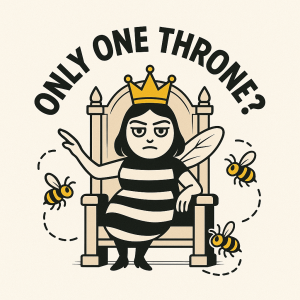 “The stories that these women shared with me were ones that they often had never shared with anyone before,” said Burns, who taught herself how to use the podcast platform and enlisted her mother, a children’s book author and illustrator, to create her podcast logo. “One of the interviews lasted four hours. It was so exciting to be able to come up with the questions that hadn’t been asked before – based on my research and collection of literature and data that I had amassed – and to try to understand the gaps that needed to be filled in, and how I could play a small part, through this project, in filling in some of those gaps.”
The beginning of each podcast episode reminds the listener that for too long women were allowed one seat at the table, one voice in the room, and one woman at the top and were forced to “circle the same throne” because they were told there wasn’t room for more than one of them.
Additionally, a key theme that also emerged across the episodes was the persistence of the “Queen Bee” stereotype that suggests that women in senior roles undermine other women.
“After exploring these topics, my findings challenged these narratives,” Burns said, “showing instead that competition among women is often driven less by personal pettiness and more by structural scarcity and cultural expectations. Across generations, participants also highlighted the invisible weight of embodied leadership – appearance, caregiving, and emotional labor – and the need for intentional systems to make collaboration possible. I learned that the viewpoints of these women were not so different. They were being spoken differently. If you stripped it down, the values were the same, the intention was the same, and all the sentiments were the same.”
Burns carefully structured the podcast to lead the listener through an initial abstract of the project. The second episode centered on information that emerged from literature review and the third around research methods. Episodes four, five, six, and seven delve into the interviews by generation, with the eighth episode providing a conclusion. She assured anonymity of the subjects by changing their names and altering their voices, through the use of artificial intelligence. She uploaded her completed project, with a playlist of the episodes to YouTube.
“The whole process was so eye-opening for me, and through these conversations I learned so much about women in leadership,” Burns said. “The Boomer women continue to fight to keep their own seat at the table. Gen X women are fighting to keep their seat but also to make sure that there is a seat for the next generation. Millennial women understand that they have a seat, but they are also coming up with stricter boundaries. Gen Z women, who have been given 24 /7 access to quick information and been told to speak out about problems, are entering the workforce and navigating leadership boldly while fending off being seen as entitled to the seat. My research, and these stories shared through the podcast, make clear that every woman did what she could to assume leadership roles with the tools her generation provided. Some built armor, some built workarounds, some built new language. The problem was never that women were being too sensitive, too ambitious, too complicated, or too dichotomous. It was never that there were too many women. The problem was too few chairs. So maybe leadership may not be about who claims the throne. Maybe it’s about how we build more of them together.”
For women seeking leadership roles today, Burns said, competence has emerged as the biggest value, along with authenticity and intentionality.
“From the very beginning, Dr. Wu advised us that the goal for our capstone project should be to create something that ‘doesn’t just live on a shelf’,” she said. “My project proved to be a synthesis of what I learned across the curriculum. It applies behavioral theory, ethical leadership, systems thinking, and structured change management to address the nuanced, often-overlooked dynamics that shape how women relate to one another across generations in corporate life. It is so gratifying to know that she and others have found value in my work.”
Attention: Students and Alumni
Are you a current AAP student or alumni and want to share your accomplishments?
Interested in pursuing a graduate degree at Johns Hopkins University?
Request information to learn more or apply here.