From Global Security Studies to Global Storytelling
Published July 8, 2026 | Request Information
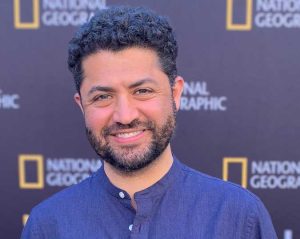 For two-time Emmy Award-winning filmmaker Baktash Ahadi, every story exists within a larger context.
That perspective was shaped in part by his time in Johns Hopkins University’s MA in Global Security Studies program, where he explored the political, cultural, and psychological forces that influence how people see the world – and the narratives that emerge from them.
Born in Afghanistan, Ahadi arrived in the United States in 1986 as a five-year-old who had spent two years in refugee camps in Pakistan. Sponsored by a Lutheran congregation in Carlisle, Pennsylvania, his parents began rebuilding their lives from scratch.
“My parents sacrificed so much for the unknown and left their country, community, and extended family,” Ahadi said. “They were resilient and persevered and assimilated. They learned English, adapted, worked incredibly hard, and put all three of their sons through college. They never finished high school, but they had character, and America has been beautifully generous to them.”
After earning a bachelor’s degree in sociology and anthropology from Susquehanna University and serving as a Peace Corps volunteer in Mozambique, Ahadi was working in Washington, D.C., in a national security role when he enrolled in Johns Hopkins in 2009.
“I wanted a degree program that would allow me to dig deeper and better understand the frameworks behind some of the most pressing issues of our time,” he said.
That journey was interrupted by an unexpected opportunity.
In 2010, one month after President Barack Obama announced the troop surge in Afghanistan, Ahadi was on a plane to serve as a combat interpreter and cultural adviser for the U.S. Marine Corps. He took a leave of absence from Hopkins and spent the next three years embedded with Marine and Afghan special forces, translating not only language but also culture, fear, hope, and human experience.
Arriving in Afghanistan for the first time since leaving as a young child, the return was incredibly personal.
“Parts of it felt deeply familiar,” he recalled. “The language, the cadence, even some of the smells. But other parts felt completely foreign.”
His role placed him between worlds. To American troops, he was Afghan. To many Afghans, he was Americanized.
 “I never felt so American as when I was in Afghanistan, and I never felt so Afghan as when I returned to America,” he said. “Identity doesn’t exist in isolation. It’s shaped by the people and communities around us.”
Working alongside Marines, aid workers, diplomats, and local communities exposed Ahadi to the complexities of war and international intervention in ways few people experience firsthand. He witnessed extraordinary courage and kindness, but also devastating loss and violence.
“I like to describe my time in Afghanistan as something I am very grateful to have done, but also extremely grateful that I never have to do again,” he said. “War showcases the rawness of the human experience. The most courageous acts I’ve ever seen were in war. The kindest acts I’ve ever seen were in war. But also the most brutal.”
When Ahadi returned to Hopkins to complete his degree, many of the questions he had wrestled with in Afghanistan became subjects of academic inquiry. While studying conflict, extremism, and national identity, Ahadi became increasingly interested in the narratives societies construct about themselves.
“The program helped me think rigorously about systems and forces shaping people’s lives,” he said. “It also helped me understand the power of narratives and the disconnect that can exist between realities on the ground and decisions being made in Washington that affect people halfway around the world. It gave me the language to understand those gaps.”
The experience also revealed questions that would later become central to his work. “What does it mean for a country to come together?” he asked. “How do people believe in service? How do ideas create unity?”
After graduating in 2013, Ahadi did not immediately set out to become a filmmaker.
Instead, he was approached by documentary filmmakers who needed help translating footage from Afghanistan. The project became Frame by Frame, a documentary about Afghan photojournalists rebuilding independent media after years of conflict.
What began as translation work evolved into cultural advising, story development, and ultimately a producing role. At the same time, he worked for the U.S. Department of State, teaching diplomats about cultural intelligence and human behavior.
Along the way, Ahadi discovered the transformative power of documentary storytelling.
“I watched people walk into a theater knowing very little about a topic and leave with a completely different understanding,” he said. “That was incredibly powerful.”
Today, Ahadi describes his work through the concept of “narrative intelligence” – the ability to understand how stories influence identity, trust, belonging, and decision-making.
Through his independent studio, The Taleem Project, he advises organizations and creates films that explore complex social and political issues through deeply human stories. Collaborations with cultural, media, and global institutions have included The Olympics, National Geographic, TIME Magazine, Paramount Pictures, The New York Times, PBS, and McKinsey & Company.
His breakthrough came with Retrograde, National Geographic’s acclaimed documentary chronicling the final months of America’s war in Afghanistan. The film earned six Emmy nominations, won three Emmy Awards, and was shortlisted for an Academy Award.
More recently, Ahadi served as producer of Champions of the Golden Valley, which won the Emmy Award for Outstanding Sports Documentary. The film follows young Afghan skiers from rival ethnic groups who find unity through sport, even as political upheaval reshapes their lives.
Looking back, Ahadi believes one of the greatest lessons from Johns Hopkins had little to do with any single course. Instead, it was learning how to continue learning.
“Your degree matters,” he said. “Johns Hopkins is fantastically useful as one most respected and valuable brands in the world. But what matters more is how it teaches you to learn how to learn.”
That mindset has allowed him to navigate an unconventional career spanning national security, diplomacy, documentary filmmaking, public speaking, and leadership development.
For Ahadi, storytelling remains a way to bridge divides and foster understanding across cultures and experiences.
“The life that I have lived so far has shown me that life is uncertain and change is inevitable,” he said. “What matters most is believing in yourself, believing in your dreams, and knowing how to craft your own story so people will listen.”
Ahadi hopes to continue creating films and telling stories that would make his ancestors proud.
“The reason I make films is because stories shape how we see people,” he said. “And how we see people shapes how we treat them.”
Attention: Students and Alumni
Are you a current AAP student or alumni and want to share your accomplishments?
Interested in pursuing a graduate degree at Johns Hopkins University?
Request information to learn more or apply here.