From Foster Care to the Frontline of Preparedness
Published July 8, 2026 | Request Information
A thank you note sits on the fireplace mantel of Tristian Smith’s home in Nebraska.
It is a letter from a high school senior who had chosen the foster care system as the focus of her final senior-class project. One of her primary sources was Smith’s self-published memoir, Against All Odds, which chronicles his journey through childhood loss, abuse, and foster care.
For Smith, who graduated from Johns Hopkins MS in Intelligence Analysis program in May 2026, the note represents something larger than a successful book. It is proof that his experiences – and the lessons he learned from them – continue to impact others.
“I know that I am making a difference in the world,” he said. “That means everything to me.”
At 37, Smith has already lived enough experiences for several lifetimes. In addition to being a published author, he has served as a military officer, become a child welfare advocate, and built a career focused on protecting others from crises and disasters.
Yet the foundation for everything he does today was built during a childhood marked by instability.
Smith’s mother died when he was seven years old. Between 1997 and 2007, he moved through nearly 30 placements in Georgia’s foster care system, attending 13 different schools across four cities.
The constant upheaval left him searching for stability. He found it through military service.
After aging out of foster care, he joined ROTC while attending Fort Valley State University and later commissioned as a U.S. Army Chemical, Biological, Radiological and Nuclear (CBRN) officer. Over the next several years, he trained military personnel to respond to some of the world’s most dangerous threats, serving in South Korea and in the U.S., before medically retiring.
Today, in his civilian role, he works in emergency management with the U.S. Air Force at Offutt Air Force Base in Nebraska, helping prepare thousands of personnel for potential emergencies.
The transition from foster youth to emergency management professional is not lost on him.
“Because of what I went through, I know what it’s like to need help and require safety,” Smith said. “I think it stems from a desire to be useful to people.”
After earning a master’s degree in emergency management at the University of Maryland Global Campus, Smith enrolled in the Johns Hopkins Intelligence Analysis program to deepen his understanding of complex threats and decision-making.
“My biggest takeaway was the amount of critical thinking and situational awareness required to be an intelligence officer,” he said. “Even the most minute details can make a difference.”
The analytical mindset mirrored much of the work Smith had already performed in military and emergency management settings. But the program pushed him to evaluate information in new ways, identify patterns, and draw meaningful conclusions from complex data.
“Intelligence is a challenge for a lot of people,” he said. “It requires you to think critically, review tons of data and information, and pull pieces of a puzzle together so leadership can better understand complex threats and environments and make key, timely, and critical decisions. I had excellent professors and was surrounded by really intelligent peers, many of whom were already working in the field. As they say, ‘Iron sharpens iron.’ I found that to be true at one of the most prestigious universities in the world.”
For his capstone project, Smith examined psychosocial and behavioral risk indicators among Americans convicted of espionage over the past 25 years. The project reflected Smith’s longstanding interest in understanding threats before they become crises.
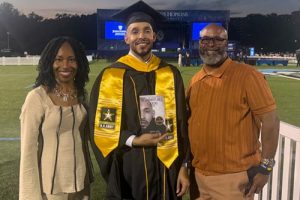
When he walked across the commencement stage, the moment represented more than earning a degree. In the audience were Kuumba and Lisa Rashidi, mentors whom he met as a freshman at college.
“Walking across the stage at Hopkins, seeing my name of the screen, and having them there to share that moment meant the world to me,” he said.
Today, Smith recognizes that the work he does is possible only through established relationships with others, whether they are partners around the world or colleagues working alongside him. For someone who often felt betrayed by adults and who struggled with abandonment and emotional attachment issues as a child, those relationships have become central to his success and sense of purpose.
Smith hopes to transition into intelligence analysis, particularly in all-source or military intelligence roles where he can combine his operational background with the analytical skills he gained at Johns Hopkins.
He also remains deeply committed to foster care advocacy and child welfare through volunteer work and public speaking. He serves as a Foster Care Review Board member and a Court Appointed Special Advocate volunteer, helping children navigate a system that encompasses more than 300,000 youth nationwide while reassuring them that their circumstances do not define their future.
One of his long-term goals is to establish housing scholarships for former foster youth pursuing education after aging out of the system.
“I didn’t get here alone,” he said. “I had people who helped me realize my potential. That’s what foster youth need – people who won’t give up on them and who help them see that they are more than what they’ve been through. There were moments in my life where the odds of success felt distant, and where simply surviving the day felt like the victory. I am living proof that resilience and education create opportunities for change.”
Attention: Students and Alumni
Are you a current AAP student or alumni and want to share your accomplishments?
Interested in pursuing a graduate degree at Johns Hopkins University?
Request information to learn more or apply here.