A Pioneer’s Journey to Diversify the Face of Medicine
Published December 23, 2025 | Request Information
LaRyel Waldon, a recent Johns Hopkins MS in Biotechnology graduate and now first-year pharmacy student in the University of California San Diego’s Skaggs School of Pharmacy and Pharmaceutical Sciences, can recall a pivotal conversation from her childhood in Grayson, Georgia, as if it were yesterday.
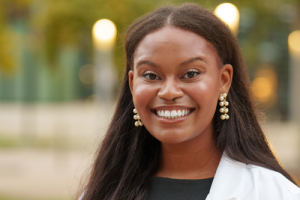 “I was talking to a boy, and he said, ‘Oh, you can’t be a doctor’,” recalled Waldon. “I was taken aback by that comment at the time, but I understand it now. I didn’t see a lot of Black doctors when I was growing up, and especially not Black female doctors. If you don’t see people who look like you in those fields, then you won’t pursue them. I think that conversation also contributed to my intrinsic motivation to pursue medicine. I saw how the healthcare system impacted my own family, and I thought I could bring not only value, but help, to the healthcare system. I decided to venture onto this science route to see where it would take me and to embrace what my peers call delulu – or being a bit delusional. I think it is really healthy to be a little delulu. What if it all goes right? What if it all works out?”
Encouraged by her single mother, Leslie Waldon, a former news producer for CNN, an educator and technology professional – to create success and to help others along the way, Waldon graduated high school with a 4.0 grade point average in just three years. She then enrolled at the University of Georgia and earned two BS degrees – biology, and biochemistry and molecular biology – with minors in health policy and management and applied biotechnology. Relocating to Los Angeles following graduation, Waldon worked as a full-time research coordinator for a facial plastic surgeon while completing her master’s degree at Johns Hopkins University.
“Johns Hopkins is a world renowned institution, and I knew that the Hopkins name would take me anywhere I wanted to go,” she said. “If I was going to take out more student loans and really make it worth my while, I needed to make sure that my degree came from a reputable institution and honestly a leader in biotechnology. As a Black woman, I was pleasantly surprised by the diversity in my class. It was evident that Hopkins valued those students and welcomed their diverse input. It felt great to be valued and seen.”
At Hopkins, Waldon embraced both the flexibility of the online platform and took advantage of the hands-on experience that brought her to JHU’s Homewood campus. She enjoyed being “back in the weeds of learning” alongside other students in her stem cell biology lab, her favorite course. She also loved experiencing the “awesome” Baltimore community. And she credits her lab professor, Vanessa Hobbs, with giving her the confidence to pursue pharmacy and backing it up with a letter of recommendation to support her on this uncommon academic undertaking.
“I chose pharmacy because I knew I wanted to work in healthcare,” said Waldon who is currently putting in 12-hour days, building the stamina and resilience that the field requires. “There is a lot of research and development in pharmacy, and the field gives me a lot of career opportunities. Having a master’s degree in biotechnology, with the rigor of Johns Hopkins behind it, has helped me a lot already, and I feel very prepared and confident in my pharmacy courses because I can see where the biology and chemistry courses merge. I learned lots of amazing and cool things at Hopkins, and now I am learning amazing things at UCSD. I am really excited about the future of research and innovation both in pharmacy and biotechnology.”
Since she is early in her four-year Doctor of Pharmacy journey, Waldon is unsure where she will find her niche in the field. Perhaps she will work in drug discovery or innovation. She has an acute interest in dermatology, skin conditions, and skin diseases. The study of infectious diseases has also piqued her interest, as has oncology pharmacy.
“At UCSD, I have enjoyed participating in community events as a pharmacy student, providing blood pressure, glucose, and hypertension screenings,” said Waldon, who is the only Black female student in her pharmacy cohort of 76 . “It is fun for me to get out into the community. It gives me a great glimpse into what people need and are expecting from future healthcare providers. I love to see the look on kids’ faces who are seeing someone like me taking the lead and showing them what is possible. A lot of young people are deterred from pursuing health sciences because they don’t believe they are qualified because of the color of their skin, their zip code, and their background. I will always be an advocate for those who didn’t have that silver spoon. I would tell them to pursue Johns Hopkins, pursue what you believe you can add value to, work hard in those spaces, and just be a little delulu. It’ll be fine. No one is stopping you.”
Waldon, who is buoyed by the ongoing support of her mother and extended family, takes on the pressure she admittedly feels as a minority woman in her field and embraces that childhood moment that has brought her to this full-circle epiphany.
“If I could speak to that boy from my youth now, I would tell him that diversity and different perspectives are needed in healthcare and that people like me (and him!) can be doctors,” Waldon said. “Me and my friends – who are African American and Asian and Hispanic and Pacific Islander – will be the face of healthcare someday. We are smart and capable, and we bring value and insight. Everyone gets better access to healthcare when you have more diverse voices in the conservation and at the table. There are a lot of health disparities and gaps in healthcare resources, but I am proud to be in a profession with a lot of dedicated and hard-working professionals who are seeking to fill those gaps and provide those services, who are ready to be patient advocates and to safeguard the public. I sometimes do feel pressure as a minority woman now. But my mother has this pressure. My grandparents and great-grandparents have had those pressures. I know it is hard, but I also know that I am my ancestors’ wildest dream, and that helps me to push forward.”