Seeing the Bigger Intelligence Picture Through AI Innovation
Published October 28, 2026 | Request Information
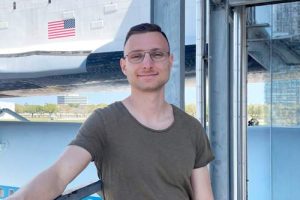 For Stefan Richter, a news report is rarely the end of the story. It’s the beginning of a series of questions: Where did the information come from? What else is happening? And how might seemingly unrelated events connect?
That curiosity led Richter from nursing in the U.S. Army to developing artificial intelligence tools that help analysts identify patterns in complex global events. While earning his master’s degree in Intelligence Analysis at Johns Hopkins University, he built independent platforms to organize information, evaluate evidence, and reveal connections that might otherwise go unnoticed.
His approach reflects a lesson he learned in nursing: Understanding a problem means looking beyond its most obvious symptoms.
“I always wanted to know how the world really works,” said Richter, who grew up in eastern Germany before moving to the United States and becoming a U.S. citizen in 2021. “I want to look through the glass rather than just at the glass.”
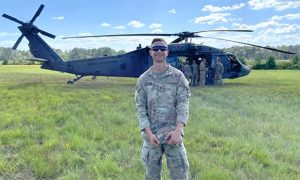 Richter’s path to intelligence analysis began at age 15, when he participated in a student-exchange program in Tennessee and stayed with a host family who had strong military ties. After completing a vocational training certificate in retail management in Germany, he returned to the United States, married, and joined the Army. He became a licensed vocational nurse and served for more than five years, including on the front lines of the COVID-19 pandemic.
Nursing taught him to assess the whole patient rather than focus on a single symptom – a perspective that would later inform his approach to intelligence analysis.
“I always tried to look at the patient, head to toe,” he said. “Just because your kidney is hurting doesn’t mean that’s the cause of your pain. What nerves are involved? What’s your lifestyle look like?”
He left nursing to pursue a career better aligned with his long-term goals. With interests in geopolitics and government decision-making, Richter saw intelligence analysis as an opportunity to pursue those interests while helping protect people.
The December 2024 attack at a Christmas market in Magdeburg, Germany, brought that motivation into sharper focus. The attack killed six people and injured hundreds, striking a country and a tradition close to his heart.
“Christmas markets are deeply rooted in German culture, and my family goes to one of these events every year,” he said. “Learning of that terrorist attack and seeing the fear it struck in everyone made me want to study extremism and work in an environment where preventing further attacks is a priority.”
Richter enrolled at Hopkins and completed his degree in 15 months while working as a role player for an intelligence contractor, simulating scenarios for professional training.
A geospatial intelligence course showed him how he could turn his curiosity about global events into practical tools. As he tracked news and geopolitical developments, he wanted a better way to visualize relationships among events without juggling browser tabs and disconnected sources.
The result was VIBE, or Virtual Intelligence Browser Environment, an AI-powered platform he developed to bring information from hundreds of open-source feeds together on an interactive 3D globe. It incorporates data on conflict, aircraft and maritime activity, satellite tracking, and sanctions, allowing users to explore developments by location and over time.
Beyond aggregating open-source information, the program can synthesize multiple sources into country-specific intelligence reports, allowing analysts to investigate emerging developments and connections among them.
Richter brought that same investigative approach to his graduate capstone, which examined potential Russian influence on German political parties. Using approximately 60,000 public records of formal questions submitted to the German government by members of parliament, he employed AI to organize and analyze the material.
The findings did not confirm his initial hypothesis through public channels. Instead, they led him to consider new questions involving other political groups and known cases of influence operations, highlighting the importance of following evidence even when it challenges initial assumptions.
His research also revealed another challenge: finding and evaluating scholarly sources could take days. To streamline that process, Richter developed Research Starter, an AI-powered tool that generates search queries based on a user’s research question, searches seven scholarly databases, ranks sources by relevance, and organizes citations for review. The tool helped him work more efficiently on his own coursework.
Richter also experimented with computer vision through Orbital Snitch, a platform designed to convert live video streams into structured information. Using machine learning, the tool detects and tracks objects and organizes observations into searchable timelines.
These projects have reinforced his belief that AI can help analysts work more efficiently, but that its conclusions must be scrutinized. Intelligence professionals still need to weigh competing explanations, identify gaps in available information, and communicate their confidence in their assessments. For Richter, technology should support critical thinking, not replace it.
“I wouldn’t necessarily trust it yet in order to take over very critical functions,” he said. “That human-in-the-loop verification has to be in there, and nothing replaces a subject matter expert with specialized knowledge in a specific field.”
At Johns Hopkins, he valued learning from faculty members with professional intelligence experience who emphasized these critical thinking skills. Small classes also gave him opportunities to ask questions, build relationships with instructors, and learn alongside classmates with diverse professional backgrounds.
“When you have a question, and you reach out to a professor, you will always get an answer,” he said.
Richter completed his degree in August 2026 and is pursuing opportunities in intelligence analysis, particularly in national security and criminal investigations. He hopes to help identify threats before they become incidents, contributing to work that often goes unseen but can protect lives, and calling on skills he first developed as a nurse: careful observation, critical thinking, and a willingness to look beyond the first explanation.
For others considering a career change, his advice is direct.
“Just do it,” he said. “Don’t overthink it. Enrolling at Johns Hopkins has been one of the best things I’ve ever done in my life. You will interact with professors who have done the amazing work you hope to do. You will have the opportunities to network with people who work in the dark every day.”
Richter hopes to build a career where success is measured not by recognition, but by threats thwarted and lives protected.
“It would be a fever dream for me to become one of these people who doesn’t necessarily get the recognition but just goes home with the satisfaction of knowing that their work prevented another attack, saved lives, and made a difference in the world.”
Attention: Students and Alumni
Are you a current AAP student or alumni and want to share your accomplishments?
Interested in pursuing a graduate degree at Johns Hopkins University?
Request information to learn more or apply here.