A Lifelong Quest to Understand Politics, People, and Power
Published October 14, 2026 | Request Information
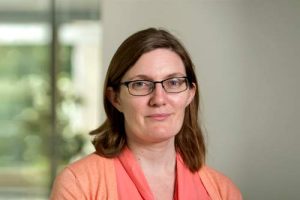 On Sarah O’Byrne’s busy calendar, one date is always circled: Election Day.
Now director of Johns Hopkins University’s MA in Government program, O’Byrne has never missed an opportunity to watch democracy unfold in real time. And, in her estimation, there is nothing better than a great Election Day watch party.
O’Byrne’s fascination with elections began in her youth in West Cork, Ireland, and deepened during her years at Trinity College Dublin, when she became engrossed not only by election returns, but by the forces behind them.
Why do people vote the way they do? Why do governments make certain choices? And how do political institutions shape what is possible?
Those questions have guided her career, taking her across economics, government, policy, international affairs, and data. Today, O’Byrne, who became a U.S. citizen in March 2025, also serves as director of the Johns Hopkins Center for Data Analytics, Policy, and Government, where she oversees programs that explore how evidence, institutions, and emerging technologies influence decision-making.
The Power of Perspective
Arriving at Hopkins at age 22, O’Byrne earned a master’s degree in economics but quickly realized the questions she found most compelling were not only about what policies work – they were about why governments choose the policies they do.
“Sometimes there appears to be an objectively good policy, but politicians can’t seem to agree on it,” she said, her Irish accent still evident. “And why is that?”
The answer, she found, often lies in understanding the structures, incentives, and institutions that shape political choices.
O’Byrne went on to earn a PhD in political science from Hopkins, specializing in comparative politics and corruption, with a minor in American politics and government. Her research examined how political institutions develop over time and how decisions made generations earlier can continue to shape policymaking today.
“I find it fascinating to go back to the 1800s and see, for instance, how the electoral process was developed,” she said. “You realize how much of what we think of as immutable today stems from fairly contingent choices made in earlier periods.”
That approach is central to her teaching and to the program she now directs.
Critical Thinking in the Age of AI
That ability to question assumptions is becoming even more important, O’Byrne said, as artificial intelligence transforms education, government, and the workplace.
While she recognizes AI as a powerful tool for gathering information, analyzing data, and generating content, she also believes its rise makes human judgment more valuable, not less.
“Students need to know how to evaluate evidence, recognize weak arguments, identify assumptions, conduct rigorous research, communicate clearly, and think critically,” she said. “These are things that AI can’t replicate and skills that we reinforce in the program.”
At the same time, she wants government students to become more comfortable with data – not necessarily as data scientists, but as informed users of information.
“I want to make the program more cutting edge and increase offerings for students who have a data focus,” she says. “Students who don’t necessarily want to go down the data analytics road completely still need to be familiar with these skills.”
For O’Byrne, the future of government education lies in combining foundational knowledge with new tools while preserving the human skills needed to interpret them.
“I want this program to continue to be nuanced and to emphasize the human side of thinking,” she said.
Collaborative Learning
Throughout her career, O’Byrne has also seen how much students learn from one another.
The MA in Government program brings together students from across the country and around the world, including military personnel, government professionals, and students beginning their careers. The diversity of experiences is one of the program’s greatest strengths.
In one class, O’Byrne recalled how a student with a humanities background from Argentina shared their experience of growing up under a dictatorship, enlightening her classmates, including U.S. servicemen.
“Even different experiences across different states can be informative,” she said. “It is interesting to see a student from West Virginia engaging with a student from Florida. This reinforces my belief that education is not simply about what happens between professors and students. Those exchanges between students create great learning opportunities.”
O’Byrne hopes to maintain the flexibility of the hybrid program while also creating more opportunities for those important connections through live discussions, presentations, and increased experiential learning opportunities. She points to the program’s current DC Lab residency as an unmatched classroom experience where students convene in the nation’s capital for visits to the Library of Congress, the Capitol, FBI headquarters and the Gallup polling company, among other destinations.
“DC is a lab,” O’Byrne said. “There are lots of different experiments happening in real time here, and it is a real advantage to be based here. The experience gives our students the opportunity to come together to meet each other, alums from the program, lobbyists, staffers, political leaders, diplomats, and others working in the public sector.”
Faculty Bringing Government to Life
That same emphasis on perspective and real-world learning extends to the program’s faculty.
O’Byrne points to instructors who bring both academic expertise and professional experience to the classroom – scholars, policy experts, and practitioners who help students connect political theory with challenges confronting governments and institutions today.
“Our faculty are people who care about students, who are willing to engage with and respond not only to students but to each other,” she said of her colleagues, who work in the highest levels of government and industry. “They are here to help students think about where they want to go with their careers and help them make connections.”
Students Give Her Hope
For someone who has spent her career studying politics, O’Byrne understands why many people feel discouraged by the current state of government.
But when she looks at her students, she sees reason for optimism.
She sees people who are passionate, curious, and committed to making a difference.
“It is pretty easy to get depressed with the state of politics these days, but we say this all the time at Hopkins – our students give us hope,” O’Byrne said. “Many of our students enter the program because they want to better understand government –from the local level to the national level – so they can help improve it. They are curious, engaged, and motivated to make a difference.”
The Personal Side of Government
For O’Byrne, the study of government remains both personal and essential. Elections may be the moments when democracy is circled on the calendar and captures public attention, but the work of understanding government happens every day – in classrooms, institutions, communities, and conversations.
“I am definitely excited to lead this program, and I want our courses to continue to be dynamic and interesting, but always flexible,” O’Byrne said. “You can get that traditional classroom experience at Johns Hopkins while continuing with your job and your life, wherever that may be. I think that is important.
“Of course, U.S. politics have changed so much in the past decade,” she continued, “but I think that’s why the MA In Government program is more important than ever – to understand that yes, everything is changing, but also that some things stay the same. To me, the study of government is everything, because it shapes the lives we lead every day.”
Interested in pursuing a graduate degree at Johns Hopkins University?
Request information to learn more or apply here.