Kathryn Fisher: Cooking Up New Perspectives on Security
Published April 21, 2026 | Request Information
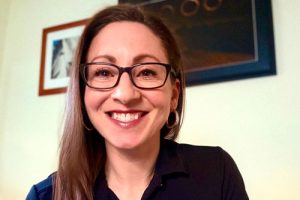 Kathryn Fisher’s research sometimes begins at the kitchen table.
A roasted vegetable tart, a spread of olives, crusty bread, and sheep’s milk cheese – the kind of vibrant, welcoming meal she likes to serve – can also spark questions about one’s world view and identity. For Fisher, assistant program director of Johns Hopkins’ MA in Global Security Studies and MS in Intelligence Analysis programs – and a graduate of the plant-based culinary arts program at the world-renowned Le Cordon Bleu in London – food is more than hospitality. It is a lens for understanding how people connect claims of belonging and heritage with geography and territory– and how those definitions can shape conflict.
Her work explores intersections of security, identity, perceived threat, and political violence. In 2027, Fisher plans to conduct research in Edinburgh and Belfast, examining how spatial and temporal configurations of identity influence security in Scotland and Northern Ireland, continuing to investigate the politics of food as a way to understand belonging. The themes may sound abstract, but Fisher traces them to lived experience, intellectual curiosity, and her career which has moved between U.S. and British universities, civilian and military classrooms, and professional kitchens.
Fisher grew up in motion, moving from Midland, Michigan to Dubai, Dallas-Ft. Worth, Seoul, Kuala Lumpur, and back again. Exposure to different cultures sparked an early fascination with geography — and, at first, weather. She entered the University of Colorado to study atmospheric science, eventually double majoring in geography and French.
The September 11 attacks, during her sophomore year of college, became a turning point. With family in New York City and Washington, D.C., and coursework focused on Afghanistan, she began paying closer attention to the global conversations unfolding around her. Fisher recalls a political science course the following year that “completely opened my eyes” and cemented her interest. She began to imagine a career in diplomacy, intelligence, or government service.
“I didn’t know what I was going to do,” Fisher joked, “but I got into this field because I just could not stop thinking about it.”
Graduate study in international affairs at American University deepened that commitment. A demanding International Relations theory course was an intellectual turning point for Fisher, and she went from applying to government jobs to pursuing doctoral work. Her master’s thesis on French and British counterterrorism led her to the London School of Economics, where she completed a PhD in International Relations focused on British counterterrorism and identity.
She later taught at National Defense University’s Fort Bragg location, which delivers a Master of Arts in Strategic Studies degree for the Special Operations community. Learning from and teaching in professional military education reinforced a drive to merge theory and practice in analyses of violence and insecurity.
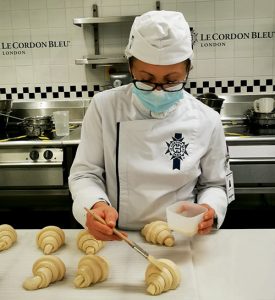 Midway through her career, Fisher made an unexpected pivot: after seven years of teaching, she enrolled at Le Cordon Bleu in London to pursue a personal passion. The experience offered a creative outlet as she continued her security research as a visiting fellow at King’s College London. She immersed herself in professional culinary training, gaining new perspectives on structure, collaboration, and hierarchy.
“I loved it because cooking is very visceral and physical and affords a total mind reset,” she said. She worked in professional kitchens for the Four Seasons but missed the classroom, so she returned to academia. Still, the culinary detour left a lasting imprint, helping her crystallize her understanding of the importance of food in culture and conflict. “Those two years of cooking really impacted my teaching and research.”
Today at Johns Hopkins, Fisher’s “meandering” path now informs her courses in global security studies and research design. Central to learning for Fisher is to think about how we think. She encourages students to combine curiosity, empathy, collaboration, and intellectual humility, while navigating the gray areas inherent in security work.
“Our students at Johns Hopkins are phenomenal,” Fisher said. “They show originality and innovative thinking, maturity, and assertiveness with a confidence that is also open to critique and ongoing self-development. In security sectors, knowing when you don’t know something is incredibly important, because if not, it can be downright dangerous. I value in our students their juxtaposition of empathy and strategic thinking.”
Fisher’s research continues to examine how difference becomes framed as danger – a shift that can be used to ‘justify’ exclusion or violence. She is also interested in violence against women in these contexts, which often persists even as other crime rates decline.
Despite the complexity of these issues, Fisher remains cautiously optimistic. She believes the world is safer from large-scale terrorist attacks than it was in the years following September 11, even as polarization and other forms of political violence have increased. Understanding motivations for the use of violence or terrorism, she emphasizes, does not legitimize harmful actions, but can perhaps help break destructive feedback loops of violence and counterviolence. “If we can better understand social phenomena and the us/them dynamics used to ‘justify’ violence, we can, ideally, find a better way to respond,” she said.
In the end, Fisher returns to the same idea that animates both her scholarship and her cooking: better understanding of the world around us begins with listening, whether around a table, in a classroom, or through fieldwork conversations.
“There are a lot of incredibly smart, dedicated people – including my colleagues and students here at Johns Hopkins – working really hard to make sure that terrorism, political violence, and other threats to security are reduced,” she said. “An overarching goal in global security studies is to contribute to such efforts, to share and build knowledge and apply it ethically, attentively, and strategically. Maybe the world is never going to be at total peace, but absolutely, 100-percent, we can all keep working to do a better job at minimizing insecurity in our respective areas of work and life.”