Elena Mastors: Decoding War, Terror, and the Human Mind
Published January 27, 2026 | Request Information
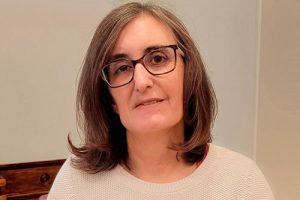 Elena Mastors has never been conflicted about conflict. In fact, she has devoted her academic focus – and much of her professional life – to applying the lens of political psychology to understanding war, terrorism, political violence, intelligence, threat and risk analysis, and political leadership. A pioneer in the field, Mastors quite literally co-wrote the book on the subject more than 20 years ago. Her Introduction to Political Psychology is now in its fifth edition. Since 2018, she also has shared her expertise with students in the MS in Intelligence Analysis and MA in Global Security Studies programs at Johns Hopkins University.
“I grew up trying to find an answer to a very basic question: why do people want to kill each other?” said Mastors, who earned a master’s degree and a PhD in political science at the University of South Florida and Washington State University, respectively. “I recognized that people have been killing each other since the beginning of time and generations have perpetuated that culture of hate. I wanted to try to understand why that was, to deeply understand the history and complexity of the hatred, as well as the group dynamics and individual behavior.”
 Mastors started by spending time in Northern Ireland studying for her dissertation. There she gained insights by “just listening” to the perspectives of various factions and examining the processes that fueled generations of conflict. Her doctoral degree led to a role as an intelligence officer at the Defense Intelligence Agency. Following the events of September 11, 2001, her work expanded into a comprehensive terrorism portfolio focused on the Taliban and Al Qaeda networks. She later helped the Defense Department by informing policymakers on broader U.S. threats, and then went on to teach in the National Decision-Making Department of the Naval War College.
“Did I think this would be the life I would lead when I was 22 years old? Absolutely not,” Mastors admitted, “but I am really glad that this has been my life. I cannot believe how much I learned, really learned, while working in the intelligence community. It made me a more pragmatic thinker and a better teacher.”
Today, Hopkins students benefit from Mastors’ extensive professional experience, including short teaching engagements in Kazakhstan and, most recently, La Fleche, France, where she worked with French military students.
She delivers a heavy dose of cognitive psychology in her Intelligence Analysis courses, encouraging students to examine how cognition and emotions influence perception and decision-making. “I try to distill the psychology down and unpack it, so the courses build on themselves” she explained. “These fields are about deep thinking. When analyzing an adversary, you must consider the complexities: Who is making the decisions? How are they making them? Why? Who advises them, and how do they function as a group?”
In her Global Security course on terrorism, Mastors emphasizes historical continuity among terrorist organizations, many of which train together and model themselves after predecessors. To challenge her students, she has them assume the roles of terrorists and design hypothetical media and recruitment campaigns, sharpening their analytical and strategic skills.
“Work in these fields can take a toll because the subject matter is so negative,” Mastors said. “Political violence is everywhere, and polarization has increased. You can intellectually understand why it is happening, but it doesn’t make it any easier. I try to impress upon my students the importance of the work – and my deep respect for what intelligence officers do – and emphasize the resilience and collaboration needed to be effective.”
According to Mastors, students who excel are deeply curious about how the world functions in relation to security. They are self-motivated and willing to think critically, to engage in discussion, and exchange ideas across diverse perspectives – skills essential for sound group decision-making and working toward the greater good.
“I really enjoy engaging with Hopkins students through practical discussions on current issues,” she said. “I provide extensive feedback and encourage them to focus, listen, read without distraction, evaluate sources critically, and make informed judgments. One of the things I value most about Hopkins is its practitioner-applied focus. A strong grasp of theory is essential, but understanding how things actually work in practice is just as important. I feel a responsibility to prepare students for the pressures they will face and to equip them with knowledge to navigate the challenges that will come their way.”