Environmental Science Bolsters Purposeful Public Service
Published December 23, 2025 | Request Information
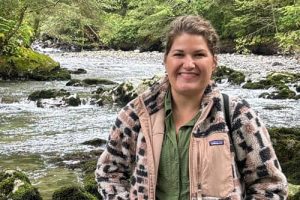 For Brit Steiner, resilience has always been a way of life – and at Johns Hopkins University, that resilience was refined into purpose. A recent graduate of the MS in Environmental Sciences and Policy program, Steiner credits her Hopkins education with giving her the scientific grounding, confidence, and credibility to take the next step in a life of public service she hopes to continue in her home state of Ohio.
Steiner grew up in Wellsville, Ohio, in modest circumstances along the Ohio River and was diagnosed with type 1 diabetes before her first birthday. Those early challenges shaped her determination and buoyed her future success. The first in her family to attend college, she earned a BA in political science and history from Malone University, before joining the U.S. Agency for International Development, where she spent 16 years serving as a diplomat and public servant across more than 40 countries.
Throughout her work in education, healthcare, energy, and food security, Steiner started to ask questions – What are the problems that need solving? How can I help solve them? She recognized that environmental issues repeatedly emerged as the root of many global challenges which led her to enroll at Johns Hopkins.
“When I was working on sustainable development, what I kept seeing as a throughline to the issues that people in the developing world were facing was the environment,” said Steiner, who witnessed the effects of climate change firsthand while working furiously on disaster relief and stabilization, deforestation, and other challenging issues with USAID under four U.S. Presidents (Bush, Obama, Biden, and Trump). “The warming of the oceans and the changes in the atmospheric processes are no longer theoretical. They are here, and they are the greatest problem for much of humanity. When I started covering Pakistan in 2011, I managed the energy and agriculture portfolios for the country and fell in love with trying to solve those issues. Then I started working on issues around food security and became the Asian chief for the innovation hub in the Agency, where I oversaw a whole host of issues, many of them environmental.”
At Hopkins, Steiner was able to learn about the “hard sciences” and foundational environmental policy.
“I finally had the chance to deeply understand the science behind the problems I’d been working on for years,” Steiner said. The program’s flexibility allowed her to balance an intense career and a newborn, while its rigor strengthened her ability to translate science into policy. Courses in oceanic and atmospheric processes and geology, along with a formative field study in Alaska, reshaped how she understood climate change and its real-world impacts.
“The Hopkins program made me more articulate and gave me credibility,” she said. “That credential still matters, and the experience emboldened me to engage more confidently with the issues I care about.”
Now back in Canton, Ohio, Steiner is drawing on her Johns Hopkins education and global experience as she runs for the Ohio State House of Representatives. She sees public service as a continuation of the values sharpened at Hopkins – evidence-based decision-making, accountability, and a commitment to improving lives.
“I have thought about and faced what many considered unsolvable problems my whole career,” Steiner said. “My Hopkins education will help me to pull all the levers that I can to help solve the problems that people are telling me they have. Most importantly, I want my boys to be proud of me and to see me as a world-class mom, because motherhood, in addition to my education and experience, has given me the confidence to run for office.
“I think you can be principled, be a person of class, dignity, honesty, and transparency, and be a public servant,” she continued. “It is more important than ever that people who have those principles – and even a little bit of bravery and experience to back it up – jump in to save our environment and our democracy. I really do know who I am, and I feel confident in what I am capable of contributing. My Hopkins education helps me connect science, policy, and people. I believe that good public policy can make lives better, and I feel prepared to help make that happen.”
Attention: Students and Alumni
Are you a current AAP student or alumni and want to share your accomplishments?
Interested in pursuing a graduate degree at Johns Hopkins University?
Request information to learn more or apply here.